A Story That Travels: Inside the Harsha Parekh Library Awards Film

How an animated film helped honour Harsha Parekh’s legacy and quietly show why libraries and librarians matter so deeply.
HPLA

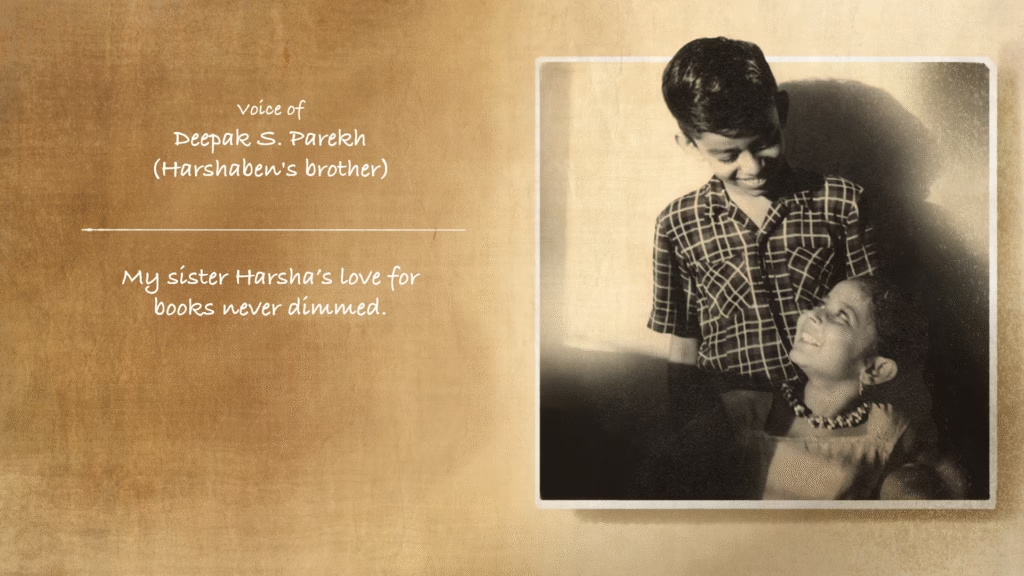
“My sister Harsha’s love for books never dimmed. She devoted her life to creating pathways for young readers,” says Deepak S. Parekh, former Chairman of Housing Development Finance Corporation (HDFC).  

The film closes on these words: from a brother to his sister. And these words bring the audience back to the person whose legacy shaped the Harsha Parekh Librarian Awards. Instituted by the H.T. Parekh Foundation, the awards honour librarians working with children across India and recognise the quiet but lasting role they play in nurturing curiosity, confidence and a love for reading.

When the foundation approached us, the intention was not just to present the awards, but to gently help people understand why they matter. 

We approached the film as a personal, reflective journey, using animation, narration, soft music and a slow visual rhythm to follow Harsha Parekh from childhood into her life’s work. So, let’s take a closer look at how the film took shape.
Understanding the Brief

At the heart of this project was a simple but meaningful challenge. The organisation did not want to create a film that merely announced an award. They wanted to explain why the Harsha Parekh Librarian Awards exist at all and why libraries and librarians deserve that kind of recognition.

The awards were instituted in honour of Harsha Parekh, an accomplished librarian and educator whose life was shaped by a deep love for books, reading and learning. The foundation wanted the audience to understand that this was not a symbolic gesture alone. It came from real life, a real set of beliefs and a lifelong commitment to the idea that libraries can change the way children grow, think and imagine. The film, therefore, had to convey the emotional legacy behind the awards and the social significance of libraries in general, and in a nation where many children grew up without access to books at all. 

The film had to convey the emotional legacy behind the awards and the social significance of libraries in general and in a nation where many children grew up without access to books at all. 

Also read: Where Nonprofit Stories Are Headed Next

The main creative idea grew directly out of that need. Instead of an outside narrator, the film would feel as though Harsha ji herself was leading the viewer through the story. They would be going on a journey with her, from her childhood to her adulthood, from a girl who discovered books to a librarian and educator who knew exactly how deeply reading could affect a life.

Writing the Script and Developing the Mood Board

Once the direction was clear, the script and visual mood had to grow together. The writing began from Harsha ji’s personal journey, so the film could feel intimate before it widened into a larger conversation about libraries, reading and access. 

The mood board was developed alongside this thinking. We wanted the visuals to feel warm, slow, and reflective rather than formal or hurried. Using the foundation’s colour palette as a base, we built a world of warm reds, yellows and blues. We also incorporated retro tones and period-specific objects to reflect the era of Harsha ji’s childhood. This included details such as an old-style box television, vintage furniture and domestic interiors that helped situate the story in an earlier time. These elements also helped the film stay rooted in memory while still leaving space for imagination.

Also read: How We Reimagined a Bhojpuri Folk Song Through Animation

Symbolism and Design Choices

In this animated film, many of the themes are not stated directly. They are shown through symbolic moments. This can be seen when a child tries to reach for books inside a school bag, but she is unable to access them. That moment turns educational inequality into something physical; the barrier is not theoretical. It is felt in the child’s inability to reach what should have been within her grasp. When she dives through and emerges into a world of imagination, running through a landscape with a deer, astronauts, planets and other dreamlike elements, the film explores a powerful point: access to books does not only improves literacy. It opens inner worlds.

In this animated film, many of the themes are not stated directly. They are shown through symbolic moments.

Another element is the paper plane that flows out of the library and moves across villages with vehicles such as a bicycle, van, camels and a horse. The paper plane represents the spirit of books and stories and the various vehicles represent the ways by which librarians and library initiatives are reaching out to the children in the remote areas.

In the end, this project became much more than an animated award film. It became a way of showing how personal legacy, educational access, and visual storytelling can come together with real sensitivity. Through a slow rhythm, thoughtful symbolism, and carefully chosen animation choices, the film gave viewers a felt understanding of why libraries matter, why librarians deserve recognition and why Harsha Parekh’s legacy continues to resonate.

If your organisation is looking to shape a story with the same care, especially around learning, legacy, or the people who quietly open new worlds for others, our team would be glad to explore it with you.


Rahul More

Video Editor

Rahul works on video editing and motion graphics across various formats. He previously worked in post-production at Sallys, with experience across commercials, web series, and digital content. He has over three years of experience in video editing and motion graphics. He enjoys reading, playing cricket, fish keeping and making short films. He holds a Bachelor’s degree in Mass Media (Journalism) and a Diploma in Filmmaking from Rachana Sansad Institute, Mumbai.

Abhinav S S

Illustrator

Abhinav works on in-house blog illustrations, storyboarding and various visual projects aligned with the studio’s creative direction. He is currently pursuing a Bachelor’s degree in Fashion Communication from National Institute of Fashion Technology (NIFT) Bhopal. He has played competitive cricket for the state of Kerala and has a strong interest in painting and graffiti.

Subscribe to our newsletter

Sign up for our newsletter and receive exclusive podcasts, blog updates.

Swanand Deo

Web Development Specialist

Swanand Deo is a WordPress and Web Development Specialist working on various digital projects. With over a decade of experience in the design and development space, he has collaborated with over 50 national and international clients. He specialises in User Experience (UX) design, WordPress development, and creating engaging digital experiences. He holds a Bachelor of Fine Arts from the University of Pune.

Aashna Chandra

Graphic Designer

Aashna works on publications, UI/UX and branding projects at SBS. She has previously worked with organisations across the social impact and development space. Her work focuses on layout design, visual identity systems and user interfaces across print and digital formats. She studied at the United Institute of Design, Gandhinagar, specialising in branding, typography, editorial design and packaging.

Vivek Warang

Digital Illustrator

Vivek works on translating ideas into visual narratives. His work ranges from creating storyboards and illustrations to ideation for special visual storytelling projects. He previously worked as an illustrator at OckyPocky. He enjoys telling stories through images and bringing concepts to life through his drawings. He holds a Bachelor’s degree in Applied Arts from D.Y. Patil College, Pune, with a specialisation in Illustration.

Rajshree Goswami

Content Writer

Rajshree began her professional journey in Kolkata and has over four years of experience as a creative writer and proofreader for academic papers. At SBS, she works across all content, including blogs, transcripts, quality checks and writing for annual reports. She is an avid reader and enjoys cinema, fiction and creative writing. She holds a Bachelor’s degree in English Honours from West Bengal State University.

Bhavesh Dhote

Founder’s Office

Bhavesh is part of the Founder’s Office, working across in-house operations, social media strategy, strategic initiatives, market research and film production. He holds a Bachelor’s degree in Electronics and Telecommunications Engineering with a Diploma in AI and Machine Learning from D.J. Sanghvi College of Engineering, Mumbai. He is also a professional badminton player, marathon runner, trekker and plays euphonium and trumpet.

Manish Mandavkar

Motion Editor

Manish Mandavkar has studied animation at Arena Animation in Mumbai. He has previously worked on animated videos and motion graphics for brands, including Unilever and Zee Movies. An avid gamer, he is also passionate about sketching and photography. He holds a degree in Commerce from the University of Mumbai.

Joel Machado

Film Editor

Mumbai-based creative consultant and film editor Joel Machado has worked on documentaries as well as films in the mainstream Bollywood sector. He was also the Chief Assistant Director on the Jackie Shroff short, “The Playboy, Mr. Sawhney.” In addition to earning a B.Com from Mumbai University, he attended the city’s Digital Academy to hone his script writing skills.

Rohit Sreekumar

Founder’s Office

Rohit is responsible for developing strategic alliances and collaborative initiatives in the social sector. He also works on project management and helps internal teams stay on track. He has previously worked at early-stage startups across product and growth roles. In his free time, he enjoys binge-watching series, gaming and reading. He holds a Master’s degree in Computer Applications from Amrita Vishwa Vidyapeetham, Karnataka.

Aliefya Vahanvaty

Sr. Creative Partner

Senior Creative Partner, Aliefya Vahanvaty has worked in a wide range of editorial roles over the course of her career, gaining experience as a correspondent, copy editor, writer, photographer, and assistant editor at publications like the Times of India, Forbes India, Open Magazine, Impact Magazine, and others. In addition to her MA in Sociology from Mumbai University, she also has an MA in Photojournalism from the University of Westminster in the United Kingdom.

Simit Bhagat

Founder

Founder, Simit Bhagat has worked in the fields of filmmaking, project management, and journalism for over 15 years. He has served in a variety of positions for organisations like the Times of India, the Maharashtra Forest Department, the Tata Trusts, and the Thomson Reuters Foundation. From the University of Sussex in the United Kingdom, he earned a Master of Arts in Science, Society, and Development.