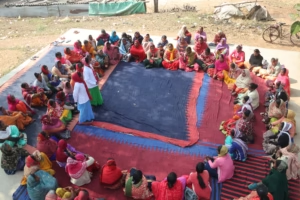
A child waits at the edge of a workday that was never designed with childhood in mind. Nearby, his mother keeps going because missing a day’s wage is not an option. Between the noise of labour, the rush of survival, and the absence of safe care, an entire world of vulnerability quietly takes shape. Baha’s story opens from this tension, where something as basic as protection, learning, and rest can become uncertain for children growing up in migrant communities.
Stories like this have value on their own, but how they are presented can make all the difference in whether people actually stop and listen, and understand and empathise. Good design is about more than making communications look beautiful. Good design is about making complex reality look clear, human, and believable. For NGOs, this is very important because their work can go unnoticed if communications don’t grab people’s attention and build trust. So let’s take a look at what corporate design trends can teach us about better communications for social causes.
1. Make the next action obvious
One thing that NGOs can pick up from fintech and D2C companies is that people should never be left guessing what to do next. Whether people are on your donation page, campaign page, volunteer page, or annual report page, the experience should be intuitive and easy to use. The message, the action, and the reason to act should all be clear within seconds.
The message, the action, and the reason to act should all be clear within seconds.
A strong example is UPLIFT Desk. After improving its website experience, the brand reported a 226% increase in orders, a 61% rise in conversion rates, and a 203% increase in customers. Those numbers matter because they show what happens when friction is reduced and the path forward becomes easier to follow. The improvement was not only about better visuals. It came from making the user journey simpler and the next step more obvious. So, overall, the aim should be to reduce clutter, shorten forms, and make the main action easy to see and complete.
2. Turn information into guided storytelling
Many NGOs still present important information as though its seriousness alone will keep people engaged. Corporate D2C brands work differently. They guide attention step by step, helping people scan quickly, understand the context, and then move deeper into the page. This approach is especially useful for NGOs. Since they build impact pages, campaign explainers, and annual reports filled with stories, data, and programme insight.
Build a journey that begins with the human story, adds proof, and then leads people towards action.
A strong example is Positive Grid on Shopify. After launching its new site, the company reported a 6x increase in conversion rate. Shopify linked this to faster site performance, a smoother checkout, and a stronger mobile experience. It also highlighted how richer product pages improved storytelling and customer education. In other words, the content did more than inform. It helped people understand value more clearly and act with confidence. Thus, for organisations, the goal should be to not just present facts in one long block. Build a journey that begins with the human story, adds proof, and then leads people towards action.
3. Make trust visible, not implied
One of fintech’s strongest design lessons is that trust should not sit in the background. It should be visible at every step. Clear language, transparent processes, upfront explanations, and easy-to-follow flows all help people feel confident enough to act. NGOs need the same clarity. Donors, volunteers, and partners should be able to see how funds are used, what happens after they sign up, and why the organisation can be relied on.
Trust becomes much easier to build when people can clearly see how things work, where money goes, what happens next, and why the process feels reliable from the start.
A strong example is Wise. In its FY2025 results, the company said it moved £145.2 billion across borders for 15.6 million people and businesses, up 23% year over year. It also reported that around 65% of transactions were completed in under 20 seconds. Those numbers matter because they show how transparency, speed, and predictability can strengthen trust at scale. Trust becomes much easier to build when people can clearly see how things work, where money goes, what happens next, and why the process feels reliable from the start.
4. Design around audience needs, not your internal structure
One of the smartest lessons NGOs can borrow from media design is that audiences do not arrive caring about departments, verticals, or internal categories. They care about what helps them understand something quickly, feel something deeply, or decide what to do next. That is why strong communication today is often structured around user need rather than organisational logic.
What holds attention best is communication shaped around audience curiosity and need, not around the way an organisation happens to organise itself internally.
A useful example comes from the BBC user-needs model, documented by WAN-IFRA. In one case study, 70% of articles published by an organisation fell into the “Update” category, yet they generated only 7% of page views. The same work found that Education content delivered the highest loyalty, while at the BBC, Inspiration stories were three times more popular than Information pieces. The numbers make one thing clear: audiences respond more strongly to content that serves their needs, not just institutional habits. What holds attention best is communication shaped around audience curiosity and need, not around the way an organisation happens to organise itself internally.
5. Build experiences people want to share
One of the most interesting shifts in corporate design is the move towards experiences that are not just functional, but naturally shareable. Brands now think about the screenshot, the personalised summary, the share card, and the small moments that people feel excited to post. NGOs can learn from this without losing seriousness. A supporter recap, a campaign’s outcome, a volunteer achievement, or a summary of impact – all of these can be crafted to feel genuinely worth sharing.
A strong example is Spotify Wrapped. Spotify’s mobile app downloads rose 21% in the first week of December 2020 after Wrapped launched. More recently, Music Business Worldwide reported that Wrapped 2025 reached 200 million engaged users in roughly 24 hours, with shares rising 41% year over year to about 500 million. The scale of that response shows what happens when content feels personal, visual, and easy to pass on.
The strongest communication is often the kind people want to carry forward themselves because it feels personal, clear, and worth showing others.
Good design does not make serious work superficial. It helps serious work travel further, land more clearly, and earn trust faster. That is what fintech, D2C, and media brands have understood well. They do not just present information. They influence attention, eliminate confusion, build credibility, and encourage actions. The opportunities for NGOs lie not in following corporate communication strategies, but in adopting the thought process behind them. The more stories make sense, the easier it is to build trust. When journeys feel intuitive, more people stay engaged. And when communication is designed around real human behaviour, important work becomes much harder to ignore.
If you found this blog useful and want more practical ideas on designing nonprofit communications, subscribe to our newsletter. We share reflections, case studies, and usable tips from the world of nonprofit storytelling to help your organisation communicate its work with more clarity, dignity, and impact.