A second is all it takes.
One second. That’s how long it takes for a child’s world to fall apart in a war zone.
Across the globe, nearly 43 million children in conflict-affected countries are still out of school. Many more are struggling to survive displacement, hunger, and violence. They face bombs instead of books. Silence instead of songs. Grief instead of games. But how do you make the world care about children they can’t see? Save the Children found an answer, in stories.
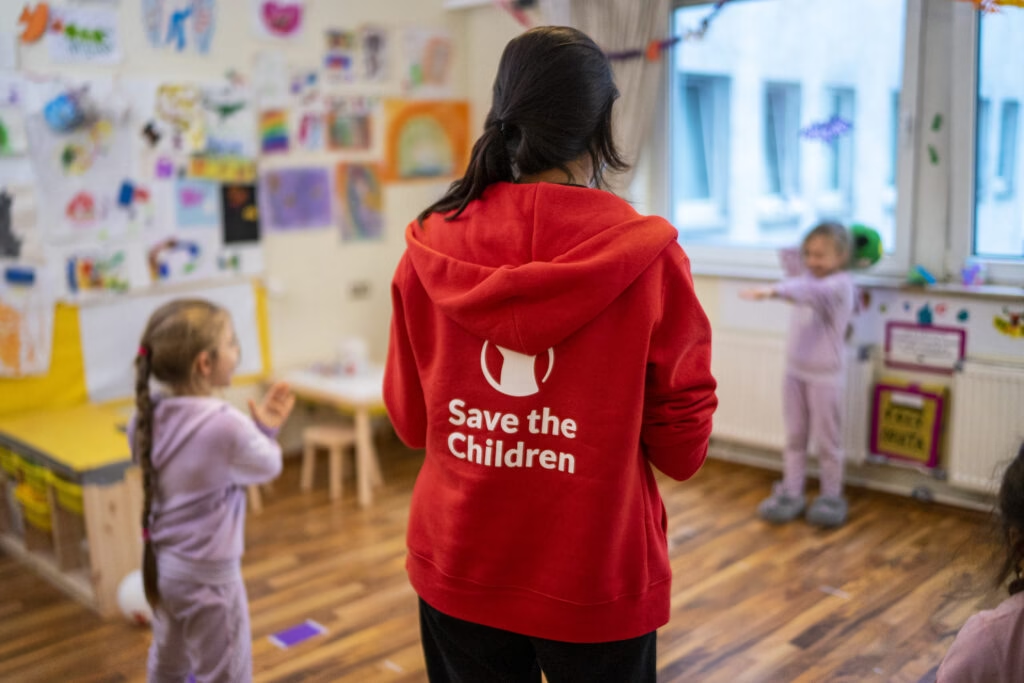
Over the past two decades, their storytelling has taken many shapes. A haunting viral video. A jumper worn with a laugh. A quiet classroom rebuilt in a war-torn town. Each one a thread. Each one a way to pull us closer to children we may never meet, but can still stand by.
Let’s take a closer look at how Save the Children has used storytelling in three powerful ways: grief, joy, and long-term change.
When war came home: The most shocking second a day
In March 2014, Save the Children released a video that changed everything. Most Shocking Second a Day begins with a birthday. A little girl smiles. Life feels normal. But as seconds pass, things unravel. Sirens. Shadows. An empty dinner table. No voiceover. No subtitles. Only fear. The girl isn’t Syrian. She’s British. And that was the point. The video brought the Syrian crisis to living rooms across the UK. It asked: what if this was your child?
Within a week, it had 23 million views. Today, it has over 78 million views. Celebrities like Ashton Kutcher shared it. News outlets around the world covered it. And Save the Children’s YouTube subscribers jumped by 1,000%. But the real success wasn’t views. It was empathy. Donations increased. So did volunteer interest. The video helped turn public attention into public action.
The real success wasn’t views. It was empathy. The video helped turn public attention into public action.
Moreover, it proved something vital: powerful storytelling doesn’t need big budgets. Just big truth. While this video pulled at heartstrings, Save the Children knew that stories of joy could be just as powerful.
In 2016, Save the Children released Still a Most Shocking Second a Day, continuing the girl’s story as a refugee and powerfully reminding viewers that the crisis doesn’t end once the bombs stop; it only changes.
A laugh, a jumper, and £30 million: The magic of joy
Not every story needs to begin with pain. Sometimes, joy makes a bigger impact. In 2012, Save the Children launched Christmas Jumper Day. It was simple. Wear a festive jumper. Donate £2. Help a child. But it wasn’t just about clothes. It was about connection.
From classrooms to boardrooms, people across the UK joined in. By 2023, over 27,000 workplaces and 1.5 million people had taken part. That year alone, the campaign raised £3 million. In total, it has raised more than £30 million. Furthermore, it made fundraising accessible. Even kids could understand it. Even companies could embrace it without hesitation. Besides, not every campaign has to lean into sadness. Christmas Jumper Day brought lightness to giving. It proved that when people laugh together, they also give together.
Christmas Jumper Day proved that when people laugh together, they also give together.
And Save the Children used that joy to build long-term supporters, not just one-time donors. Beyond viral videos and festive fundraisers, Save the Children has also led global efforts to address deep-rooted, systemic challenges.
Rewrite the Future: From hope to classrooms
While the jumpers made headlines and the video went viral, another campaign quietly rewrote lives, literally.
In 2006, Save the Children launched Rewrite the Future, a global education campaign for children in conflict zones. At the time, 115 million children were out of school. Nearly one in three lived in war-affected countries.
The goal was ambitious: enrol 3 million out-of-school children and improve education for 8 million more by 2010.
By 2008, they had already improved education for 10 million children. They trained 20,000 teachers. Built or rehabilitated nearly 5,000 classrooms. In Afghanistan alone, 2.5 million children received better education, and 61,000 children were newly enrolled.
By 2008, Save the Children had already improved education for 10 million children.
Moreover, the work didn’t stop at school walls.
In Bosnia, education spending increased by 8%. In Uganda, smaller class sizes became a government priority; in Southern Sudan, they built 54 classrooms and 72 toilets in just one year. And in Côte d’Ivoire, they introduced codes of conduct to eliminate corporal punishment in 1,800 schools.
Additionally, Save the Children advocated at the global level. They co-led the Global Education Cluster with UNICEF and pushed for education to be part of peace agreements and made schooling a core part of humanitarian response.
They didn’t just tell stories; they built systems.
The child is the story
Across all of these campaigns, whether light-hearted or life-altering, one truth holds firm: the child is always at the heart. Whether in a viral video or a flooded school tent, the child’s voice carried through. Gabriel from Angola said, “When I think of a good day in my life, I think of the day I started coming to school.” Mary from Southern Sudan said, “Without education, we would still be in the bush.”
Their words remind us why storytelling matters. Not for the sake of content. But for connection. Save the Children’s work proves that when stories are rooted in truth, they can bridge worlds. They can make faraway crises feel local. And they can move people to act.
Save the Children’s work proves that when stories are rooted in truth, they can bridge worlds. They can make faraway crises feel local.
If you’re working in the social sector and wondering how to apply this kind of storytelling, we’ve got a newsletter where we explore emerging trends in nonprofit storytelling—from participatory campaigns to visual narratives.
If that sounds like something you’d want to read, subscribe today.