How Animation Helped Upaya Tell a Story of Dignified Jobs

Step into an animation where stalled dreams find a bridge across the missing middle, hinting at how steady livelihoods begin to reshape entire lives.
UPAYA Animated Video

Across India, many people still wake up not knowing what their income will look like that day. At the same time, thousands of entrepreneurs are running small businesses that create regular jobs. These businesses can offer steady work and dignity, but growing them is not easy. They are often too large for microfinance and seen as too risky by banks. As a result, many remain stuck in the middle.

This space is the missing middle, where potential waits in silence. That silence is where Upaya Social Ventures steps in. Upaya works with entrepreneurs whose businesses can create dignified jobs for people living in extreme poverty.

They needed one narrative that could hold it all. And that is where Simit Bhagat Studios came in. Together, we began shaping an animated film that could help viewers understand why dignified jobs are needed, how Upaya enables them, and what changes when people find stable livelihoods.

Why Upaya Needed This Video

Upaya wanted a versatile storytelling tool. Something they could share in board meetings, at conferences, in conversations with donors, and across digital platforms. A film that would introduce Upaya in a way that felt clear to newcomers, and reassuring to those already familiar with their journey.

Animation offered the flexibility and accessibility they were looking for. It allowed us to simplify complex ideas without losing depth. It allowed Upaya’s story to travel easily across different levels of literacy, language, and background.

Animation allowed Upaya’s story to travel easily across different levels of literacy, language, and background.

The timeline was short. Their team needed a version that could confidently represent their mission. We worked closely with them throughout the process, reviewing storyboards together and building the film step by step, so decisions were quick and clear. The result was a film they could use with confidence across conversations and platforms, a story they could now tell with greater clarity.

How We Used Animation to Tell the Story

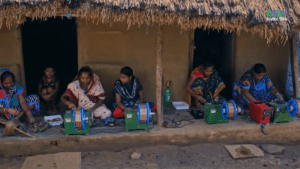
The film opens with a character named Saibai. Her journey reflects thousands like her who found a path to stability through work. Animation helped us enter her world gently, making the story personal before it becomes systemic.

To explain Upaya’s model, we introduced a three-part pie chart: impact-first investments, technical support, and impact measurement and management. Each slice becomes its own short sequence. The pie rotates, and the viewer moves into each area to understand how job creation actually happens on the ground.

Throughout the film, the icons, charts, and characters work together to reveal a truth.

Throughout the film, the icons, charts, and characters work together to reveal a truth. Dignified jobs are created not only by money, but by the support systems around entrepreneurs. Animation allowed that ecosystem to be understood in a few minutes with both clarity and empathy.

Why Animation Matters for Stories Like This

Animation allowed Upaya’s work to be understood in a way that feels human and accessible. It helped show the scale of the problem and the bridge of opportunity. Additionally, it showcased the positive ripple that a single dignified job can create. The storytelling stays simple while the meaning remains layered.

Today, this film helps Upaya introduce its mission in rooms where attention is short and stakes are high. It ensures that people understand them fully, not in fragments. Sometimes what a story needs most is a format that welcomes everyone in.

If your organisation is working to improve lives and needs a story that communicates your impact with both clarity and heart, Simit Bhagat Studios would be happy to collaborate with you. Together we can shape visual narratives that make your work easier to see, easier to share, and easier for others to believe in.


Subscribe to our newsletter

Sign up for our newsletter and receive exclusive podcasts, blog updates.

Swanand Deo

Web Development Specialist

Swanand Deo is a WordPress and Web Development Specialist working on various digital projects. With over a decade of experience in the design and development space, he has collaborated with over 50 national and international clients. He specialises in User Experience (UX) design, WordPress development, and creating engaging digital experiences. He holds a Bachelor of Fine Arts from the University of Pune.

Mrinali Parmar

Associate (Partnerships)

Mrinali Parmar works on operations and building partnerships with social impact organisations. With five years of work experience, she has focused on education and promoting awareness of climate change and sustainability in her operations role. She holds a Master’s Degree in Commerce from the University of Mumbai and is passionate about linguistics, speaking six languages.

Swarnima Ranade

Voice Actress

Swarnima Ranade is a medical doctor turned voice actress who has done voice-over work for everything from commercials to documentaries to corporate narration to children’s books. She has worked with numerous noteworthy businesses in the past, such as Tata, Uber, Walmart, and YouTube Kids. She graduated from SVU in Gujarat with a degree in dental surgery.

Kumar Shradhesh Nayak

Illustrator

Kumar Shradhesh Nayak is a professional artist, illustrator, and graphic designer who studied at the National Institute of Fashion Technology in Hyderabad. His experience includes stints at EkakiVedam and Design Avenue, both of which are prominent advertising firms. He enjoys trying out new approaches to illustration and creates artwork for a variety of projects.

Divya Shree

Content Producer cum Editor

Divya Shree is a media alumna from Symbiosis Institute in Pune who loves producing and editing non-fiction content. She has directed, shot, and edited videos for various productions. Her strengths are research, audience awareness, and the presentation of intricate topics with clarity and interest.

Manish Mandavkar

Motion Editor

Manish Mandavkar has studied animation at Arena Animation in Mumbai. He has previously worked on animated videos and motion graphics for brands, including Unilever and Zee Movies. An avid gamer, he is also passionate about sketching and photography. He holds a degree in Commerce from the University of Mumbai.

Joel Machado

Film Editor

Mumbai-based creative consultant and film editor Joel Machado has worked on documentaries as well as films in the mainstream Bollywood sector. He was also the Chief Assistant Director on the Jackie Shroff short, “The Playboy, Mr. Sawhney.” In addition to earning a B.Com from Mumbai University, he attended the city’s Digital Academy to hone his script writing skills.

Apoorva Kulkarni

Partnership Manager

Apoorva Kulkarni is the Partnerships Manager, and is responsible for developing strategic alliances and collaborative initiatives with other organisations in the social development ecosystem. For the past five years, she has been employed by major corporations, including Perthera (USA) and Genotypic Technology. She has written and published poetry, and she has been an integral part of The Bidesia Project. At Georgetown University in the United States, she earned a Master of Science in Bioinformatics.

Aliefya Vahanvaty

Sr. Creative Partner

Senior Creative Partner, Aliefya Vahanvaty has worked in a wide range of editorial roles over the course of her career, gaining experience as a correspondent, copy editor, writer, photographer, and assistant editor at publications like the Times of India, Forbes India, Open Magazine, Impact Magazine, and others. In addition to her MA in Sociology from Mumbai University, she also has an MA in Photojournalism from the University of Westminster in the United Kingdom.

Simit Bhagat

Founder

Founder, Simit Bhagat has worked in the fields of filmmaking, project management, and journalism for over 15 years. He has served in a variety of positions for organisations like the Times of India, the Maharashtra Forest Department, the Tata Trusts, and the Thomson Reuters Foundation. From the University of Sussex in the United Kingdom, he earned a Master of Arts in Science, Society, and Development.