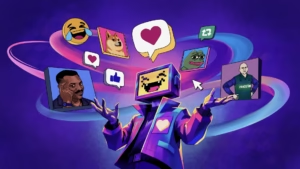
It started with a meme. A Bollywood scene. A sarcastic caption. We hit “post” and didn’t think twice.
Then came the comment: “This is funny, but also painfully true.”
That’s when something clicked. If a meme could make someone laugh and feel seen, maybe it wasn’t just a meme. Maybe it was a way in.
At Simit Bhagat Studios, we’ve been exploring how even the most casual formats, like film memes, can hold deeper truths about the nonprofit sector. Not just to entertain, but to connect. In Where Memes Meet Meaning, we shared how humour, used with intent, can shine a light on things like funding gaps, field frustrations, and donor dynamics, without ever losing sight of the seriousness beneath.
And we’re not the only ones experimenting. Around the world, organisations are ditching solemn tones and embracing satire, stand-up, emojis, and puppets to bring people into difficult conversations. Humour doesn’t replace truth. It carries it, lighter, farther, and with more staying power.
Let’s look at how some nonprofits are using humour to highlight their work:
1. They make fundraising entertaining
Giving doesn’t always come from guilt. Often, it comes from joy. Humour makes people feel good while doing good, and that matters. It also helps people stay with you and remember why they chose to give in the first place.
For example, the UK charity Comic Relief has almost mastered this mix of humour and heart with its yearly Red Nose Day telethon. Since 1988, the live BBC show has blended celebrity sketches, music performances and short films about people whose lives have been shaped by donations. Meanwhile, red nose merchandise turns participation into something visible, wearable, and fun.
Although it’s packed with jokes, the impact is serious. Since launch, Comic Relief has raised over £1.6 billion. In 2025 alone, it raised £34 million. Fundraising becomes more than an ask; it becomes an experience people want to return to.
2. Humour breaks taboos
Some issues are so overwhelming that people tune out before they even begin listening. Air pollution, for example, rarely sparks genuine interest. Yet humour can shift that.
In February 2025, ASAR and comedy media house DeadAnt hosted a unique event in Mumbai called Laughs Per Minute: Breathless Edition. Twenty-five comedians, including names like Aditi Mittal and Raunaq Rajani, performed fast-paced sets focused entirely on air quality. Moreover, each performer was given just 60 seconds to deliver their punchlines, keeping the pace high and the energy sharp.
One joke went, “Buildings called ‘Sea View’ are now called ‘If you can see view’.” It was funny, but painfully true.
The idea came from Brikesh Singh, ASAR’s communications head and a comedian himself. He wanted to take jargon off the table and replace it with clarity and connection. The show’s success led to a similar event in Delhi, proof that when people laugh, they’re also more willing to listen.
3. They make awkward topics shareable
Sanitation isn’t glamorous. Talking about toilets rarely comes up in daily conversation. However, humour has a way of cracking open uncomfortable silences.
That’s exactly what WaterAid did with its 2015 campaign #GiveAShit. The campaign used a mobile app that let users create and share their own poop emojis. Additionally, over 50 celebrities and influencers participated, helping the message reach far beyond WaterAid’s existing supporters.
But they didn’t stop there. The team hosted an actual art exhibition in New York, cheekily called The Shit Show, featuring poop-themed works that were both hilarious and deeply thought-provoking.
The result? 230 million media impressions, 11,000 new supporters, and campaign reach in 53 countries. By turning an awkward issue into a meme-worthy movement, WaterAid proved that humour doesn’t just entertain, it educates and activates.
4. They turn education into theatre
Not every setting has access to textbooks, clinics, or the internet. But everyone understands stories. And when stories are funny, people don’t forget them.
That’s why, back in 1988, South Africa’s AREPP launched Puppets Against AIDS, a live puppet show designed to spread awareness about HIV. With creative input from Jim Henson, yes, that Jim Henson, the show followed characters like Jo and Mary, using drama and humour to show how HIV spreads and how to prevent it.
Furthermore, the shows included live music, interactive Q&As, and condom demonstrations. The puppets themselves were grey-faced, representing the idea that HIV affects all communities, regardless of background.
The program toured across Africa and eventually reached over 150 countries. A published study in AIDS Care confirmed improved knowledge and protective behaviour. When the science felt distant, puppets brought it home.
5. They challenge stigma with satire
Mental health campaigns often struggle to connect with men. The language feels too clinical, or worse, too soft. However, humour provides an unexpected entry point.
That’s what inspired Man Therapy, a campaign launched in Colorado in 2012 to address suicide rates among working-age men. At its centre is Dr Rich Mahogany, a moustachioed, flannel-wearing therapist who delivers straight-talking mental health advice with a healthy dose of sarcasm.
The campaign’s website, mantherapy.org, features practical tools like crisis support and the signature 18-Point Head Inspection. Additionally, it offers DIY coping tips and a full resource directory, all delivered with a wink.
The reach has been remarkable. Over 2 million visits, 500,000 assessments completed, and CDC-funded studies showing a reduction in suicide risk. Later, Beyond Blue picked up the campaign in Australia, demonstrating how effectively it could work across borders. Man Therapy reminds us that humour can meet men where they already are and gently pull them back from the edge.
Humour Doesn’t Mean Less Impact
Nonprofits face enormous pressure to make serious issues heard. Yet seriousness alone isn’t always effective. Sometimes, the best way to communicate gravity is through levity.
Humour invites people in. It lets them drop their defences. Moreover, it gives them a moment to laugh, right before they learn something they’ll never forget. Whether it’s poop emojis, puppet shows, or punchlines about pollution, humour has shown it can reach places that data never will.
So the next time someone says comedy isn’t serious, show them the numbers. Show them the stories. And show them how laughter can lift more than spirits. It can lift entire causes.
If you care about the future of storytelling in social impact, don’t miss a beat.
Subscribe to our newsletter for real-world strategies, campaigns that worked, and ideas that spark connection in unexpected ways.