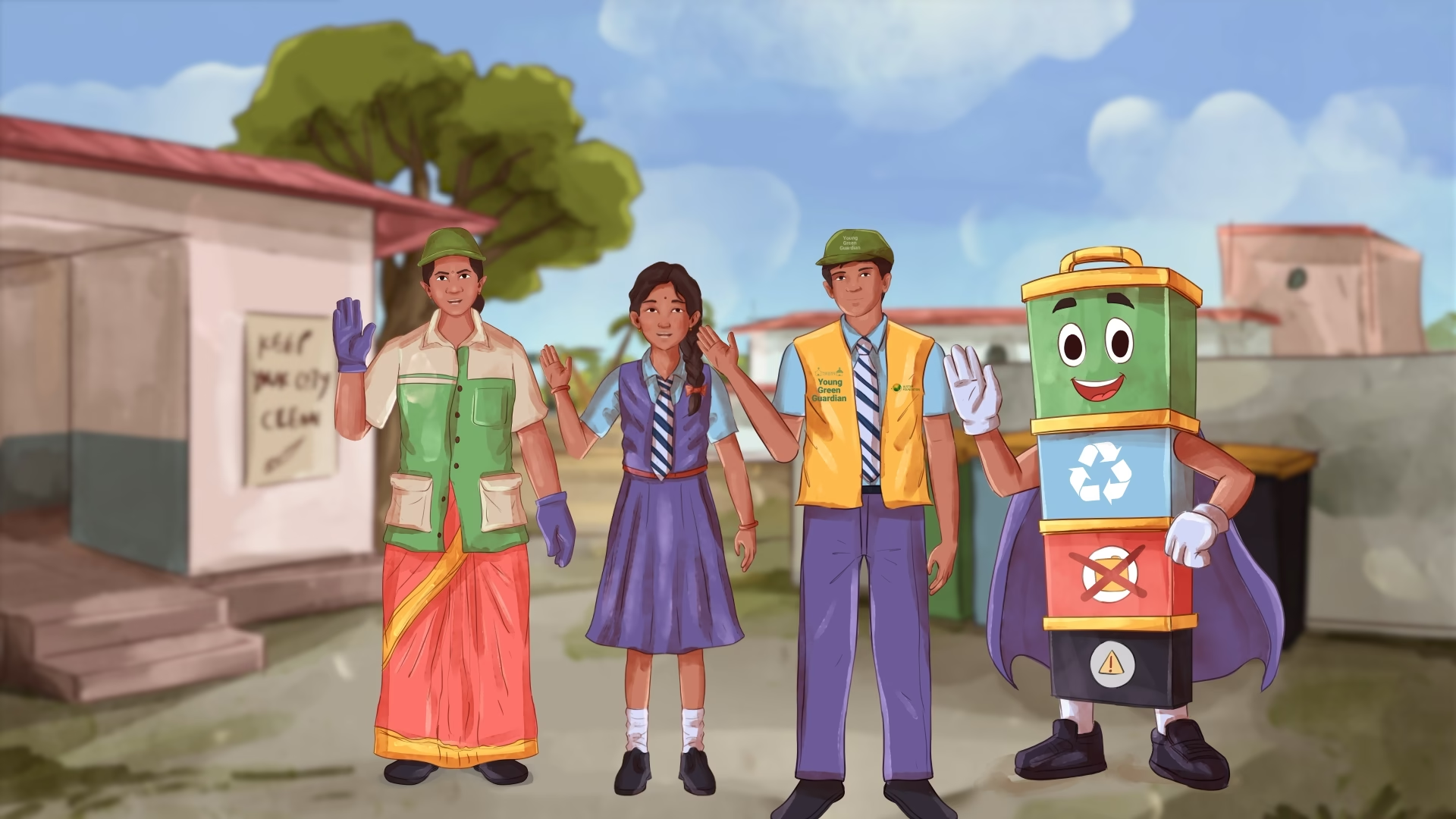
For Asha, waste initially ends at the dustbin. Peels, paper, bottles and packets are simply things we throw away. As the film progresses, she begins to understand that waste has a journey. And that one everyday decision, choosing the right bin, can affect recycling, worker safety and the cleanliness of an entire city.
That idea became the starting point for Young Green Guardians: My Waste, My Responsibility, an animated film developed for Sampark to introduce children to responsible waste segregation in Bengaluru.
Our Creative Approach
Sampark came to us with the core information and messages the film needed to communicate. They wanted an animated treatment that could speak to younger audiences without reducing the subject to a list of instructions.
The challenge was to explain four categories of waste, the consequences of mixing them, the role of waste workers and the responsibility of citizens, all within a short film. So, we built the script around characters and conversations, then used 2D animation to visually support each part of that learning journey.
We built the script around characters and conversations, then used 2D animation to visually support each part of that learning journey.
Working with a child audience shapes almost every creative decision differently to an adult-facing film. Children have shorter attention spans, so abstract cause-and-effect concepts need visual shortcuts rather than statistics. The video has to encourage repeat viewing, as children often watch educational content multiple times in classrooms or at home, unlike adults who may watch an awareness film only once.
Explaining the Message Through Dialogue
Rather than relying on a single narrator, we used Asha’s curiosity to guide the film. She asks questions a child might naturally have: Where does waste go? Is everything we throw away useless? What happens when we mix different kinds of waste?
Kiran responds as an older Young Green Guardian, allowing facts to emerge through conversation. Even a statistic such as Bengaluru generating around 6,000 tonnes of waste every day becomes easier to picture when it is compared with almost 2,000 truckloads.
Translating scale into something visual and countable is a technique we use across our explainer work whenever a script involves large or abstract figures.
This kind of comparison matters more than the raw number itself. A child, or an adult for that matter, cannot easily picture 6,000 tonnes, but a line of nearly 2,000 trucks is something the mind can hold. Translating scale into something visual and countable is a technique we use across our explainer work whenever a script involves large or abstract figures. This dialogue-led structure also meant that the animation could respond directly to what each character was saying, instead of simply illustrating a continuous voice-over.
Creating Mr Segregator for Young Viewers
The Four-Bin Rule was the most important practical takeaway, so we wanted to give it a recognisable character.
Mr Segregator was designed as a slightly cartoonish guide built around the four bins themselves: green, blue, red and black. The illustrator combined these elements into one playful character, adding features such as a cap and expressive facial details so that he would immediately feel approachable to children.
His role was not simply visual. He breaks segregation into four questions that children can remember and use later, turning wet, dry, hazardous and e-waste into a simple decision-making exercise. In practice, this means a child learns to ask: is it wet or food waste (goes in the green bin), is it dry recyclable material like paper, plastic or metal (blue bin), is it hazardous, such as batteries, medicines or chemical containers (red bin), or is it electronic waste, such as an old charger or broken toy (black bin). Reducing four categories into four yes-or-no questions is what makes the rule usable at the point of throwing something away, rather than something remembered only for a classroom quiz.
Giving an abstract system a face and a personality is a technique that works particularly well with children, since they tend to retain a rule far more easily when it is attached to a character they like than when it is presented as a plain list.
Giving an abstract system a face and a personality is a technique that works particularly well with children, since they tend to retain a rule far more easily when it is attached to a character they like than when it is presented as a plain list. It also gives teachers and parents a shorthand to reinforce the message after the film ends, simply by asking “what would Mr Segregator say?”
Combining Simple 2D Movement with Lip Sync
The animation approach drew from techniques we had used across earlier illustrated films. Some scenes use relatively simple character movements, such as gestures, hand movements and changes in expression, while the speaking sequences use a lip-sync plugin to make the conversations feel more natural.
Because this film depended heavily on dialogue between four characters, lip sync became particularly useful. A dedicated lip-sync plugin was used during production to match mouth movements with the spoken lines. This allowed us to retain the simplicity of a 2D illustrated film while giving the speaking characters more presence on screen.
The Effect of Thoughtful Animation
By the end of the film, Asha has moved from asking where waste goes to taking the Green Guardian pledge herself. The progression gives the film a clear purpose: moving a young viewer from curiosity to understanding and finally to action.
For us, Young Green Guardians showed how scriptwriting, character design, voice and animation can work together to make an instructional subject easier to absorb. Instead of asking children to remember a long list of rules, the film gives them questions, characters, colours and visual cues they can return to.
For organisations working on child-facing behaviour change campaigns, environmental or otherwise, a few things from this project are worth carrying forward. First, give the audience a curious, relatable guide rather than a narrator, since children learn through a character’s questions more readily than through direct instruction. Second, translate any statistic into something visual and countable. And give a system with multiple rules, whether that’s a four-bin rule or a handwashing routine, a character or shorthand people can recall in the moment they actually need it, not just in the classroom.
At Simit Bhagat Studios, we use scriptwriting, illustration and animation to turn complex information into clear, accessible stories. If your organisation has an important message that needs to reach people, we’d be happy to help tell it.