Using Animation to Talk About Pregnancy With Care

Discover how we used gentle 2D animation to create a 10-part animated series on pregnancy.
The Beginning of Life

Pregnancy is often wrapped in silence and half-knowledge, not because people do not care, but because many are unsure how to speak about it. When children meet these ideas early, explained clearly and in an age-appropriate way, it becomes easier to understand what is happening, and that space for fear and misinformation starts to shrink.

To support this kind of learning, Pratham Open School released a series of 10 short Hindi videos on pregnancy and child development. For their Hindi YouTube channel, with around 215K subscribers, Pratham released 10 short videos, each under five minutes, explaining pregnancy, foetal development, and key bodily changes. They approached us to design and produce the series using 2D animation. 

Why Animation Was the Right Medium

From the start, animation felt less like a style choice and more like a responsibility. The subject matter needed to be handled gently, and the audience needed information that was clear without being heavy. Filming sensitive biological topics often requires controlled settings, careful casting, and detailed production planning. Even then, there are questions of privacy, appropriateness, and what can or cannot be shown.

From the start, animation felt less like a style choice and more like a responsibility.

Also read: Why Animation Works for Nonprofits

With 2D animation, those constraints ease. We can visualise processes that are impossible to film, simplify what would otherwise look intimidating, and guide attention exactly where learning needs to happen. Animation also gives you the freedom to represent the body and its changes in a way that is informative without being graphic or uncomfortable, which matters when the viewer is a student.

Perhaps the biggest advantage was control. In educational content, clarity is rarely accidental. Animation lets you design for clarity. You can slow down a moment, visually repeat a concept, highlight a detail with an icon, and build familiarity through consistency. Instead of asking the viewer to keep up, you can meet them where they are.

Our Approach to Making the Videos

Once Pratham shared the scripts, our focus shifted to translation, not of language, but of meaning. The challenge was never just to animate what the script said. It was to make sure the viewer understood it. For that, we treated every video like a short lesson with one central takeaway. Anything that distracted from that core idea was trimmed visually, even if it was technically possible to include.

Storyboarding followed a simple, disciplined process. First, we sat with the script until the learning point was clear, then we searched references on YouTube and other explainer formats to understand how similar ideas were shown. From there, we planned frames that expressed the same concept in a simpler, more visual way. We kept the structure largely intact, adding value mainly through smoother transitions between steps, scenes, or time shifts.

We kept the structure largely intact, adding value mainly through smoother transitions between steps, scenes, or time shifts.

We began with research and references, studying how other educational explainers handle biology for young audiences, and noting where they become too cluttered or too scientific. That early review helped us set a simple rule: keep scientific terminology minimal, keep visuals readable, and keep the pacing calm.

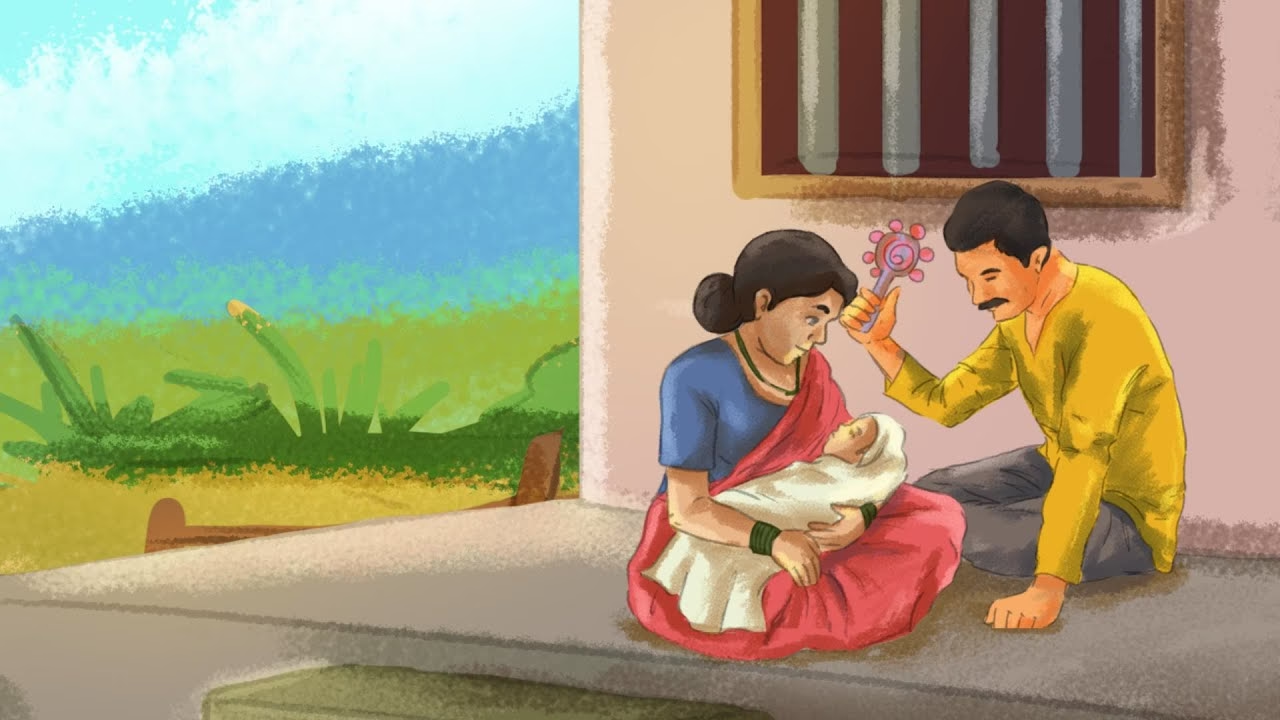
We chose a clean 2D style and kept motion minimal. We moved away from a glossy, polished vector look because it felt too clinical for young audiences. Instead, we used a hand-drawn feel with visible brush strokes and light texture. Colours stayed lively but softened into pastel tones, inspired by Studio Ghibli’s balanced palettes, and adapted for clear, mobile-friendly viewing.

Also read: How Animation Helped Upaya Tell a Story of Dignified Jobs

The use of text on the screen became an important aspect of the learning process. We used on-screen text to highlight key words and points, ensuring that viewers did not rely on the voice alone for comprehension. Also, timed the appearance of icons precisely when they were needed, which helped keep the screen uncluttered.

We handled sound with the same restraint. Background music stayed light and non-intrusive, so the narration and on-screen information remained the main focus. The aim was to support attention, not pull it away.

Designing for Comfort, Not Just Information

Because pregnancy is both biological and deeply personal, we kept returning to one question while designing: Will this feel safe to watch and easy to understand? That question shaped every decision, from colour and composition to how much detail to show, and how long to stay on each visual.

In the end, the series is built to do one thing well: make a complex life process understandable to children. The goal was not to overwhelm learners with detail, but to give them clarity they can carry, revisit, and share.

When education is designed with that kind of care, it does not just teach; it transforms. It equips. And that is what this series set out to do.

If your organisation is working to make complex ideas accessible, animation can help communicate them with care and clarity. We would be glad to support you in shaping your next learning or awareness initiative.

Rahul More

Video Editor

Rahul works on video editing and motion graphics across various formats. He previously worked in post-production at Sallys, with experience across commercials, web series, and digital content. He has over three years of experience in video editing and motion graphics. He enjoys reading, playing cricket, fish keeping and making short films. He holds a Bachelor’s degree in Mass Media (Journalism) and a Diploma in Filmmaking from Rachana Sansad Institute, Mumbai.

Abhinav S S

Illustrator

Abhinav works on in-house blog illustrations, storyboarding and various visual projects aligned with the studio’s creative direction. He is currently pursuing a Bachelor’s degree in Fashion Communication from National Institute of Fashion Technology (NIFT) Bhopal. He has played competitive cricket for the state of Kerala and has a strong interest in painting and graffiti.

Subscribe to our newsletter

Sign up for our newsletter and receive exclusive podcasts, blog updates.

Swanand Deo

Web Development Specialist

Swanand Deo is a WordPress and Web Development Specialist working on various digital projects. With over a decade of experience in the design and development space, he has collaborated with over 50 national and international clients. He specialises in User Experience (UX) design, WordPress development, and creating engaging digital experiences. He holds a Bachelor of Fine Arts from the University of Pune.

Aashna Chandra

Graphic Designer

Aashna works on publications, UI/UX and branding projects at SBS. She has previously worked with organisations across the social impact and development space. Her work focuses on layout design, visual identity systems and user interfaces across print and digital formats. She studied at the United Institute of Design, Gandhinagar, specialising in branding, typography, editorial design and packaging.

Vivek Warang

Digital Illustrator

Vivek works on translating ideas into visual narratives. His work ranges from creating storyboards and illustrations to ideation for special visual storytelling projects. He previously worked as an illustrator at OckyPocky. He enjoys telling stories through images and bringing concepts to life through his drawings. He holds a Bachelor’s degree in Applied Arts from D.Y. Patil College, Pune, with a specialisation in Illustration.

Rajshree Goswami

Content Writer

Rajshree began her professional journey in Kolkata and has over four years of experience as a creative writer and proofreader for academic papers. At SBS, she works across all content, including blogs, transcripts, quality checks and writing for annual reports. She is an avid reader and enjoys cinema, fiction and creative writing. She holds a Bachelor’s degree in English Honours from West Bengal State University.

Bhavesh Dhote

Founder’s Office

Bhavesh is part of the Founder’s Office, working across in-house operations, social media strategy, strategic initiatives, market research and film production. He holds a Bachelor’s degree in Electronics and Telecommunications Engineering with a Diploma in AI and Machine Learning from D.J. Sanghvi College of Engineering, Mumbai. He is also a professional badminton player, marathon runner, trekker and plays euphonium and trumpet.

Manish Mandavkar

Motion Editor

Manish Mandavkar has studied animation at Arena Animation in Mumbai. He has previously worked on animated videos and motion graphics for brands, including Unilever and Zee Movies. An avid gamer, he is also passionate about sketching and photography. He holds a degree in Commerce from the University of Mumbai.

Joel Machado

Film Editor

Mumbai-based creative consultant and film editor Joel Machado has worked on documentaries as well as films in the mainstream Bollywood sector. He was also the Chief Assistant Director on the Jackie Shroff short, “The Playboy, Mr. Sawhney.” In addition to earning a B.Com from Mumbai University, he attended the city’s Digital Academy to hone his script writing skills.

Rohit Sreekumar

Founder’s Office

Rohit is responsible for developing strategic alliances and collaborative initiatives in the social sector. He also works on project management and helps internal teams stay on track. He has previously worked at early-stage startups across product and growth roles. In his free time, he enjoys binge-watching series, gaming and reading. He holds a Master’s degree in Computer Applications from Amrita Vishwa Vidyapeetham, Karnataka.

Aliefya Vahanvaty

Sr. Creative Partner

Senior Creative Partner, Aliefya Vahanvaty has worked in a wide range of editorial roles over the course of her career, gaining experience as a correspondent, copy editor, writer, photographer, and assistant editor at publications like the Times of India, Forbes India, Open Magazine, Impact Magazine, and others. In addition to her MA in Sociology from Mumbai University, she also has an MA in Photojournalism from the University of Westminster in the United Kingdom.

Simit Bhagat

Founder

Founder, Simit Bhagat has worked in the fields of filmmaking, project management, and journalism for over 15 years. He has served in a variety of positions for organisations like the Times of India, the Maharashtra Forest Department, the Tata Trusts, and the Thomson Reuters Foundation. From the University of Sussex in the United Kingdom, he earned a Master of Arts in Science, Society, and Development.