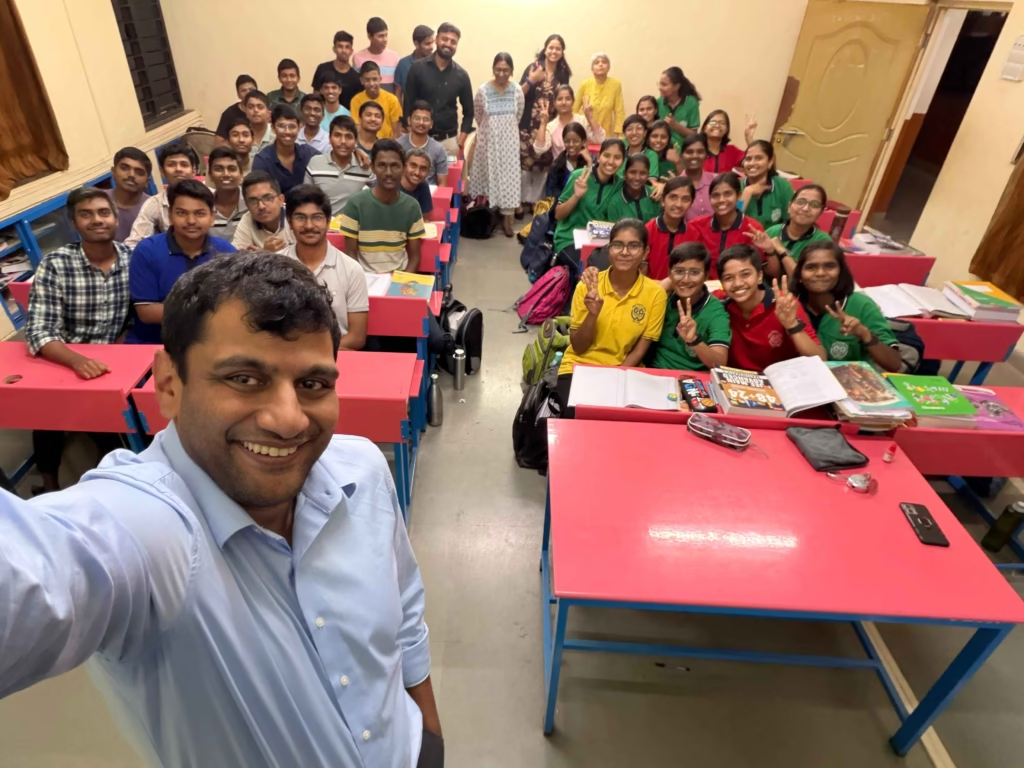
In this Leadership Series interview, Akshay Saxena reflects on the experiences that took him from IIT Bombay and a consulting career at Boston Consulting Group (BCG) to co-founding Avanti Fellows, a non-profit organisation that now works with state governments to help over 90,000 students from low-income backgrounds compete for India’s top colleges. A brief stint witnessing extreme inequality beside a cement factory township and the discomfort of realising his privilege, became turning points that shaped his understanding of what real change requires.
The conversation explores how Saxena approaches ego, delegation and organisational trust, why Avanti chose to become a government-partnered, CSR-funded non-profit rather than chase venture capital and how he has learned to redefine what winning means as the organisation has grown to 350 to 400 people. He also discusses communications, founder visibility and the discipline required to keep pivoting.
For leaders working across the development sector, the interview offers practical reflections on scaling with integrity, building teams that can outlast their founder and working with government as a partner rather than a critic.
Transcript of the Interview
Simit: You’ve been at this for over fifteen years now. Harvard Business School (HBS) is done, BCG is done. What is actually driving you today?
Akshay: The goal for me has always been whether you can make this area attract more investment, both from government and the public sector. It sounds like an odd thing to say, but the highest potential, highest achieving young people in India, especially from low-income backgrounds, get the least investment. That is the critical pillar of upward mobility, and this is not just our data but a global pattern. If you really want families to make multi-generational leaps, you cannot achieve that without extraordinary outcomes for someone in that family.
The critical pillar of upward mobility is that the highest potential, highest achieving young people in India, especially from low-income backgrounds, get the least investment.
I think Raj Chetty’s work in the US is the most pertinent example here. His research on the “Lost Einsteins” shows that only five or six per cent of students at top Ivy League schools are first-generation learners, and that children from high-income households, even when matched academically with low-income children, are four to five times more likely to become innovators or start companies. If a low-income child is a quarter as likely to achieve everything else, and eighty per cent of India’s population is low income, the barriers here are likely even more systemic.
For me, equity and poverty alleviation matter, but I am driven most by national progress: true social mobility and meritocracy, which will not happen automatically. This year we can feel proud that we sent 2,000 children to top tier colleges. But that number should be 2 lakh, and there is a lot of work left to do.
What I do day to day has changed a great deal over time. In the early years it was survival: we were the teachers, we were raising money, we were convincing people to give us money. For a long time after that it was teaching myself. Now it is advocacy, working with government and figuring out what creates non-linear scale for our work. I am also excited about playing a role in bringing the sector together, now that we are fortunate enough to have that kind of standing.
Growing Up Between Discipline and Freedom
Simit: I read that when you were at BCG, you were posted near a cement factory and you would spend evenings in the truckers’ colony nearby. Can we start from there?
Akshay: It actually started a little before that. I grew up in the armed forces, and leaving that world was a real shock. If you grow up in the armed forces, everyone is flat. There are jawans and officers, of course, but from a child’s perspective there was never really a difference. We wore the same uniforms, used the same facilities, had the same access. The idea of what society should be was grounded in a certain kind of nationalism.
Getting into IIT was not conventional for me either. I went to coaching but could not afford much of it. Once I was on campus, the experience was jarring. I did not even understand that people went to Kota for two years just to prepare. For the first time, I saw how differences played out: children from rural India, children who came in through reservation and the typical median student, whose family had spent money on coaching. If you grow up in the armed forces, you are class rich but cash poor. You speak good English, you know how to use a fork and a spoon and you have had a lot of exposure. Watching all of that play out for the first time was quietly discriminatory, even if none of us intended it to be.
For the first time, I saw how differences played out: children from rural India, children who came in through reservation, and the typical median student, whose family had spent money on coaching.
Sport was the one place those differences fell away, because eventually you either put the ball in the basket or you do not. My closest friends there were kids from rural India, and they were the most inspiring people I had met: clearly smarter than me, and they had overcome far more. But it was also obvious that they struggled to get placed after graduation, because what a firm like BCG measures has nothing to do with who you are. It is about how you present to a client.
In my final year, Krishna, my co-founder and I started a student mentoring programme that began as a suicide prevention effort. Talking to first-year students, you would see kids come in with deep insecurities, kids who did not speak English well, kids who came in through reservation and were then graded on a curve. All of this seeded the idea for me that IITs were not truly meritocratic, and that government investment in them would not deliver what the country needed unless representation became genuinely national.
The Township and the Wall Outside It
Simit: And then BCG placed you in that cement factory township. What did that experience do to you?
Akshay: Looking at that township was a study in contrast. Inside it, there was a factory, housing, every facility you needed. Outside the same wall, there was starvation and terrible public health outcomes, truckers driving for hours at a stretch, a high rate of road accidents. It is almost as if we build a wall and decide that everything inside it is fine, and whatever happens outside is not our concern. There are exceptions, companies like the Tatas among them, but at the time it was very stark.
I was wearing suits, doing consulting, earning what felt like an ungodly sum of money for what my actual skill set was worth, with no real use for it. So I started giving loans to people. You give someone money to open a jewellery store, it does well for three months, then a family member falls ill, the public health system does not help and that person ends up in debt with a moneylender charging one to two per cent a month. Finished.
If you genuinely want to help someone, getting their children or grandchildren into the same driver’s job or carpenter’s job will not shift anything. Someone in that family line has to end up with a job like mine, or it does not move at all.
What settled deeply in my head from that was that there is no incremental fix here. If you genuinely want to help someone, getting their children or grandchildren into the same driver’s job or carpenter’s job will not shift anything. Someone in that family line has to end up with a job like mine, or it does not move at all.
By the time I was at Harvard Business School, the real impetus was simple: we already knew how to organise Asia’s largest technology or music festival on campus, so why not put that same energy into building Asia’s largest social change movement? That is really how Avanti started, with very limited early ambitions. We began as a volunteer collective of twelve or thirteen student co-founders. I was in the US at the time, having left business school to help start a medical device company. But watching what that first group achieved in two or three years, including a government partnership, made clear we could do this at a bigger scale.
Choosing an Unconventional Career at an Early Age
Simit: Was there also a part of you resisting the linear path everyone else around you seemed to be on?
Akshay: Most people on my path went into private equity or started something for money, because those are the efficient ways to do well financially. I was still somewhat on that track, planning to work at a startup and figure out something else later. Choosing social change was not really a considered decision. It was emotional and intuitive, and if I am honest, it came from a place of hubris: the sense that we would do it too.
Choosing social change was not really a considered decision. It was emotional and intuitive, and if I am honest, it came from a place of hubris: the sense that we would do it too.
At the time, it almost required that kind of trajectory to take that kind of risk. Funding for social work is far more structured now. Looking at my peers then, people like Madhav, Rukmini(Pratham), Atul Satija(/Nudge Institute), almost everyone had some form of security blanket or savings before they started their second career, often in their mid twenties. Some were far more courageous than us. But for most of us it was a mix of genuine interest and not yet having life’s realities fully dawn on us. You need a bit of foolhardiness and hubris to start anything. I had plenty of both. It worked out, which is good.
When It Stopped Being Easy
Simit: When did reality first hit, when running Avanti stopped being straightforward?
Akshay: Compared to many social change organisations I have spoken to, our day to day work is actually the easiest kind of transaction, because the children we work with have already figured out how to survive and thrive in a broken system. It is not like anti-trafficking work, which is deeply depleting. The real question that nagged at us was whether this even counted as social work, and whether it was right to spend so much on one child.
Because I already had a lot of privilege built up by then, our early fundraising was easier than most. The pressure appeared when we tried to scale. Running three or four centres and raising three or four crore rupees was viable. Running two hundred centres and raising two hundred crore meant building something larger than most successful startups at the point of acquisition, with no profit incentive and nothing but people’s goodwill. In 2013 and 2014 there was no CSR structure in India, so you either convinced international funders, the Indian diaspora or people in India directly, in that order of ease. Realising that fundraising engine would have to be built from nothing was daunting. That is when we chose to start a social enterprise, as many organisations of that vintage did, because none of us genuinely believed we could scale purely on donations.
Running two hundred centres and raising two hundred crore meant building something larger than most successful startups at the point of acquisition, with no profit incentive and nothing but people’s goodwill.
Running that social enterprise turned out to be far harder. Once you are selling a service, the entire frame changes. You cannot tell a child they were not selected and ask if they are ready to pay instead. The incentive structure shifts, and you are left asking whether you are trying to keep a child in your centre or actually do what is best for them, even if that is not what their parent can afford. Those six or seven years were extraordinarily hard. We were competing against commercial coaching chains that could outspend us, and the model was failing from day one while we spent a lot of energy convincing ourselves and our investors otherwise. Making payroll every month was hard. Keeping good people engaged was hard. Convincing government to invest was hard.
It got genuinely difficult psychologically too. You start to wonder whether you are chasing investor returns or actual outcomes, and you realise that for the first time in your life, something you have done everything right for is not guaranteed to work. Decisions you made five years ago are now playing out, and you cannot undo them. In some ways that is a great empathy building exercise, because it is how most people who did not go to IIT or business school experience life all the time. We taught ourselves how the industry really worked, and why children were not getting in: not just a lack of money for coaching, but deep, structural reasons around mindset, family history and aspiration.
Competing, in a strange way losing money while commercial players like Akash and FIITJEE made money, taught us things we would never have learned otherwise. COVID turned out to be a moment of rebirth. We burned everything to the ground and rebuilt it from scratch, and I feel genuinely fortunate that opportunity presented itself.
Becoming a Government Partnered Non-Profit
Simit: Where does that leave you today? Is Avanti a non-profit by conviction, or is that still an open question for you?
Akshay: We are entirely a non-profit today, a decision we took around 2021. Most of our funding is CSR and most of our work is with government, which is not the same structure many large education non-profits have, but it works for a few clear reasons.
You have to test and identify children at population scale, which only government can do. You eventually have to place children in residential schools if you want them to compete with children who already have every facility at home, and only government can run residential schools at that scale. And the credit and ownership have to sit with government, because if something happened to me tomorrow, the programme should not die with me.
My goal is not for Avanti to stop existing. My goal is for it to always exist, independent of me.
The second unlock is distributed revenue. Our CSR partners are numerous, long term and genuinely committed, so the risk of any one centre closing is low, and CSR is an engine that can keep scaling: you could build a thousand crore non-profit on it if run well, as long as impact stays attributable rather than loosely claimed. The fourth piece is helping government eventually run this itself, with its own money and ownership, which has already started in states like Tamil Nadu, and which Telangana has been doing well for close to a decade. My goal is not for Avanti to stop existing. My goal is for it to always exist, independent of me. What the organisation does should keep changing, but I think the structure we have built is the right one.
Walking Away From Venture Capital
Simit: Given your training in startups, did you ever seriously consider building this as a for-profit, venture backed business?
Akshay: From my startup training, I have always believed you should decide quickly and pivot fast, and not let ego root you in the wrong choices. We have pivoted many times, and for the better. We did raise some venture and impact capital early on, but every serious VC we spoke to would ask what our primary goal was. The moment I said impact, that was the end of the conversation. If I were an LP in a VC fund, I would not want them spending on impact instead of returns either, and that is fair.
We were clear from our first fundraise that we were not going to make much money, so the real pivot was learning how to build lean and cost efficient without much capital. You still make mistakes, because a founder’s grip on reality is always a little deluded. What became clear over time is that I had no real interest in building a VC backed business in this space. If I wanted to win that particular game, I would have had to build something like Akash or Narayana.
Winning the impact game meant building exactly what we are now building, and nothing else: with the trust of government, as its partner rather than its critic.
Winning the impact game meant building exactly what we are now building, and nothing else: with the trust of government, as its partner rather than its critic. We will never publicly criticise government policy, because that is simply not our goal. Getting clearer, narrower and more focused is a lifelong project. We are maybe seven out of ten on that today, but as you get larger, clarity and simplicity matter more than almost anything else.
Redefining What Winning Means
Simit: Does ego still play a role, especially now that you are running a large organisation on grant money rather than equity?
Akshay: Ego is always there. I think a certain part of Indian society equates the absence of failure with success, and success itself is relative. If you are raising venture capital, are you in the top one per cent, are you a unicorn? If you are raising grant money, are you in the top one or two per cent of organisations doing that?
What has taken real work for me is constantly clarifying what I am actually trying to win at. I am still trying to win, always, but the more nuanced you get about what winning even means, the more peace you find. This year, winning looks like our organisation running well, people knowing what they are doing, people disagreeing healthily rather than unhealthily across 350 to 400 people spread across the country and having the clearest, most attributable impact we can. In two or three years my goals will probably look different again.
I am still trying to win, always, but the more nuanced you get about what winning even means, the more peace you find.
I have shifted towards much shorter term goals. Early in a social change organisation, you are constantly repeating your twenty year vision, and we still do that, but the real focus, as in business, is your five quarter, or even one quarter, goal. Being ultra clear about that brings real peace, because you are chasing something you can actually see and reach. I would like to think about five year goals only once every five years, but we are not quite there yet, because we are still very much in the fundraising game.
Why Non-Profits Are Not the Easier Path
Simit: Is it harder to build and scale a non-profit than a business?
Akshay: They are both hard, in different ways, and about equally so. Non-profits face a smaller, shallower ecosystem: your metrics are more convoluted because impact means different things to different people while profit means the same thing to everyone, your capital pool is shallower and your talent pool in certain functions is sparser. You are always partly evangelist and partly operator, which is genuinely difficult. In some ways non-profits and startups are similar. You are both losing money and trying to do something audacious. But because the ecosystem is smaller, I think it is also more unfair, and we have been beneficiaries of that unfairness: the colleges we went to, how we speak and dress, the privileges we were simply born with. There are more capable people on the other side of that unfairness.
The commercial world is fairer in comparison, because if you are making money, you are making money, and that is unambiguous. If my primary goal were not societal change, I would always prefer running a company. Trying to create social change through an organisation is perhaps the hardest problem there is, precisely because so few examples of people who have succeeded at scale can still be told apart from their commercial competitors.
Simit: Is the non-profit world more cut throat than business, then, given how limited the funding pool is?
Akshay: Not more cut throat exactly, but the market is much deeper for business. Building a thirty crore coaching business is not that hard. Four teachers who teach well and consistently for ten years will get there, and possibly further. Building a thirty crore non-profit doing the same thing is far harder, not because there are more competitors, but because everyone is competing for a much smaller pool of money. Getting to even a thirty or sixty crore non-profit in India is extraordinarily hard, and doing it with integrity, which most non-profits genuinely try to do, makes it harder still. If I did not care about this particular problem, I would always choose to run a startup instead. If it fails, the investor’s money sinks and you move on. Here, the emotional investment is so much higher that it becomes very hard to walk away.
The Hardest Thing to Unlearn
Simit: What has been the biggest unlearning for you, personally?
Akshay: That you cannot solve your way out of everything with intellectual smartness and effort. That is part of why tech companies are somewhat easier to start: you can solve a narrow problem for one customer group on a spreadsheet or in code, and the transaction is clear. Education and health are thick problems. Perhaps ten per cent of the outcome is in your control, and everything else is interconnected. You are playing whack a mole.
Even in our work, which I keep saying is among the easier versions of this kind of work once you have found the right children, you would imagine that consistent teaching over two years guarantees results. But school administration, parents, other teachers, news, social media, a child’s own trauma, all of it is involved in whether that outcome actually happens. The hard unlearning was realising the answer is not how efficient my pedagogy is. I can bring the world’s best pedagogy, the most overused term in education, adaptive learning, fifteen AI models and none of it will be the most important thing.
The most important thing is whether I can build a culture of care, where the teacher cares, the school administration cares and the child cares.
The most important thing is whether I can build a culture of care, where the teacher cares, the school administration cares and the child cares. You cannot standardise that sitting in a room. It is cultural. You have to trust that the person next in line, and the person after them, will do the right thing and that is the actual secret of social innovation: grassroots organising and culture building. That work is deeply unintellectual, and for someone like me, it has been genuinely difficult to make peace with.
The fortunate thing is that the people who run Avanti with me, Vandana, Panchali, Agni and others, do not prioritise the same things I do, which is the greatest gift. And as the organisation gets bigger, the things I personally can do in ten hours a day matter less and less. That is important, and it is very hard to unlearn for someone used to succeeding by doing exactly that.
Learning to Let Go
Simit: Does that unlearning extend to trusting others with decisions, even when you think you would do it better yourself?
Akshay: This happens for me with real difficulty. I think the only thing I have managed successfully is creating a place where people who work with me can ignore me and know there will be no consequences. That is the best I have achieved. Over time, working with the same people for long enough, you become far more comfortable trusting them. The real challenge is in the areas you genuinely are good at. You got where you are because you did not trust others to do that particular thing. You do not go from zero to one, or zero to ten, by handing your work to someone else. That is why executives from large companies rarely start successful ones themselves: you do not get there by letting people do what they want, you get there by getting into everything yourself.
I think the only thing I have managed successfully is creating a place where people who work with me can ignore me and know there will be no consequences.
But the need to get into everything has to shrink over time, and the shift from being someone who is in everything to being a good manager, which is what people at large companies are genuinely good at, has close to a ninety per cent failure rate among founders. I do not think I am there yet at all, but I do believe the people running things day to day are more capable than me, and that they do not listen to me when I interfere. If I can achieve that much, I think it is enough. Leadership should not be entirely hands off, but that involvement needs to stay limited.
Building a Team That Outgrows You
Simit: How do you approach building a team, both at the start and now?
Akshay: You look for people who are better than you at the things you would never do yourself. I think two kinds of people have done extraordinarily well at Avanti: those who understand the actual problem better than me, not how to explain it to a donor but the real, messy problem, which by now describes most of my colleagues, and those who can build an excellent culture around solving it. One of our longest standing employees started as a typist and now leads production.
In that narrow area, there is no chance we would hire anyone who understands it better than he does. Those are the people who end up building the organisation, and the ones you hire early become the people who actually run it, not you. The hardest part has been helping them feel genuinely empowered to decide without asking me first. In a founder led organisation moving from zero to a hundred, that shift takes the longest to arrive.
Why People Stay
Simit: How do you get people to be as invested in the organisation as you are?
Akshay: I think the people who have stayed are, if anything, more passionate than I am. More seriously, clarity of purpose and consistency matter enormously. People need to know what you stand for and that you will actually do what you say. The people I respect most, whether or not I agree with them, are consistent: I know what they believe and that they act accordingly. It is very hard to stay with someone long term whose goalposts keep moving. The other part is spending real time as an equal with the people who join early, building the organisation hand in hand as peers, even though I am technically the boss.
People join early stage organisations because they want to feel part of building something, and they want the camaraderie of going through the conflict together. You have to be willing to be vulnerable and let them see you struggling too, because then they have as much invested in what you are building as you do.
I actually think this is easier in non-profits than in for-profit companies, because there is a written truth that you are not personally benefiting from the organisation’s growth. Avanti could become twenty times its size and, beyond my own salary, I gain nothing from it. Everyone at Avanti goes through the same journey I do, which is an extraordinarily unifying thing, and it is true of cooperatives and trusts as much as non-profits.
The core difference between a non-profit and a company is ownership. There is no ownership by design in a non-profit, so if it is ethically run and well governed, it should have zero incentive to be exploitative. That is a genuine asset, because at no point does it feel like you are working for one person rather than a cause. Your wages might be ten to thirty per cent lower, but you are in a structure with no incentive for anyone except getting the work done.
There is no ownership by design in a non-profit, so if it is ethically run and well governed, it should have zero incentive to be exploitative.
We did run a for-profit arm alongside the non-profit for years, and the people who stayed longest were always the ones we had hired into the non-profit side. In a company, some people join hoping for a valuation upside, others for a good line on their CV before moving on. The transaction is clear: you make profit, I make money. That clarity is exactly what social enterprises lack, because half the time neither the promoter, the employee nor the investor is quite making money and once private equity does come in to make money, whatever the organisation originally stood for starts to shift. Non-profit is genuinely easier in that respect. India’s CSR framework is unique in the world, and I think in ten years we will see several thousand crore non-profits here, well governed because the people funding them are also required to be compliant.
Depth Over Breadth and Saying No to Money
Simit: Do you think organisations should stay narrowly focused rather than spreading themselves across many programmes?
Akshay: I am a big fan of single programme non-profits. Multi-programme organisations struggle because the organisation itself no longer knows what it does. I think you need hundreds of organisations, each doing one thing well, rather than a handful trying to do everything.
Simit: Isn’t that a chicken and egg problem, though, when donors ask you to take on something adjacent just to secure funding?
Akshay: When you are in survival mode, anywhere between zero and five crore, you take the money you can get, and that is fine. Once you are past a certain size, there is no need to chase mission drift, even if we are still occasionally tempted by something we are genuinely excited about. Taking on a new programme purely because a donor wants it is never worth it. I also think many non-profits do not make the effort to educate their donors. If a donor asks for something that does not fit, you can simply say so, and revisit it once your existing programme meets their objective. There is not enough pushback in this sector.
For very small organisations under six crore, though, I think the opposite advice applies: take almost any reasonable money loosely related to your problem area, because at that stage you do not fully know what you are doing yet, and some donors have better intuition about the problem than you do. We did not always follow that discipline ourselves once we were larger, and we regretted it. At various points, thirty to forty per cent of our budget went to programmes we no longer had conviction in, simply because we had signed a four year grant and had to deliver it. Very few funders will let you say a programme is not working and you want to change course, so you keep filing reports that look fine. Once you know what you are doing, it becomes entirely reasonable to say no to money for something else.
Talking About Failure Without Changing Anything
Simit: There is a lot of talk in this sector about being more open about failure. What is your view?
Akshay: I talk about failure constantly, but I do not think it is really about failure. What people in our sector love doing is discussing failure without changing anything: a programme fails, and the next grant application is for the same programme. If that is what is happening, talking about failure is just virtue signalling, no different from writing “I am a perfectionist” as your greatest weakness in a business school essay. If I were a funder, I would measure how many times a non-profit has genuinely changed its programme, and if the answer is never in five years, I would not fund them. Something is wrong. The organisations I respect most have pivoted endlessly and keep evolving, and that should be our job in this ecosystem. We are never going to be the biggest education provider, so our job has to be innovation.
Learning to Work With Government
Simit: How did you actually learn to work with government at that scale?
Akshay: Not working with government is like building an app and refusing to use online advertising. You have to find a way in, and if you cannot as a charity, something is deeply wrong with your model. My experience is that nine times out of ten, officers posted to education roles are there because they genuinely want to do something interesting. There is little electoral upside or budget to fight over in education, so most people there have the right intentions.
Trust is extraordinarily important. Officials need to believe you are there to help them achieve goals that mattered to government, not to lecture them. You cannot walk in acting like the expert who has come to explain things. That might have worked in the 1970s for someone returning from abroad. It does not work now. The conversation has to be: we would like to help, what are you trying to do, would you like to try this? Trust is hard earned, because well run, honest non-profits are outnumbered by ones that are not, so credibility becomes a genuine issue, much like it is for companies bidding on tenders.
Trust is extraordinarily important. Officials need to believe you are there to help them achieve goals that mattered to government, not to lecture them.
In years one to five, I would wait five or six hours to meet an officer, and sometimes they simply would not see me. I probably spent eighty per cent of my time sitting outside government offices, working on a laptop. There is no shortcut, and you cannot hire someone senior to do this for you. By years five to ten, the wait was down to half an hour or an hour. By years ten to fifteen, I would wait ten minutes and leave without interruption. You have to remember that even a district level officer might run five hundred schools, and meeting you is simply not the most important thing on their mind that day. Doing social good work does not entitle you to their time.
Luck matters too. There are moments when the right officer and the right political environment converge, and it happens rarely, almost like a lottery. If you are not in the room when that window opens, you miss it, so you have to keep showing up and waiting. Every non-profit that has scaled has figured this out, and it is always the founders who figure it out, never a hired specialist. If you cannot articulate what role government will play in your programme, something is fundamentally wrong with your model, though that role does not always need to be deeply integrated. Even a programme that government does not directly run can still depend on government data or identification of the children it serves.
A Case for Young Founders
Simit: For young people starting out now, with all that enthusiasm and a bit of delusion, what would you say to them?
Akshay: I love the delusion. The only real hope in this sector is young founders, for everything. I am sure there are twenty things we are doing wrong, and the only way those get fixed is if someone comes into the same space and does a better job than us, not necessarily at our scale, just better. A twenty five year old full of hubris and delusion is a genuine national asset. We should encourage them, because they are willing to fail, willing to try, willing to pivot and if they do fail, they become extraordinary hires for larger organisations later.
A twenty five year old full of hubris and delusion is a genuine national asset.
My advice is to lean into that delusion and keep at it. In the age of AI, this is the one sector guaranteed to grow, so there is real room for founders here. My only real ask is to do something genuinely new rather than repackage what already exists. Hold yourself to the same bar you would if you were applying to an accelerator that only takes ideas it considers new.
Advice He Would Give His Younger Self
Simit: If you had to tell your twenty-five-year-old self two or three things, what would they be?
Akshay: Most of what I would tell my younger self is advice that very serious people actually gave me at the time: do fewer things, do them in a more focused way, more clearly. That advice has been consistent throughout my life, and it is correct. But the truth is that at the founder stage, you also need the ability to ignore advice. The advice I actually took, and still repeat, is not to listen to too much of it, just to pivot, adapt and stay agile, because speed and agility are the only real advantages an early stage organisation has over a larger one. You can move faster, work longer hours, sleep less, take less money and stay nimble. If you do that well, you might not succeed, but at least you will fail fast.
Knowing when to pivot requires real metacognition, and that is where our sector genuinely struggles. In startups, failure is brutally clear: your seed round did not lead to a series round, you have failed, move on. In non-profits, money arrives in far murkier ways. People get inspired by your story and keep funding you, often because it is such a small share of their net worth that they never look too closely. So the ability to drift for years, unaccountably, is extraordinarily high in our sector.
I have seen organisations running on thirty or forty lakh budgets for a decade with no meaningful change, simply because a funder likes the story and keeps renewing it. That drift is bad for the founder and bad for the organisation, though honestly not bad for the funder, who can usually afford it. But eventually you look up and ask yourself what you have actually been doing, because there is no natural mechanism that kills weak non-profit work the way a market kills a weak business. Every organisation, whatever its model, needs to hit some minimum bar of scale and evidence that it is genuinely working.
Making Room for Communications
Simit: Was communications always something you took seriously, or did that come later?
Akshay: Much more now than in the early years, when I was the communications function myself. Over the last four or five years we have built real capacity for it, though the work is genuinely endless. The storytelling side of it matters most, because that is what people actually relate to. There is a dual agenda for us now: fundraising, which is fine, and the fact that our children’s stories are genuinely inspiring to other children like them, something we should be doing more of, even if it often gets pushed down the priority list by operational demands. It should sit within your admin budget, and we are fortunate now to have unrestricted funds we can use for it.
In the early years, communications took up twenty five to thirty per cent of my time, largely because fundraising is essentially communications. Now it is under ten per cent. My hope is that we treat it as a public good rather than marketing.
Simit: Did you ever feel that your own visibility as a founder overshadowed the organisation’s brand?
Akshay: Much less so now, but in the early years, absolutely. Avanti was known through me.
Advice for People Considering the Switch
Simit: One last question. For people thinking about moving from corporate roles into the social sector, what would you tell them?
Akshay: Volunteer first. Visit programmes, and not just for an hour. Go and stay for two days somewhere and actually see the work, because without something close to an obsessive relationship with it, it is hard to justify the long-term cost you are taking on. Compensation in this sector has genuinely improved, but there is still a real opportunity cost to moving. I think it is more than made up for by the impact you have day to day, but that immersion has to come first.
A Final Reflection on the Sector
Simit: Is there anything else you would want to leave us with?
Akshay: I am incredibly optimistic about India, because I am incredibly optimistic about our development sector. The quality of talent across every function now, fundraising, communications, legal, compliance, programmes, is genuinely rich. I think our third sector is as strong as our corporate sector, and closely linked to it. Whatever number we eventually reach, whether that is thirty trillion dollars of GDP or, more importantly, our development goals, I think we will look back on these last twenty or twenty-five years as the period in which we genuinely built the foundations of a sustainable, scalable civil society. It is a very exciting space to work in, and I hope more people do slightly unbelievable things here.
Simit: Thank you, Akshay, for speaking so openly about ego, delegation and the discipline of scaling with government rather than around it. Your reflections offer a clear-eyed view of what it actually takes to build institutions that outlast their founders. We are grateful for your time and honesty.
Follow the Leadership Series for more practical lessons from social sector founders navigating growth, government partnership and organisational culture.