What Working with Sankara Eye Hospital Taught Us About Case Studies

This behind-the-scenes piece reveals how case studies become deeply human narratives.
Case Study

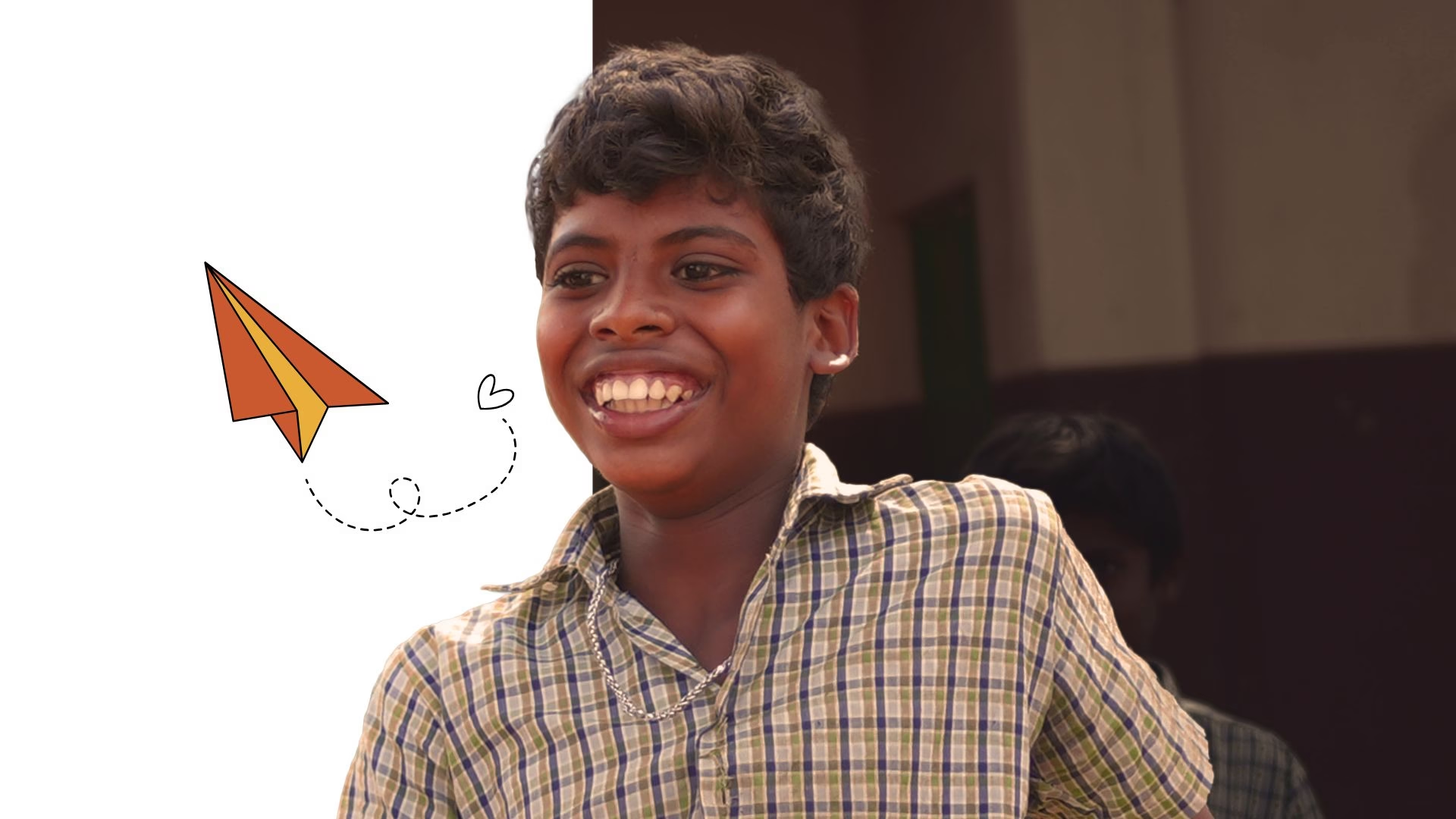
The first time Munishwaran saw his mother’s face, he froze. For twelve years, he had only known her by voice and touch. A life-changing surgery changed that, and we were there to tell his story.

And that’s the thing about case studies, they’re not just reports of impact. They’re windows into lived experience. Done well, they move beyond metrics and reveal the human heartbeat of a programme.

We worked with Sankara Eye Hospital to capture the stories of their beneficiaries whose lives were transformed through free eye care. Each story taught us something, not just about sight, but about how organisations can approach storytelling with sensitivity, authenticity, and purpose.

Language Differences? Build Bridges, Not Barriers

When we interviewed Munishwaran in Tamil Nadu, the conversation flowed smoothly. A member of our team spoke Tamil, as did his teachers and Sankara’s team. This shared language made it easier to get deeper insights: how he once walked to school guided by his brother, how he picked up a pencil after surgery, how he now dreams of joining the police force. It was a rich, fluid exchange.

With Prabhakar in Andhra Pradesh, the situation was different. He spoke Telugu, which no one on our team did. But even though there was no perfect language match, we still managed to piece his story together with the help of Sankara staff member.

Across the conversation, we captured powerful snippets, how Prabhakar initially feared surgery, how he found comfort in fellow patients’ stories, how thrilled he was to be earning again, and encouraged others to seek treatment. All of these pieces fit together to make a complete story arc.

 Even though we didn’t speak the same language, we were able to put together a story that felt complete and true by being patient, working together, and picking up on each other’s emotions.

Remote Interviews Can Work With Patience and Planning

All the interviews were done over the phone. In areas like Murbad, Maharashtra, where 70-year-old Mahadu lives, network quality can fluctuate. At times, the voice at the other end would fade slightly, or we’d miss a word or two. But with some patience and repetition, we were able to gather everything we needed.

With some patience and repetition, we were able to gather everything we needed.

We simply repeated questions gently, confirmed what we heard, and slowed things down. These extra few minutes gave us a story that was worth every second, how Mahadu hadn’t woven a basket in almost two years, how the first thing he did after surgery was walk to his rice paddy, how he finally felt useful again.

And if anything wasn’t clear during the call? The Sankara team followed up. They helped clarify certain details after the interview, which ensured the final narrative was both accurate and complete.

With a calm pace and open line of communication, even phone-based interviews in remote locations can produce deeply human stories.

Emotion Doesn’t Always Come Easily; Ask with Intention

Most beneficiaries don’t begin with long, expressive answers. When asked how the experience was, many understandably say, “It was good.” That’s where thoughtful questioning comes in.

Instead of general prompts, we used specific ones: What did you feel the night before surgery? Whats the first thing you noticed when the bandage came off? What did you miss doing when your vision was affected?

In Mahadu’s case, asking how he felt about weaving again opened the door to a much deeper story, about dignity, daily rhythm, and a sense of purpose returning to his life. In Prabhakar’s case, it helped us understand how much it meant for him to no longer rely on others and to tell his passengers about Sankara with pride.

A little extra care in framing our questions allowed us to move beyond surface-level responses and into stories that captured both struggle and strength.

Case Studies Take Time, But They Give Back So Much More

What these three case studies reminded us is that a powerful story doesn’t appear fully formed. It takes a few questions, a few pauses, and a few return calls. But if you listen closely, even a short interview can contain a lifetime’s worth of meaning.

If you listen closely, even a short interview can contain a lifetime’s worth of meaning.

From a boy who drew his first picture, to a man back in his driver’s seat, to an elder picking up bamboo again, these are not just stories of sight regained. They are stories of life restarted.

And despite all the logistical realities, language, signal, and pace, each one came together. Not perfectly. But beautifully.

A little adaptability, the right collaborators, and a strong sense of purpose are often all you need to tell a story that truly connects.

If you’d like to read more real-world case studies from the nonprofit sector and learn how to bring your own organisation’s work to life through thoughtful, impactful storytelling, subscribe to our newsletter.

Rahul More

Video Editor

Rahul works on video editing and motion graphics across various formats. He previously worked in post-production at Sallys, with experience across commercials, web series, and digital content. He has over three years of experience in video editing and motion graphics. He enjoys reading, playing cricket, fish keeping and making short films. He holds a Bachelor’s degree in Mass Media (Journalism) and a Diploma in Filmmaking from Rachana Sansad Institute, Mumbai.

Abhinav S S

Illustrator

Abhinav works on in-house blog illustrations, storyboarding and various visual projects aligned with the studio’s creative direction. He is currently pursuing a Bachelor’s degree in Fashion Communication from National Institute of Fashion Technology (NIFT) Bhopal. He has played competitive cricket for the state of Kerala and has a strong interest in painting and graffiti.

Subscribe to our newsletter

Sign up for our newsletter and receive exclusive podcasts, blog updates.

Swanand Deo

Web Development Specialist

Swanand Deo is a WordPress and Web Development Specialist working on various digital projects. With over a decade of experience in the design and development space, he has collaborated with over 50 national and international clients. He specialises in User Experience (UX) design, WordPress development, and creating engaging digital experiences. He holds a Bachelor of Fine Arts from the University of Pune.

Aashna Chandra

Graphic Designer

Aashna works on publications, UI/UX and branding projects at SBS. She has previously worked with organisations across the social impact and development space. Her work focuses on layout design, visual identity systems and user interfaces across print and digital formats. She studied at the United Institute of Design, Gandhinagar, specialising in branding, typography, editorial design and packaging.

Vivek Warang

Digital Illustrator

Vivek works on translating ideas into visual narratives. His work ranges from creating storyboards and illustrations to ideation for special visual storytelling projects. He previously worked as an illustrator at OckyPocky. He enjoys telling stories through images and bringing concepts to life through his drawings. He holds a Bachelor’s degree in Applied Arts from D.Y. Patil College, Pune, with a specialisation in Illustration.

Rajshree Goswami

Content Writer

Rajshree began her professional journey in Kolkata and has over four years of experience as a creative writer and proofreader for academic papers. At SBS, she works across all content, including blogs, transcripts, quality checks and writing for annual reports. She is an avid reader and enjoys cinema, fiction and creative writing. She holds a Bachelor’s degree in English Honours from West Bengal State University.

Bhavesh Dhote

Founder’s Office

Bhavesh is part of the Founder’s Office, working across in-house operations, social media strategy, strategic initiatives, market research and film production. He holds a Bachelor’s degree in Electronics and Telecommunications Engineering with a Diploma in AI and Machine Learning from D.J. Sanghvi College of Engineering, Mumbai. He is also a professional badminton player, marathon runner, trekker and plays euphonium and trumpet.

Manish Mandavkar

Motion Editor

Manish Mandavkar has studied animation at Arena Animation in Mumbai. He has previously worked on animated videos and motion graphics for brands, including Unilever and Zee Movies. An avid gamer, he is also passionate about sketching and photography. He holds a degree in Commerce from the University of Mumbai.

Joel Machado

Film Editor

Mumbai-based creative consultant and film editor Joel Machado has worked on documentaries as well as films in the mainstream Bollywood sector. He was also the Chief Assistant Director on the Jackie Shroff short, “The Playboy, Mr. Sawhney.” In addition to earning a B.Com from Mumbai University, he attended the city’s Digital Academy to hone his script writing skills.

Rohit Sreekumar

Founder’s Office

Rohit is responsible for developing strategic alliances and collaborative initiatives in the social sector. He also works on project management and helps internal teams stay on track. He has previously worked at early-stage startups across product and growth roles. In his free time, he enjoys binge-watching series, gaming and reading. He holds a Master’s degree in Computer Applications from Amrita Vishwa Vidyapeetham, Karnataka.

Aliefya Vahanvaty

Sr. Creative Partner

Senior Creative Partner, Aliefya Vahanvaty has worked in a wide range of editorial roles over the course of her career, gaining experience as a correspondent, copy editor, writer, photographer, and assistant editor at publications like the Times of India, Forbes India, Open Magazine, Impact Magazine, and others. In addition to her MA in Sociology from Mumbai University, she also has an MA in Photojournalism from the University of Westminster in the United Kingdom.

Simit Bhagat

Founder

Founder, Simit Bhagat has worked in the fields of filmmaking, project management, and journalism for over 15 years. He has served in a variety of positions for organisations like the Times of India, the Maharashtra Forest Department, the Tata Trusts, and the Thomson Reuters Foundation. From the University of Sussex in the United Kingdom, he earned a Master of Arts in Science, Society, and Development.