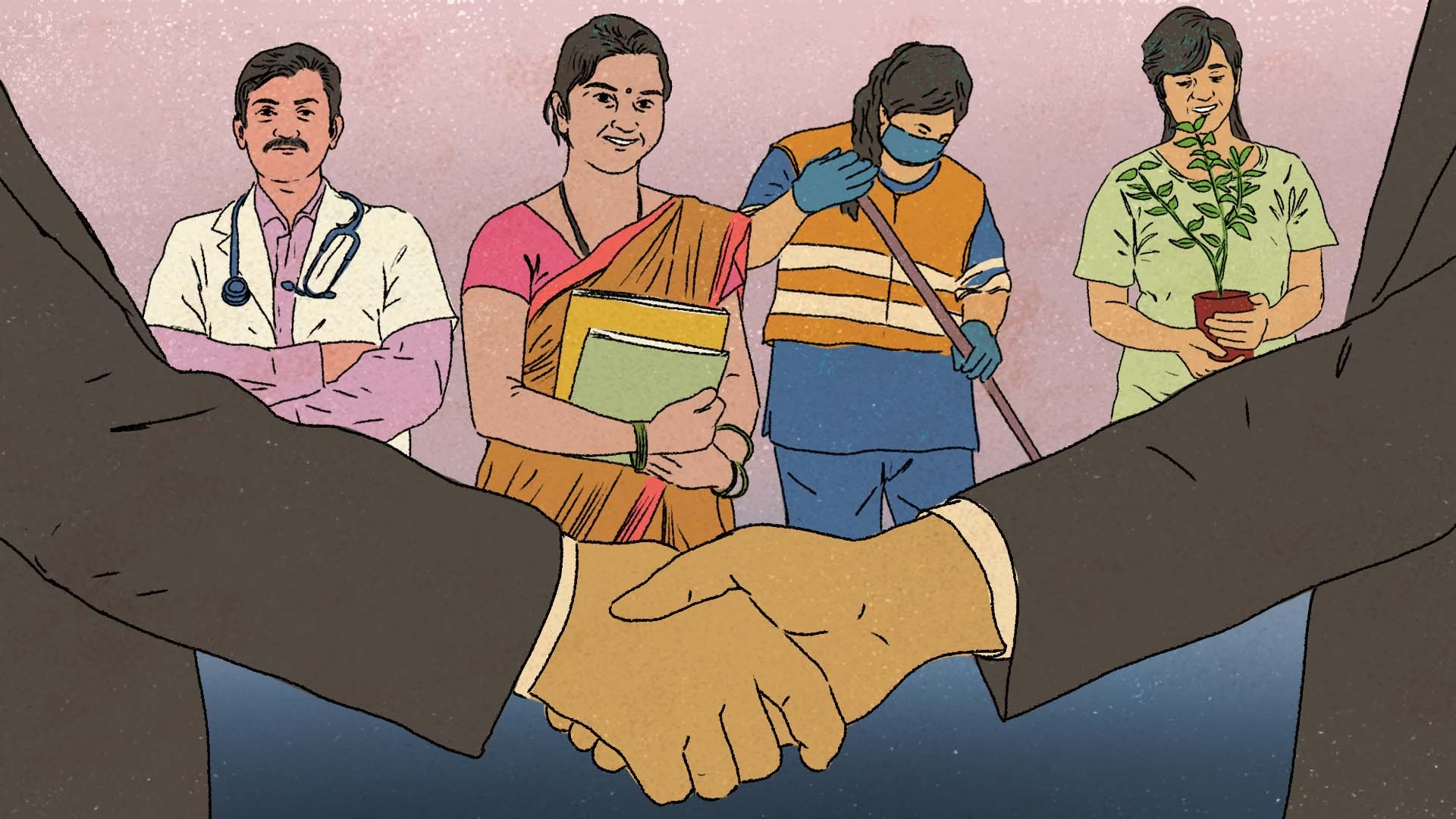
Did you know that more than half of NGOs worldwide report that attracting and retaining skilled professionals is one of their biggest barriers to scaling impact?
Behind every successful health camp or remedial class, there is often a doctor giving up her weekend, a teacher staying late after hours, or a social worker stitching together fragile networks of support. Their time, confidence, and knowledge are what transform transient campaigns into long-lasting transformations.
In our earlier blog, we looked at how volunteer voices, like Dr. Nabila Ismail’s viral reel, can spark movements by making invisible struggles visible. This time, we step further into the story. What draws professionals into NGO work? What do they see, feel, and wrestle with as they balance their careers with service? And how can NGOs create the conditions that make them stay?
Let’s walk into their world and see how alliances with professionals can endure far beyond a single project.
Doctors Who Go Beyond the Clinic
Behind every effective health programme there is often a doctor giving time outside the clinic. Their presence adds not only skill but credibility. This can be seen at Operation Smile, where surgeons volunteer for cleft palate surgeries. Nurse Linda James put it plainly: “I’ve become a better person and nurse because of those experiences.” Anaesthetist Adam Dobson echoes this sentiment, saying, “It’s endlessly rewarding. You feel you’re part of a well-supported organisation that is professionally very responsible and has extremely strong governance.”
Studies echo this reality. Volunteer physicians describe service as an “escape hatch” from daily stress, yet point to barriers such as limited time, logistics, and malpractice concerns. Without attention to these frictions, goodwill rarely becomes a long-term commitment.
When NGOs ease practical hurdles, share clear patient outcomes, and acknowledge professional development through credits or mentoring, doctors feel their expertise is valued.
In India, ARMMAN, an Indian nonprofit organisation, scaled medical expertise through mobile health programmes like mMitra and Kilkari. Doctors could reach millions of mothers without overloading their schedules. When NGOs ease practical hurdles, share clear patient outcomes, and acknowledge professional development through credits or mentoring, doctors feel their expertise is valued. That is when they remain, not as occasional visitors, but as long-term partners.
Teachers as Education Allies
For NGOs working in education, teachers often decide whether an intervention fades or truly takes root. Many hesitate when new ideas arrive as extra work. Respect for their craft and simplicity in methods make all the difference.
Pratham’s Teaching at the Right Level (TaRL) shows how, by grouping children by ability rather than age and equipping teachers with straightforward techniques, TaRL produced measurable gains in literacy and numeracy across multiple RCTs. Engagement held because progress was visible, not theoretical.
For NGOs working in education, respect for teachers’ craft and simplicity in methods make all the difference.
At Malaysia’s Dignity for Children Foundation, teachers such as Hannah Mae Chin describe the joy of seeing pupils “shine when they finally understand”, while Shomaskumar Susei admits challenges exist but says the mission kept him committed. Room to Read lightens workload further by pairing libraries with early-grade coaching.
When teacher agency is respected, support is practical and in-class, and quick wins are shared openly, teachers lean in. Programmes thrive when educators see both their expertise and their pupils’ progress honoured.
Social Workers & Hybrid Professionals
Not every ally is a clinician or a teacher. Many are professionals, from engineers and lawyers to marketers and social workers, who bring skills and networks that stretch beyond the classroom or clinic. What unites them is the search for community and purpose that outlasts a job description.
The Robin Hood Army, a zero-funds volunteer organisation, lives this truth. With more than 263,000 “Robins”, it has served 153 million meals without raising funds. On its RobinSpeak platform, volunteers share intimate snapshots, like handing a hot meal to a family under a bridge or hearing the gratitude of an older woman after days of hunger. These experiences are much more effective than a chart or other abstract representations at keeping commitment grounded.
When professionals find environments that honor their identities and development opportunities, service starts to become more than just a moment and instead contributes to something much bigger.
Teach for India, an Indian nonprofit organisation, charts another path. Fellows enter classrooms, often emerging in such a way that they become lifelong advocates for education, with alumni now working with 33 million children!
Community, recognition of peer work, and space to grow and develop new skills anchor that commitment. When professionals find environments that honor their identities and development opportunities, service starts to become more than just a moment and instead contributes to something much bigger.
What Professionals Say They Need
Professionals bring skills, but they also bring expectations formed by training, ethics, and workplace culture. Meeting those expectations is what turns a short stint into a steady alliance.
Research with volunteer physicians in safety-net clinics found that humanitarian intent was strong, yet departures followed when time, supplies, or liability were not addressed. One doctor explained that volunteering offered relief from burnout, but only when the clinic had the systems in place to support them. Teacher-volunteers like Joana Assuno reflected, “I was there to learn much more than teach”, showing that professionals seek personal growth as much as service.
When roles are defined, handovers are real, and learning is acknowledged, professionals are far more likely to remain allies for the long term.
Studies from Nepal and Haiti add an important guardrail. Local professionals resented being sidelined when international NGOs arrived without preparation or plans for continuity. Trust frayed, and good intent could not repair it. Clarity, cultural respect, and continuity matter. When roles are defined, handovers are real, and learning is acknowledged, professionals are far more likely to remain allies for the long term.
Building Partnerships That Last
The most successful NGOs do not see professionals as extra hands. They treat them as partners whose judgement, networks, and standards shape outcomes.
Disaster-response group Team Rubicon offers a clear example. The “Greyshirts,” veteran volunteers, share candid thoughts about fatigue, solidarity, and recovery. Such candidness contributes to developing trust and people feeling involved. During the COVID-19 crisis in India, clinicians from the Indian diaspora established remote triage and telehealth systems. Their defined operating procedures and methods for coordinating structures permitted busy clinicians abroad to facilitate and help without chaos and disorder.
Professionals stay when respect is felt, connections are real, and impact is visible.
Patterns emerge. Professionals stay when respect is felt, connections are real, and impact is visible. Spaces for honest storytelling, links with professional bodies, and a focus on systemic outcomes help people see their role as collaboration rather than charity. That is what brings them back.
Conclusion
Scaling impact has never been only about money or headcount. Many programmes falter not because funds are missing, but because trusted professionals are. Doctors, teachers, social workers, and hybrid volunteers bring more than technical skill. They have credibility, consistency, and the ability to turn good intentions into lasting change.
The stories of Operation Smile, Pratham, Robin Hood Army, and Team Rubicon point to a shared lesson. When service is meaningful, logistics are smooth, and professional identity is treated with respect, people stay.
In the end, professionals are not searching for one-off acts of charity. They are looking for purposeful partnerships. When NGOs build those partnerships with care, they do more than win allies. They secure the foundations of lasting impact.
Want More Stories Like This?
Subscribe to our newsletter for practical communication insights, grounded case studies, and storytelling strategies that connect mission with measurable change. Whether you are building a pitch, a partnership, or a movement, consider this your creative field kit.