A story does not begin with a strategy deck. It begins in a lane, a classroom, a village meeting, or outside a home where someone first feels seen. Sometimes it begins with a child finding her footing again after loss. Sometimes with a young person discovering that support can arrive not as charity, but as presence, continuity, and care. What stays with us in such moments is not only the intervention itself, but the way trust is built around people over time.
That is what strong community engagement does. It does not simply reach people. It listens, returns, includes, and grows alongside them. When done well, it turns participation into ownership and programmes into relationships. That is why understanding the characteristics of a successful community engagement strategy matters so much. So let us take a look at five qualities that help community engagement feel more credible, lasting, and genuinely rooted in people.
1. Give the community real decision-making power
A community engagement strategy becomes meaningful when people are able to do more than simply attend meetings or respond to consultations. The real shift happens when communities can influence decisions, shape priorities, and play a role in determining how resources are used. That is what turns participation from a symbolic exercise into something lasting and effective.
The strongest engagement strategies are the ones where communities do not just voice needs, but help shape what happens next.
A strong example is participatory budgeting in Porto Alegre, Brazil. Residents were not invited only to speak. They helped decide budget priorities, and the outcomes were measurable. Sewer and water connections rose from 75% of households in 1988 to 98% in 1997. The city’s health and education budget increased from 13% in 1985 to nearly 40% in 1996. Participation also grew sharply, from fewer than 1,000 people each year in 1990 to more than 16,000 in 1998 and around 40,000 in 1999. The strongest engagement strategies are the ones where communities do not just voice needs, but help shape what happens next.
Also read: How Smile Foundation Built a Universe of Stories
2. Build through trusted local leadership, not outsider persuasion
Community engagement becomes far more effective when the message is carried by people the community already knows, recognises, and trusts. Such trust cannot be replaced by sophisticated campaigns. At times, local leadership, language, understanding of cultures, and frequency of presence are more important than attempts to persuade others. When engagement is based on familiar relationships, people are more likely to listen and respond to messages and become engaged.
The most credible engagement often grows when communities hear the message from people they already trust, rather than from systems that feel distant.
The case of India’s Social Mobilization Network in the fight to eradicate polio is a clear example. The initiative worked in underserved and vaccine-resistant communities through more than 7,000 frontline social mobilisers, many of them women from the same local context. Every month, the network conducted over 7,000 mothers’ meetings and more than 200,000 one-to-one interpersonal sessions, reaching around 2.53 million households. In CMC areas, 76% of children were vaccinated at booths, compared with 43% in non-CMC areas. The most credible engagement often grows when communities hear the message from people they already trust, rather than from systems that feel distant.
3. Listen continuously, not just once
Community engagement becomes far more meaningful when listening is built into the process, not treated as a one-time exercise at the beginning. Strong strategies create simple, repeated ways for people to respond, raise concerns, and shape decisions over time. That is what turns consultation into participation and feedback into something genuinely useful.
The key to engagement sticking is not asking people what they think but to continually listen to what they say and act on it.
One of the best instances of the above model at work is the UNICEF program called U-Report, which has already covered 39 million U-Reporters across the globe as of January 2026. In 2025, the program enrolled 4 million young people in Côte d’Ivoire and 9 million young people in the Democratic Republic of the Congo alone. In Ukraine, 150,000 respondents were surveyed, and the results of those were used to implement changes like a youth center in Lviv, mental health services during the COVID-19 pandemic, and the National Youth Strategy, which will run until 2030. The key to engagement sticking is not asking people what they think but to continually listen to what they say and act on it.
Also read: How the Green Revolution Lives On: Lessons in Communication for NGOs
4. Close the feedback loop with transparency and accountability
Community engagement weakens quickly when people are asked to share their views but never get to see what changed afterwards. Strong strategies do more than collect feedback. They make performance visible, create room for questions, and show whether improvement actually happened. Such transparency can help communities feel that participation is going somewhere.
People are far more likely to stay engaged when they can see the baseline, question the system, and witness real improvement over time.
The Uganda community-based monitoring study is a good example of this. Communities were provided with report cards on the quality of primary health services in the community, as well as support from local NGOs to monitor service providers and encourage better performance. A year later, the results were striking. Child mortality fell by 33%, outpatient service use increased by 20%, and infant weight improved by 0.14 z-scores. These numbers matter because they show that accountability is not just about better meeting processes or stronger relationships. It can directly affect service delivery and human outcomes. People are far more likely to stay engaged when they can see the baseline, question the system, and witness real improvement over time.
5. Reach enough of the community to change behaviour, not just awareness
Community engagement can look active without actually changing very much. Meetings may be held, messages may circulate, and participation may appear visible on the surface. But stronger strategies go beyond awareness. They reach enough people, and they involve them deeply enough, to shift everyday behaviours, norms, and decisions across the community.
Real engagement starts to matter most when participation becomes deep and widespread enough to influence how a community collectively acts.
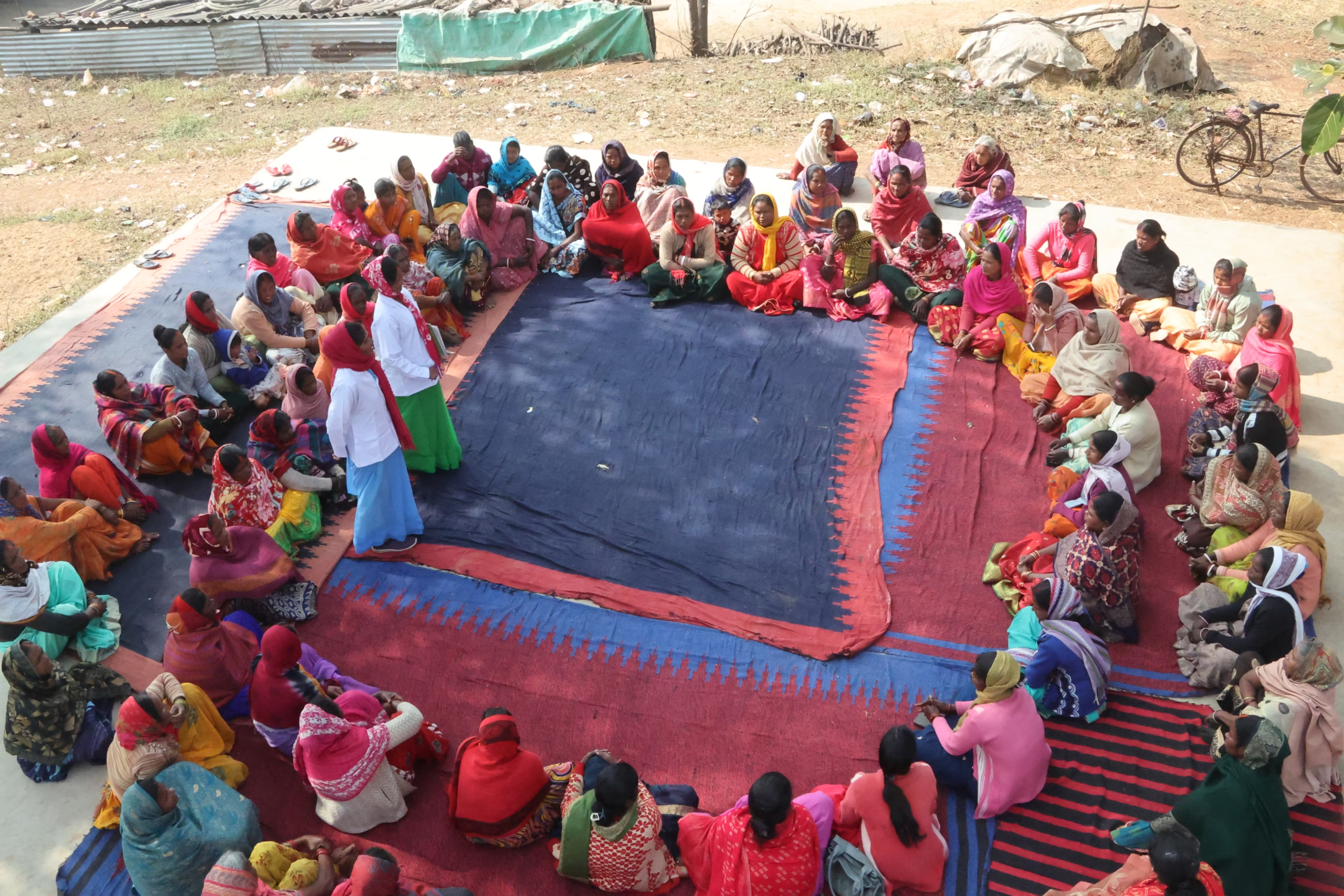
Participatory women’s groups for maternal and newborn health in South Asia offer one of the clearest examples. In a Lancet trial in rural India, newborn mortality was 30% lower in intervention areas than in control areas. Another Lancet study found that such groups reduced neonatal mortality by 30% in Nepal and 32% in rural India. Most strikingly, a later meta-analysis showed that where at least 30% of pregnant people participated, maternal mortality fell by 49% and neonatal mortality by 33%. Real engagement starts to matter most when participation becomes deep and widespread enough to influence how a community collectively acts.
What successful community engagement really depends on
Across very different settings, the same pattern keeps emerging. Community engagement works best when people have real influence, when trusted local leaders guide the process, when listening continues over time, when progress is made visible, and when participation is deep enough to change behaviour or improve services. These are not surface-level tactics. They are what make engagement credible and lasting.
If you found this blog useful and want more practical ideas on nonprofit communication and engagement, subscribe to our newsletter. We share reflections, case studies, and grounded examples to help organisations build stronger participation, trust, and long-term community relationships.