When Shafali Verma was growing up in Rohtak, cricket was already her dream. But the game came with a condition. The boys in her neighbourhood would not let her play if they knew she was a girl. So she cut her hair short. Only then was she allowed onto the field. Years later, as the youngest Indian cricketer to debut in T20 internationals, Shafali spoke openly about that choice. Not as a dramatic confession, but as a matter-of-fact memory of what it took for a girl to be taken seriously in a sport that India treats like religion.
Her story is not an exception. It is a reflection of how public spaces, playgrounds, and ambitions have long been gendered in this country. Even today, as women’s cricket finally gains recognition, many female athletes speak about being underestimated, discouraged, or outright denied access simply because they were girls. And yet, they persist.
This tension between restriction and resilience is exactly the world Vacha works within.
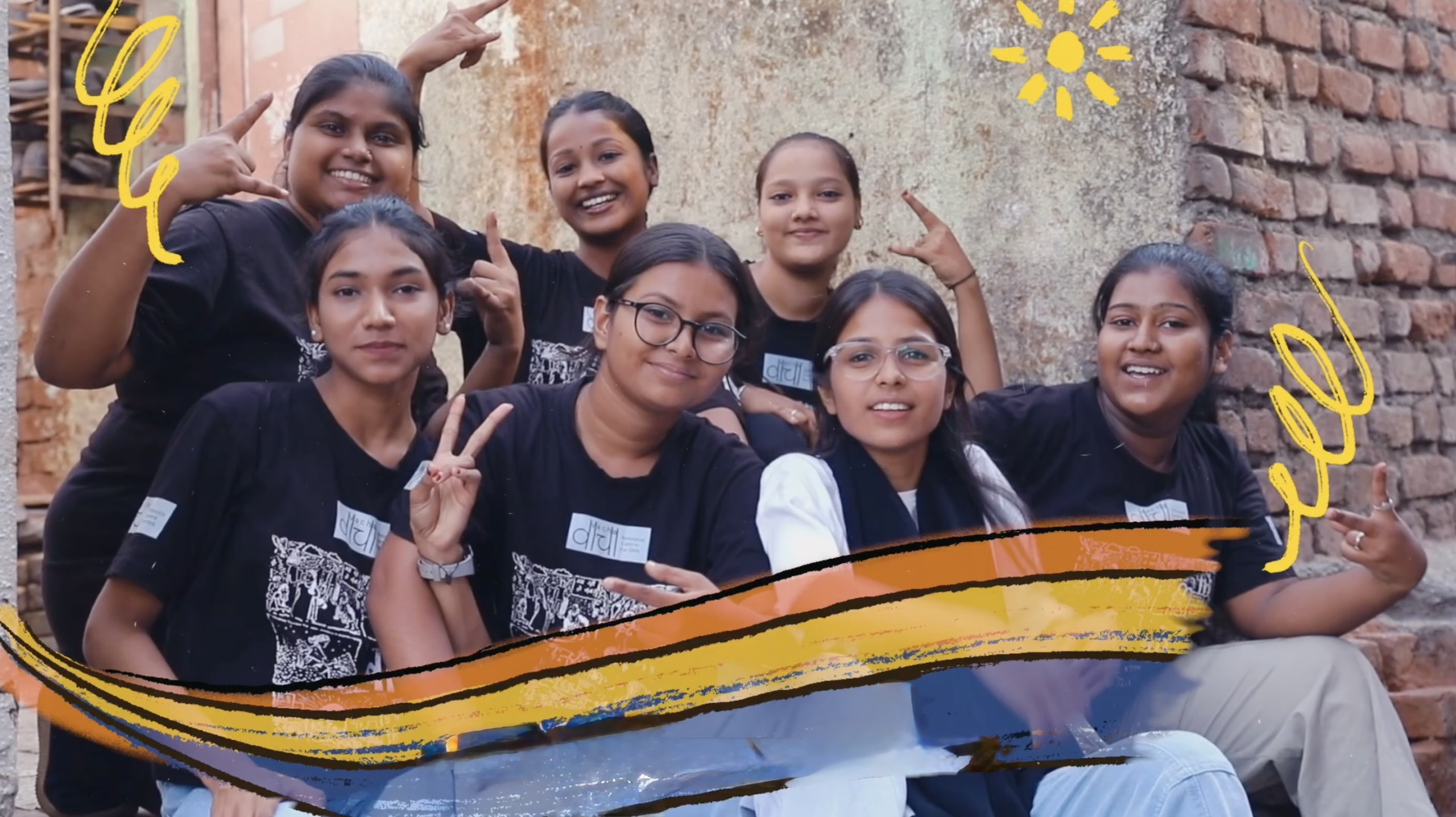
Vacha is a Mumbai-based organisation that has spent decades working with adolescent girls from under-resourced communities, focusing on education, life skills, safety, and confidence-building. Their work centres girls’ voices, not as future beneficiaries, but as present decision-makers. This was our second collaboration with Vacha, and for this film, the intention was clear. They wanted to show not just the challenges girls face, but the quiet, everyday ways in which girls are already rewriting the rules.
Also read: How Organisations Are Using Storytelling to Talk About Women Empowerment
The Brief and the Turning Point
It all started with a live-action movie. A thorough recce was done in a number of places in and around Mumbai, such as bastis in Kalyan and Bandra. The locations were narrowed down, the participants were chosen, the families were told, and the shoot was carefully planned to be respectful and realistic. The first cut stuck to that plan. But when we stepped back and watched it, something felt missing.
Animation entered the process not as a pre-planned device, but as an improvisation born from the edit.
The film was honest, but it risked becoming familiar. Like many well-meaning social sector films, it documented change without fully capturing how it feels to be young, hopeful, and defiant at the same time. The protagonists were girls, teenagers still forming their sense of self. Their world needed a language that felt closer to their imagination. That is when animation entered the process. Not as a pre-planned device, but as an improvisation born from the edit.
Why Live Action Alone Was Not Enough
We realised that certain emotions cannot always be filmed directly. Confidence. Aspiration. Inner resistance. These often live beneath the surface. Animation gave us a way to make those inner worlds visible without turning the film into something heavy or didactic.
Animation gave us a way to make confidence, aspiration, and inner resistance visible without turning the film into something heavy.
The approach was deliberately hand-drawn and playful. On-screen text appears early in the film, styled like bold quotations, making the girls’ words feel assertive and unmistakably theirs. These were not captions. They were declarations.
Small animated stars appear beside moments of choice or resolve, serving as visual punctuation. They subtly tell the viewer, this moment matters. Doodles of rainbows, suns, and swirling lines turn regular lanes and classrooms into places where anything can happen. The goal was not to escape reality, but to add meaning to it.
Also read: How NGOs Are Using Storytelling to Combat Domestic Violence
Reclaiming Public Space Through Design
One of the most telling sequences in the film shows girls playing cricket. In real life, many women athletes have spoken about being laughed at or ignored when they tried to play. In this scene, the background is intentionally expanded with an illustrated cheering crowd. It is a simple intervention, but a powerful one. It visualises a world where girls are watched, supported, and celebrated.
Similarly, when a girl rides a cycle, an illustrated helmet appears on her head. Safety is communicated without alarm. Strength is shown without aggression. In another moment, a superhero-style cape is drawn onto a girl’s back, reframing her not as someone overcoming odds, but as someone already powerful.
Safety is communicated without alarm. Strength is shown without aggression. We tried reframing her not as someone overcoming odds, but as someone already powerful.
Education scenes use metaphor to open the frame further. A globe held by a teacher sends an illustrated plane flying outward. A graduation cap appears on a girl studying on a laptop. These are not grand claims. They are gentle reminders that learning expands horizons.
Even impact numbers were treated with care. When the film states that Vacha has impacted over 50,000 lives since 2000, the number is bold, bright, and integrated into the frame beside a real girl standing confidently. The data never floats alone. It is always anchored in a human presence.
Why This Approach Mattered
This film was about more than technique. It was about not seeing girls as problems that needed to be fixed. We decided to show them as people who think, play sports, learn, and become leaders. Animation helped us meet them where they are, without diluting the seriousness of the issues they face.
Just as Shafali Verma once cut her hair to step onto a cricket pitch, countless girls continue to adapt themselves to fit a world not built for them. At Vacha, and through this film, the work is about changing that world instead.
If you are looking to tell stories that respect complexity, amplify lived experience, and use design with intention, we would love to collaborate.