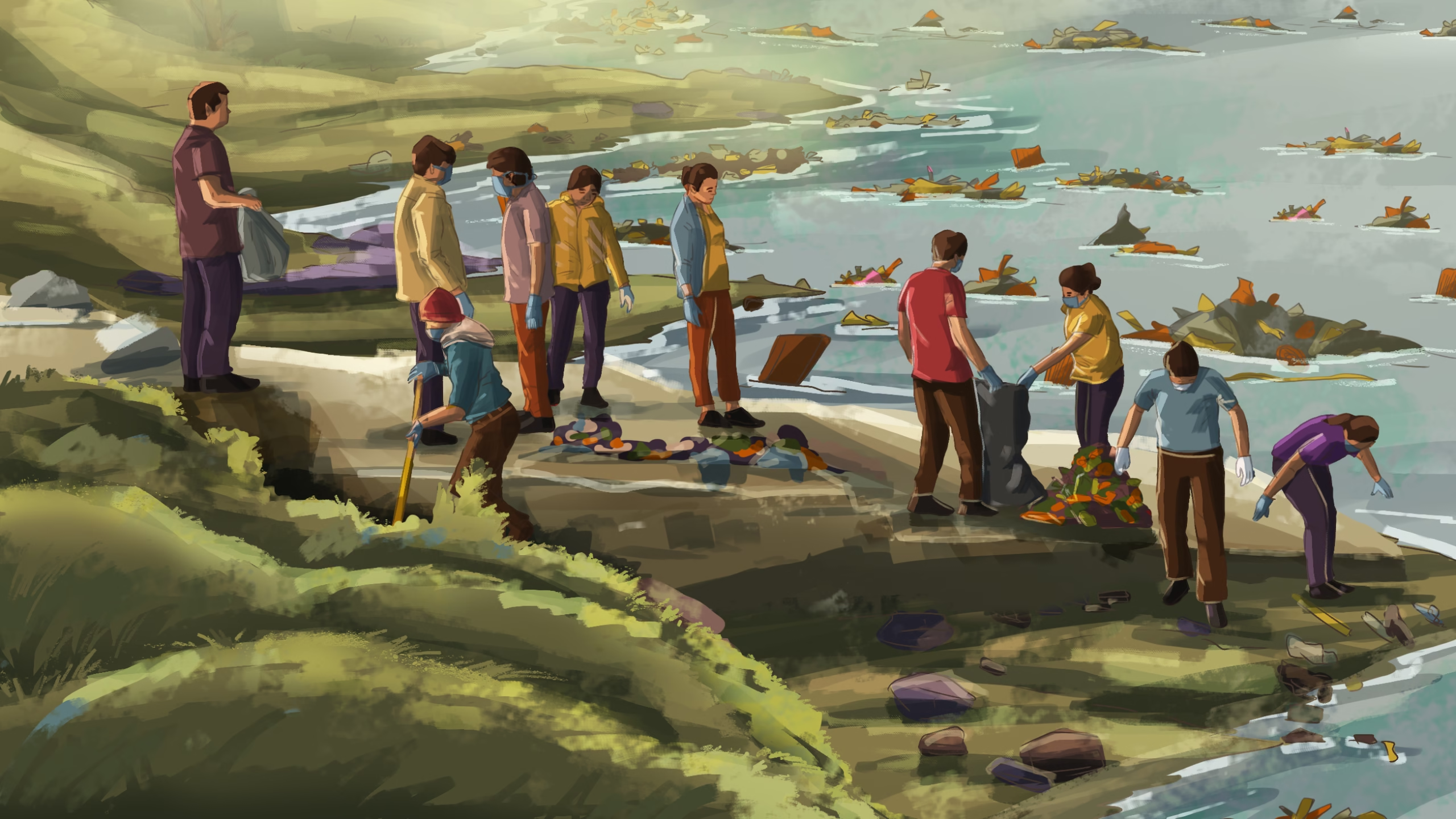
In Bundelkhand, a farmer once told journalist Roli Srivastava: “When I was young, I knew which corner the rain cloud would come from. For ten years now, that cloud has not appeared.” One sentence, full of loss, captured more than any chart on rainfall patterns could. After all, climate change is a lived reality. It is not just a collection of statistics. Moreover, it shapes daily choices, such as families leaving villages after yet another failed harvest.
In our Stories of Change podcast, Roli Srivastava, the co-founder of The Migration Story, spoke about how nonprofits must bring these lived experiences to the centre of their work. It’s not about forcing the word “climate” into every mission, but about connecting global crises to human struggles already unfolding on the ground. Storytelling, she argued, is the bridge. And across the environmental sector, NGOs are discovering this for themselves. From roadshows and art installations to viral films and comics, stories are pulling people closer to the climate fight. So, let’s look at five organisations that show how powerful storytelling can turn awareness into action.
1. Gaj Yatra: Taking Elephants on a Journey Through Stories
When the Wildlife Trust of India and the International Fund for Animal Welfare launched Gaj Yatra in 2017, they could have run another poster campaign about elephant conservation. Instead, they took elephants on the road, not live ones, but parades, life-sized sculptures, and community festivals that travelled across 12 states. At the heart of it was “Gaju,” a friendly elephant mascot who made the issue playful and personal, especially for children.
The campaign showed that storytelling, when embedded in local culture, can move both hearts and policy.
The genius of Gaj Yatra was how it blended culture with conservation. Local artists and school children created elephant-themed art; traditional performers carried the message into their own communities. What might have seemed like another wildlife appeal suddenly felt like a shared celebration. And the impact wasn’t just symbolic. Corridor mapping expanded from 88 to 101 identified routes, six of them already secured and two more underway; vital lifelines for more than 27,000 wild elephants. With thousands flocking to events like the Gaj Mahotsav in Delhi, the campaign showed that storytelling, when embedded in local culture, can move both hearts and policy.
2. Greenpeace Philippines: The “Dead Whale” That Shocked the World
In 2017, people strolling along Manila Bay were stunned by what looked like a 15-metre decomposing whale washed ashore. Some thought it was real. In truth, it was Greenpeace Philippines’ “Dead Whale,” an installation built entirely out of plastic waste with the help of ad agency Dentsu Jayme Syfu.
The shock was deliberate. By mimicking the tragic sight of whales dying from ingested plastics, a grim reality underscored by an actual whale in Davao that had swallowed 40 kilograms of plastic, the piece turned a data-heavy issue into a gut punch. Its timing was equally sharp: launched during the ASEAN Summit, when regional leaders were in the spotlight.
The “Dead Whale” proved that art, staged well, can turn pollution into a global reckoning.
The result? Within a day, 3,000 people had signed a petition. Media coverage spread across Southeast Asia and beyond, generating over 1.5 billion impressions. Awards followed, but more importantly, so did conversations in homes, classrooms, and political offices. The “Dead Whale” proved that art, staged well, can turn pollution into a global reckoning.
3. Conservation International: When Mother Nature Speaks
What if nature spoke back? That question shaped Conservation International’s “Nature Is Speaking” films, launched in 2014. Instead of policy jargon, they used star power: Julia Roberts as Mother Nature, Harrison Ford as the Ocean, Reese Witherspoon as Home. The casting wasn’t gimmick, it was strategy. Familiar voices drew audiences in, and the lines they spoke landed hard: “Nature doesn’t need people. People need nature.”
Numbers and reports had been saying it for years, but a line spoken in Julia Roberts’ voice reached people in a way statistics never could.
It sounds simple, but it worked. In 2015, Conservation International ran a #NatureisSpeaking social media drive where 1 million hashtag uses unlocked a $1 million donation from HP for its Earth Insights partnership. They succeeded and the films found their way into schools, boardrooms and even parliaments. For once, forests and oceans weren’t treated as abstract ecosystems; they became characters with their own voices and agency.
By blending cinematic storytelling with cultural influence, Conservation International reframed conservation as a story of survival rather than charity. Numbers and reports had been saying it for years, but a line spoken in Julia Roberts’ voice reached people in a way statistics never could.
4. Comics: Turning Environmental Justice into Illustrated Stories
Some issues are too complex for reports and too dry for speeches. That’s where comics step in. In 2012, law professor Rebecca Bratspies and artist Charlie LaGreca created Mayah’s Lot, part of the Environmental Justice Chronicles. It told the story of Mayah, a young Black girl who rallies her neighbours to block a toxic waste facility.
Illustrated storytelling can make environmental justice not only understandable but empowering, especially for young readers.
What made Mayah’s Lot powerful wasn’t just the plot. Students in New York helped shape the story, adding metaphors like the aspen seed for resilience and even fantasy sequences. It was civic education dressed as a comic book, showing how to attend council meetings, use environmental data, and fight back. In Queens schools, about 200 children piloted the workshops and soon state agencies and even the UN Environment Programme were supporting expansions.
Comics like Rewriting Earth and Odyssey 2050 carried the medium global, raising awareness and even funding land protection. The lesson? Illustrated storytelling can make environmental justice not only understandable but empowering, especially for young readers.
5. Rainforest Alliance: Asking the World to “Follow the Frog”
Not every campaign needs shock or solemnity. The Rainforest Alliance leaned on humour and a little green frog. Their film Follow the Frog, directed by Max Joseph, lampooned the fantasy of dropping everything to “save the rainforest.” Viewers followed a hapless man through a wild, disastrous adventure before the narrator cut in: you don’t need to do all this. You just need to buy Rainforest Alliance Certified products.
A playful story had become a worldwide shorthand for sustainable choices.
The punchline landed. The three-minute video soared past 5 million YouTube views. From there, Follow the Frog grew into an annual global campaign. Toolkits were provided to brands, everyday consumers became engaged through social media challenges, and partnerships with outlets like The Guardian expanded reach.
As of 2022, that frog seal had spread to 54,000 certified products involving 6,000 companies and four million farmers in 60 countries. A playful story had become a worldwide shorthand for sustainable choices.
Why NGOs Must Keep Storytelling at the Heart of Climate Action
Put these stories side by side, elephants journeying across corridors, a whale made of plastic, Julia Roberts giving voice to Mother Nature, a girl saving her community through comics, and a frog guiding consumers towards change, and a simple truth emerges. Numbers are important, but on their own, they rarely move people. Stories do.
Numbers are important, but on their own, they rarely move people. Stories do. Tell stories people can feel, and action will follow.
As Roli Srivastava reminded us in our Stories of Change podcast, climate change is lived in villages, homes, and fields long before it’s debated in boardrooms. NGOs that place these voices at the centre of their work make their missions stronger, not narrower. By mixing data with narrative, they turn abstract crises into personal truths, and give communities the chance to see themselves as part of the solution.
For nonprofits everywhere, the lesson is both urgent and hopeful: tell stories people can feel, and action will follow. You can listen to the full conversation with Roli in our Stories of Change podcast.
Want more real-world examples like these, plus practical ideas on how your NGO can craft campaigns that move hearts, build trust, and deepen donor engagement?
Subscribe to our newsletter. Each edition is packed with lessons on powerful storytelling, ethical communications, and ways to turn your mission into real, measurable change.