One morning in Copenhagen, Ole Kassow noticed an elderly man sitting alone by the roadside. The city moved past him in a rush of cyclists heading to work, but he stayed still, watching each passing bike as if following a memory. Ole found himself wondering if this man had once cycled those same streets, if he could still recall the feeling of the wind in his hair.
That simple moment grew into a much bigger question. What could change if older people were invited to share their stories again? In a world where 1 in 4 older people experiences social isolation, as the World Health Organization notes, many non-profits are now trying to bring seniors’ voices back to the centre.
So where do you begin? How can non-profits use stories not just as a tool, but almost like a lifeline that brings dignity, connection and meaning back to the people who carried us this far?
1. Creating Safe Spaces for Shared Memories
One strong way to bring seniors’ stories forward is to create spaces that feel like home. Places where every memory is welcome, no matter how small or how far back it goes.
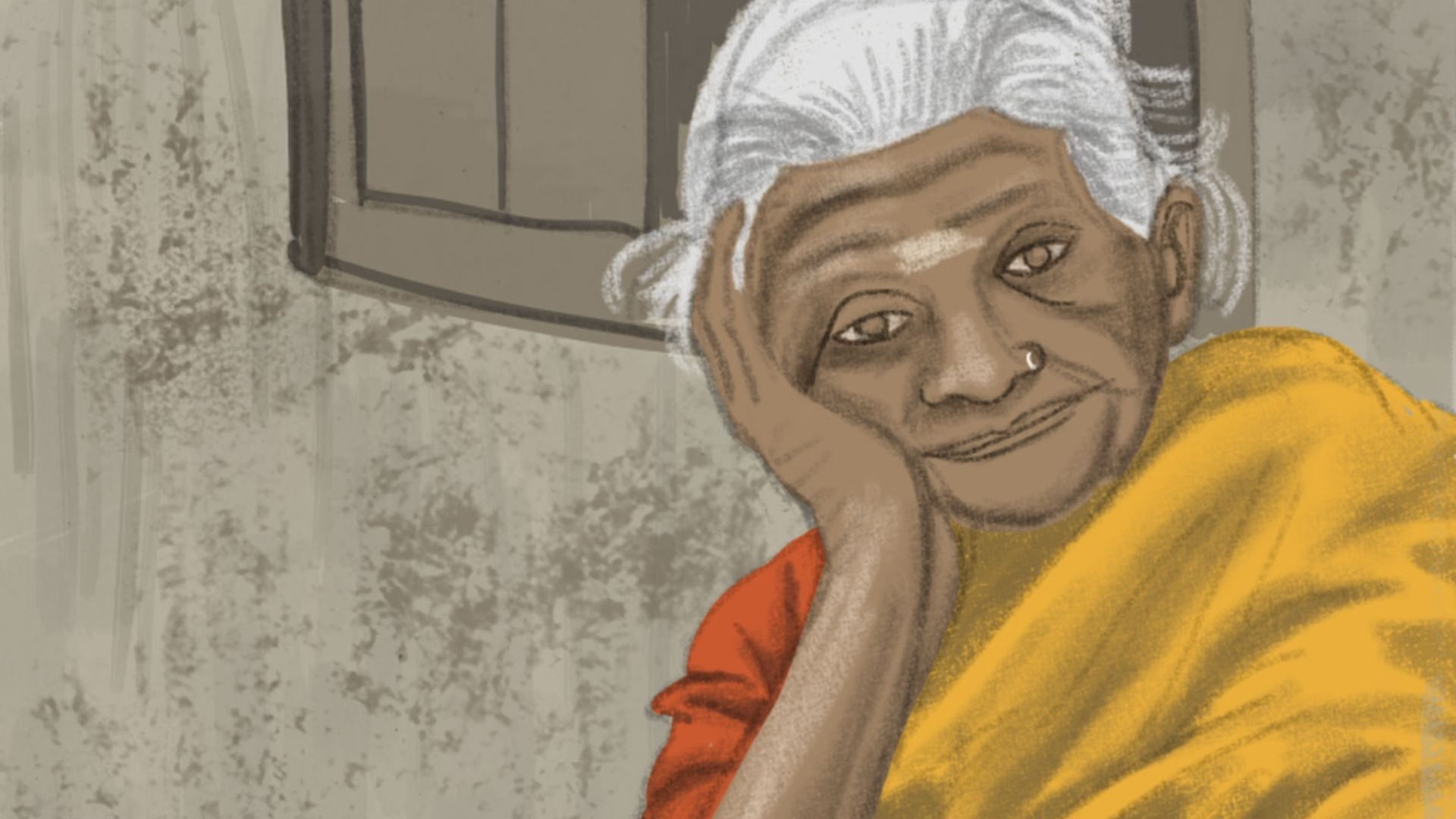
Addaghar in Guwahati, India, does this with a lot of warmth. Meenaxi Barkotoki started it, and it’s a warm, inviting place. Seniors gather there twice a week, sharing stories, laughter, and tea. It is more than a club. It feels like a small sanctuary where the quiet loneliness of empty rooms is slowly replaced by voices and companionship.
Addaghar is a sanctuary where the quiet loneliness of empty rooms is slowly replaced by voices and companionship.
Addaghar’s way of working is simple. Offer a room, a cup of tea and someone who is ready to listen. During the pandemic, it was the seniors who reached out to Meenaxi and asked her to reopen, because their shared laughter and memories felt too precious to let go. In that room, they feel seen again, part of a living community that still values their stories.
This kind of work does not rely on big budgets or special equipment. It is about being present. It is about treating the details of an ordinary life as something worth honouring. And it is an approach any non-profit can shape for its own context, whatever the scale or budget.
2. Turning Everyday Experiences into Living Stories
Another way non-profits connect with older people is by turning familiar activities into shared journeys of memory and conversation.
Cycling Without Age, started in Denmark in 2012, brings this idea to life through trishaw rides that take seniors out of care homes and back into the streets they once knew. Volunteer pilots pedal slowly through old neighbourhoods, and as they ride, seniors start talking about the places, people and moments tied to each turn.
Cycling Without Age brings the idea of taking seniors out of care homes and back into the streets they once knew.
The effect of these rides has been studied. A 2018 study in Spain found that seniors “felt more motivated and happy” after the rides. In Singapore, a 2019 study showed a 60% improvement in mood and outlook after just five trips. These are not just outings. They are gentle trips into memory, held together by fresh air, conversation and attention.
Cycling Without Age also shows that you do not always need a large budget to make a deep impact. By turning a simple ride down a familiar road into a space for stories, non-profits can help seniors feel like the main characters in their own lives again.
3. Using Letters to Bridge Distances and Loneliness
Today, most messages are typed and sent in seconds, so a handwritten letter can feel like a small gift. Love For Our Elders in the United States leans into this feeling, using simple letters to gently close the distance created by loneliness and isolation.
Founded by Jacob Cramer in 2013, the initiative has sent more than 750,000 handwritten letters to seniors around the world. Each envelope carries more than ink. Each letter quietly says that someone, somewhere, paused in their own day to care.
Each letter quietly says that someone, somewhere, paused in their own day to care.
When visits were limited or stopped altogether during the COVID-19 pandemic, these envelopes became small windows to the outside world. A lot of seniors said the notes gave them hope and comfort and reminded them that people still cared about them.
For non-profits, this is a soft reminder that connection does not always need a big campaign. A pen, a sheet of paper and a few honest lines can bring back the feeling of being remembered.
4. Turning Pain into Purpose through Advocacy
Some stories are hard to hear, but saying them out loud can be the first step towards change and healing. HelpAge India, among others, employs storytelling to illuminate the harsh truths of elder abuse and neglect.
Their #MainBhiHoon campaign lifts up the voices of older women who have been ignored or mistreated and makes it clear that they deserve respect, safety and care.
HelpAge India’s #MainBhiHoon campaign lifts up the voices of older women who have been ignored or mistreated.
In 2018, a HelpAge India intern shared the story of a mother who was pushed from a rooftop by her son because she was seen only as a dependent. The story was shocking, and it reached thousands of young people. It opened up conversations about responsibility, kindness and how elders are treated within families.
By sharing these stories, HelpAge India does more than raise awareness. It gives seniors a platform to speak and invites younger people to listen. In this way, painful experiences are turned into strong calls for change, so that fewer older people are left feeling invisible.
5. Using Movement and Music to Unlock Stories
Not every story comes out in sentences. Some are held in bodies, gestures, songs and shared laughter. In Minnesota, Kairos Alive! combines dance and storytelling to help older adults reconnect with their bodies and memories.
Their intergenerational dance halls bring seniors, children and caregivers into the same space to move together. A quiet care home room becomes a place filled with music, clapping and small moments of joy.
Not every story comes out in sentences. Some are held in bodies, gestures, songs and shared laughter.
A study by St. Catherine University found that these sessions helped improve balance and memory among seniors, which is particularly important for frail residents. Beyond the numbers, there is something else that matters just as much. With every shared step, older people reclaim a part of themselves, their rhythm and their story.
Stories That Build Bridges Across Generations
Taken together, these five examples show that storytelling is more than a communication tool. It is a bridge. It brings seniors out of the corners of loneliness and back into circles of connection.
Each of these organisations also shows that you do not always need expensive technology or complex setups to make a difference. With patience, creativity and a willingness to listen, stories can grow in very simple spaces.
If you care about building a world where every older person feels heard and valued, it might help to pause and ask yourself: what kind of bridge can you build in your own community?
And if you would like to keep learning how stories can nudge the world towards a kinder place, you can subscribe to our newsletter for real-life examples, research and small, practical ways to put storytelling to work.