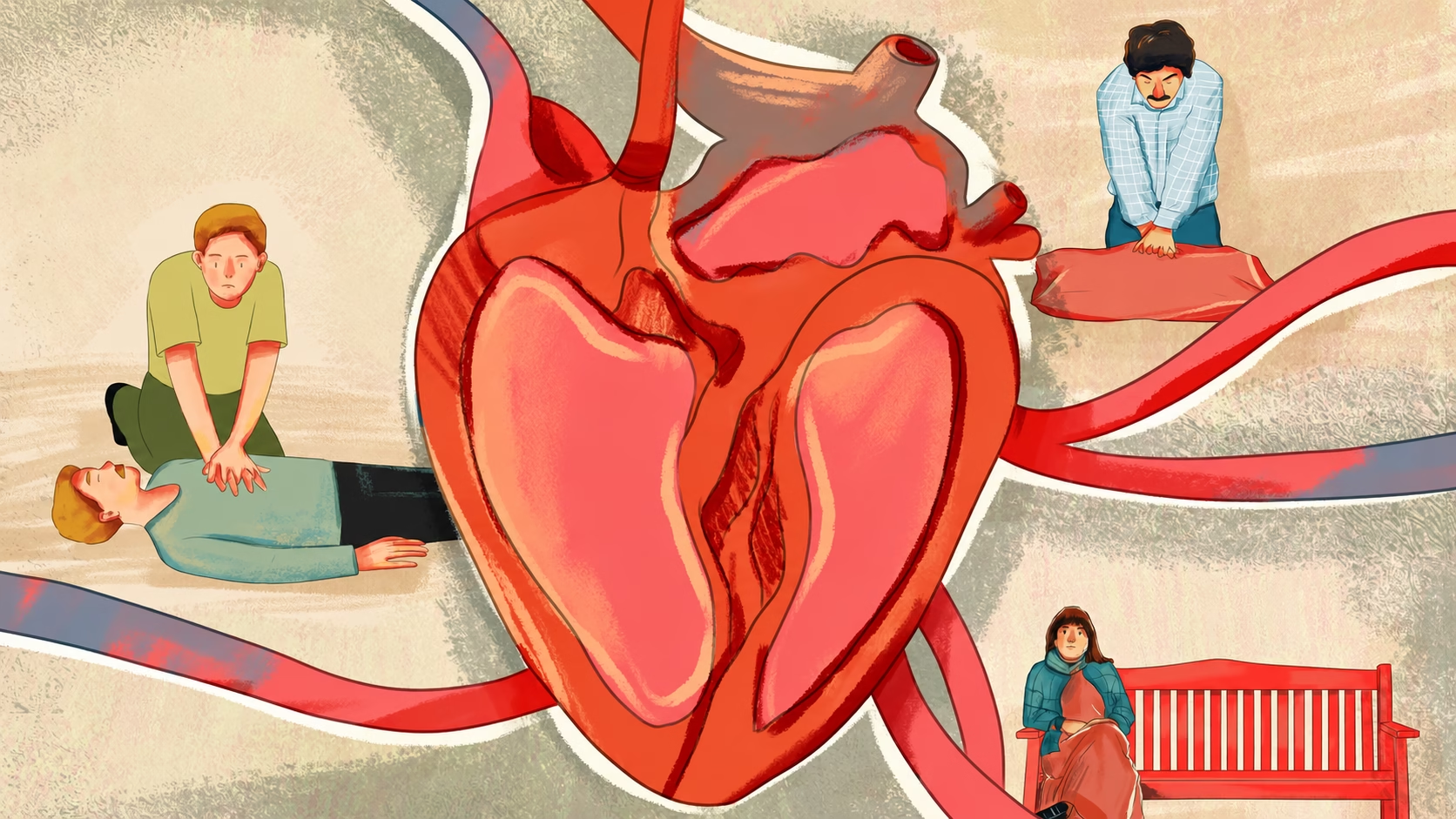
Sharon Shankster and Noura Mehdinejad were estate agents, not paramedics. When a man named Jerry Fitzgerald suffered a heart attack, the two of them started chest compressions and sang “Stayin’ Alive” to keep the rhythm. They had learnt how from a television advert starring former football hard man Vinnie Jones.
Neither of them had been on a first-aid course. What they had was a disco song and a 40-second ad that had lodged itself in their heads.
That, in a nutshell, is how the British Heart Foundation works.
Heart disease is mostly invisible. It sits quietly in arteries and genes until, without warning, it does not. For six decades, BHF’s job has been to make that invisible threat into something people can hear, watch, laugh at, practise and walk past on their way to work. Its best campaigns do not explain heart disease so much as stage it.
The scale of the organisation depends on that skill. In 2024-25, BHF reported £181 million in total income after retail costs, including £166.6 million in fundraising income. Gifts in wills were the single largest source at £108.4 million, and corporate partnerships added £12.4 million. In the same year, it awarded £108.4 million in research grants, backing 717 active projects and 1,220 researchers and PhD students.
A charity funded that way needs communications that do three jobs at once: make complicated science feel worth paying for, persuade people to give, and teach ordinary people what to do in the four minutes after someone collapses. Here is how it has done that, campaign by campaign.
2004: Fat, dripping from a cigarette
BHF’s early reputation was built on shock. In 2002, one of its ads, showing a woman with a plastic bag over her head, drew more complaints than any other ad that year, according to the Advertising Standards Authority.
Two years later came “Give Up Before You Clog Up”. The TV ad showed fatty deposits being squeezed out of a 32-year-old smoker’s artery, then cut to people in a pub brushing fat off their clothes as it dripped from their cigarettes. The idea was to fuse two images in a smoker’s mind: the cigarette tube and the clogged artery.
One unforgettable image beats a page of statistics.
It worked uncomfortably well. An independent evaluation found 94% of smokers recognised some part of the campaign, and 90% remembered the dripping-fat ad specifically. BHF’s smoking helpline took more than 12,000 calls. BHF later estimated that more than 14,000 smokers quit as a direct result.
2008: An appointment to have a heart attack
The next problem was a myth that Hollywood had built. On screen, heart attacks look like a man clutching his chest and falling over. In reality, symptoms can be vague, and people die because they wait too long to call the emergency helpline number.
BHF’s answer was “Watch Your Own Heart Attack”, a two-minute film starring Steven Berkoff that showed what a heart attack actually feels like, first aired on ITV1 on 10 August 2008. Berkoff warned viewers that symptoms could be mistaken for a sports injury or indigestion.
BHF had turned an ad break into an event people tuned in for.
The media plan was as clever as the film. It ran as the only advert in a commercial break during Midsomer Murders, with people able to sign up for text or email reminders so they would not miss it. It drew 6.5 million viewers, more than the 6.1 million who watched the episode it interrupted.
2010: Making women laugh about Angina
Coronary heart disease was the biggest killer of women in the UK, yet women saw breast cancer as the bigger threat. Another scary ad risked being tuned out.
So BHF went the other way. For its first campaign aimed at women, it staged a comedy show hosted by Victoria Wood called The Angina Monologues to raise awareness of heart disease amongst women. It played at the Theatre Royal Haymarket in London on 5 December 2010, with live screenings in 30 Vue cinemas. It reached 1.3 million Sky viewers, and 440,000 DVDs of the show went out with Woman’s Weekly around Mother’s Day.
2012: Vinnie
Then came the campaign that defines BHF to this day. The Hands-Only CPR film, made by Grey London, cast Vinnie Jones telling viewers to call 999 and push hard and fast in the centre of the chest to the rhythm of “Stayin’ Alive”.
The song was not a gimmick: it has a tempo of about 100 beats a minute, close to the recommended rate of compressions. Jones’s hard-man persona made the instruction feel like an order rather than advice, and the song became soundtrack, metronome, memory aid and dark joke all at once.
Within four weeks, the campaign reached 86% recognition and raised the share of people likely to perform hands-only CPR from 54% to 71%. An IPA case study later linked it to 30 documented saved lives and an estimated £48.5 million in societal value.
BHF did not let it fade. A follow-up featured “one Vinnie saved earlier”: survivor Alan “Lucky” Linton, alongside a new training film, Mini Vinnie, aimed at children. Linton put it simply: “I’m here today because of Vinnie Jones, the Bee Gees and Hands-only CPR.”
Nine years later, the campaign proved it could return at a moment’s notice. When Denmark’s Christian Eriksen collapsed on the pitch at Euro 2020, BHF had no ad and no media budget. Working with ITV, it placed a 40-second spot before a later match, timed for when pundits were likely discussing Eriksen, with Vinnie Jones on voiceover. It went out just 72 hours after the idea was conceived. 1.6 million people saw it live, and it created 58,000 more potential lifesavers.
2022-23: Science, sold as wonder
CPR is something you can do today. Research is a promise about a future most donors will never see, and that is a much harder thing to sell.
In January 2022, BHF and Saatchi & Saatchi launched “This Is Science”, which framed BHF research as turning science fiction into reality. The film, voiced by Cillian Murphy, opens on a young boy with a large scar on his chest getting ready for school. The scar is the proof: this child is alive because something that once sounded impossible became routine.
The donor is not asked to pity illness. They are invited into the discovery.
The 2023 sequel went further. In “The Greatest Treasure”, again narrated by Murphy, a woman named Libi wakes up inside her own heart, reimagined as an electric landscape developed with advice from BHF experts. Its bespoke score was built around a heartbeat that briefly turned irregular before settling.
2022 and 2024: The flatline trick
BHF’s most distinctive move is to make the medium itself suffer a cardiac arrest.
On 1 August 2022, listeners to the Heart radio network heard ads from brands including Sainsbury’s, Admiral Insurance and Dunelm suddenly cut off by a beeping heart monitor that flatlined. The stunt marked BHF’s largest-ever single research grant: £30 million to CureHeart, an international team working on gene therapies for inherited heart muscle diseases. Getting seven unrelated advertisers to let a charity “kill” their ads was its own feat.
It reached an estimated 3.5 million listeners, lifted BHF homepage visits by 8.2%, and raised both understanding of BHF’s work and consideration of donating by 22%.
Two years later, BHF did it to the most famous theme tune on British television. On 27 October 2024, after Coronation Street’s Gail Platt had a cardiac arrest, the show’s end-credits music was cut by the sound of a flatlining heart and a BHF message. From sign-off to broadcast took four days. BHF searches rose 44% afterwards, and website donations around the broadcast rose 7%.
2024: One letter, twelve murals
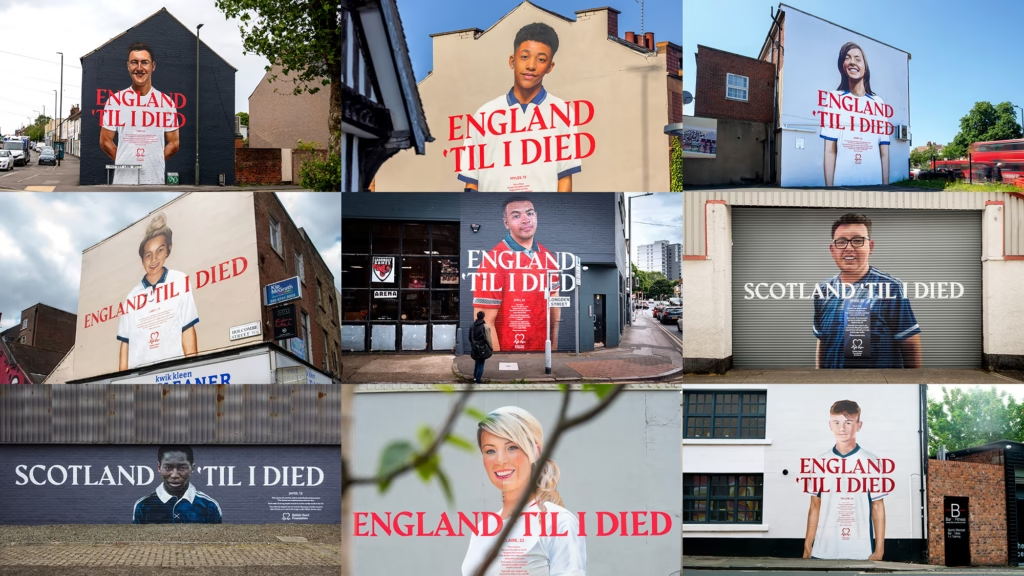
Ahead of UEFA Euro 2024, BHF took a supporter’s vow of loyalty, “‘Til I Die”, and put it in the past tense.
“‘Til I Died” launched with 12 hand-painted murals, each in the hometown of a young football fan who had died of heart disease, in cities including Birmingham, Cardiff, Edinburgh, Glasgow and London. The number was not arbitrary. BHF estimates that 12 people under 35 die suddenly in the UK each week from an undiagnosed heart condition.
The murals were of real people. One, in Hammersmith, showed Libbey Peverall from West Drayton, an aspiring beautician and football fanatic, wearing an England shirt. Another, in Chesterfield, remembered Tom Henson, a promising footballer who died at 23 after a cardiac arrest while playing with friends.
A single letter turned a chant into evidence of a life cut short.
The campaign generated more than 300 pieces of coverage, an estimated earned reach above 595 million, a website traffic rise of over 1,000% and more than £735,000 raised within weeks. Saatchi & Saatchi later took it to the Euro 2024 final in Berlin.
2024 onwards: Borrowing football’s clock
If “‘Til I Died” used football to mourn, “Every Minute Matters” used it to mobilise. The partnership between BHF and EFL sponsor Sky Bet launched in May 2024, built on a stark fact: every minute without CPR and defibrillation cuts a person’s chance of survival by around 10%.
So football gave up a minute. All three EFL play-off finals at Wembley in May 2025 kicked off one minute late, and in February 2026, 36 Championship, League One and League Two fixtures did the same. The campaign pointed fans to RevivR, which can teach CPR in roughly the length of a 15-minute half-time, and Sky Bet donated for every goal scored across selected fixtures.
BHF reports that the partnership donated £3 million in its first year, helped more than 500,000 people start learning CPR and funded 220 community defibrillators.
The plumbing behind the ads
None of these campaigns would matter much if a frightened bystander had nowhere to go next. That is why BHF has quietly built the infrastructure that turns attention into action.
The ads create the impulse. RevivR and The Circuit make sure it has somewhere to land.
RevivR, launched in 2022, is a free online tool that teaches CPR in as little as 15 minutes using only a phone and a cushion, with real-time feedback on compressions. The Circuit, built by BHF and partners, is the UK’s first national defibrillator network: a live database that syncs every 60 seconds with every UK ambulance service’s dispatch system. Since 2022, every ambulance service has been connected, so 999 call handlers can direct bystanders to the nearest registered defibrillator.
2026: Benches for the living
For its 65th anniversary, BHF flipped one more convention. Memorial benches mark a death. “In Living Memory” installed 65 red benches, each bearing the name of someone alive today because of BHF-funded treatments or research, and meant to stay in place for at least five years.
The stories are local and specific. Bristol’s bench, on Narrow Quay, is in living memory of eight-year-old Ivy Lloyd. In Malvern, one honours Clint Heaton, 57, at the hospital where he had a heart transplant in October 2023. Emma Willis met survivors for television, online and social storytelling around the campaign.
The playbook
Line up twenty-two years of BHF work and the method is remarkably consistent.
Borrow something people already own. A disco song, a soap opera, a radio ad break, a football chant, a kick-off time, a park bench. BHF rarely invents a new symbol. It works around a familiar one.
Change one thing about it. A cigarette that drips fat. A tune that flatlines. A chant missing a tense. A bench for the living. The smaller the change, the bigger the jolt.
Make the medium act out the message. The radio ad has a cardiac arrest. The match starts a minute late. The ad break becomes the event. The audience does not just learn about interruption; they experience it.
Always give people a CTA. Call 999. Push to the beat. Learn CPR in 15 minutes. Register a defibrillator. Donate to research. Emotion without an action fades; BHF almost never leaves it there.
Build the pipes. Awareness is cheap if nobody can act on it. RevivR and The Circuit are the unglamorous reason the glamorous work pays off.
For us, the lesson is that science and storytelling are not a trade-off. Research becomes easier to understand, and easier to fund, when it is attached to rhythm, interruption, ritual and a single person’s story, and when the audience is handed a clear part to play.
Sharon Shankster and Noura Mehdinejad did not need to understand cardiology. They needed a song, and the confidence to sing it.