In a dusty village outside Kanpur, a woman once bound by poverty now sorts fragrant marigold petals, transforming what was once temple waste into a livelihood; in rural Tamil Nadu, a barefoot grandmother performs cataract surgery with the precision of a seasoned eye doctor; in a remote Rajasthan hamlet, a farmer watches a video, in her own dialect, on how to double her yield without chemical fertilisers. These are not stories from another world. They are happening right here, led by communities who dared to reimagine old problems through new, localised solutions.
Across India, grassroots innovation is proving that scale doesn’t always start in boardrooms. It starts in backyards, with people who see a need, craft a frugal solution, and then pass it forward. Whether it’s tackling healthcare inequity, menstrual shame, or agricultural knowledge gaps, these five community-rooted initiatives show us that lasting impact grows from the ground up.
1. Restore Vision at Scale: Aravind Eye Care System (Tamil Nadu)
What if hospital care could be delivered like McDonald’s delivers burgers, fast, efficient, consistent? That was the radical idea behind Aravind Eye Care, founded in 1976 by Dr G. Venkataswamy in Madurai.
Today, Aravind is the largest eye care provider in the world, having conducted over 9.4 million surgeries and 84.5 million outpatient consultations. Most patients receive care for free or at heavily subsidised rates. The system performs around 240,000 surgeries annually, accounting for nearly 40% of all cataract surgeries in Tamil Nadu.
Aravind has conducted over 9.4 million surgeries and 84.5 million outpatient consultations.
Their innovation? A high-volume, low-cost surgical model inspired by assembly-line efficiency. Through Aurolab, their in-house manufacturing unit, Aravind produces intraocular lenses at one-tenth the global price, now exported to 160 countries. Quality hasn’t been compromised; Aravind’s infection rates remain below international norms.
This isn’t just healthcare. It’s a people-first, systems-thinking revolution in rural medicine.
2. Transform Waste into Dignity: HelpUsGreen / Phool (Kanpur)
Each day, India’s temples discard thousands of kilos of flowers into the Ganges. In 2015, a startup in Kanpur turned this waste into wealth.
HelpUsGreen (also known as Phool) now collects over 2.4 tonnes of floral waste daily from temples and mosques. So far, it has diverted over 21,060 metric tonnes of waste from rivers—converting it into charcoal-free incense sticks, compost, and biodegradable packaging.
Phool has diverted over 21,060 metric tonnes of waste from rivers.
But the deeper story lies in its workforce: over 100 marginalised women are employed, many of them previously in manual scavenging. Income for these women has risen six-fold, and their work has received global recognition.
With US $1 million in raised investment and a growing export market, Phool is proof that circular economy models rooted in local context can clean rivers, lift lives, and honour faith in one breath.
3. Let Farmers Tell the Story: Digital Green (Rajasthan & Beyond)
Not all revolutions require satellites or AI. Sometimes, they need a handheld camera and a good neighbour.
Digital Green, born out of Microsoft Research in 2006, empowers farmers, especially women, to record and share low-cost, hyperlocal videos in their own dialects. These videos cover everything from composting to water-saving techniques, creating trust and adoption that top-down schemes often lack.
Digital Green empowers farmers, especially women, to record and share low-cost, hyperlocal videos in their own dialects.
Active in over 2,000 villages across seven states, Digital Green has reached over 150,000 farmers, with 70% participation by women. Their Loop app, piloted in Bihar and Odisha, connects smallholders with urban markets, boosting incomes by reducing dependency on middlemen.
At its core, Digital Green combines community storytelling and technology, amplifying indigenous knowledge, digitising peer learning, and keeping the farmer front and centre.
4. Light by Learning: Barefoot College (Rajasthan & Global)
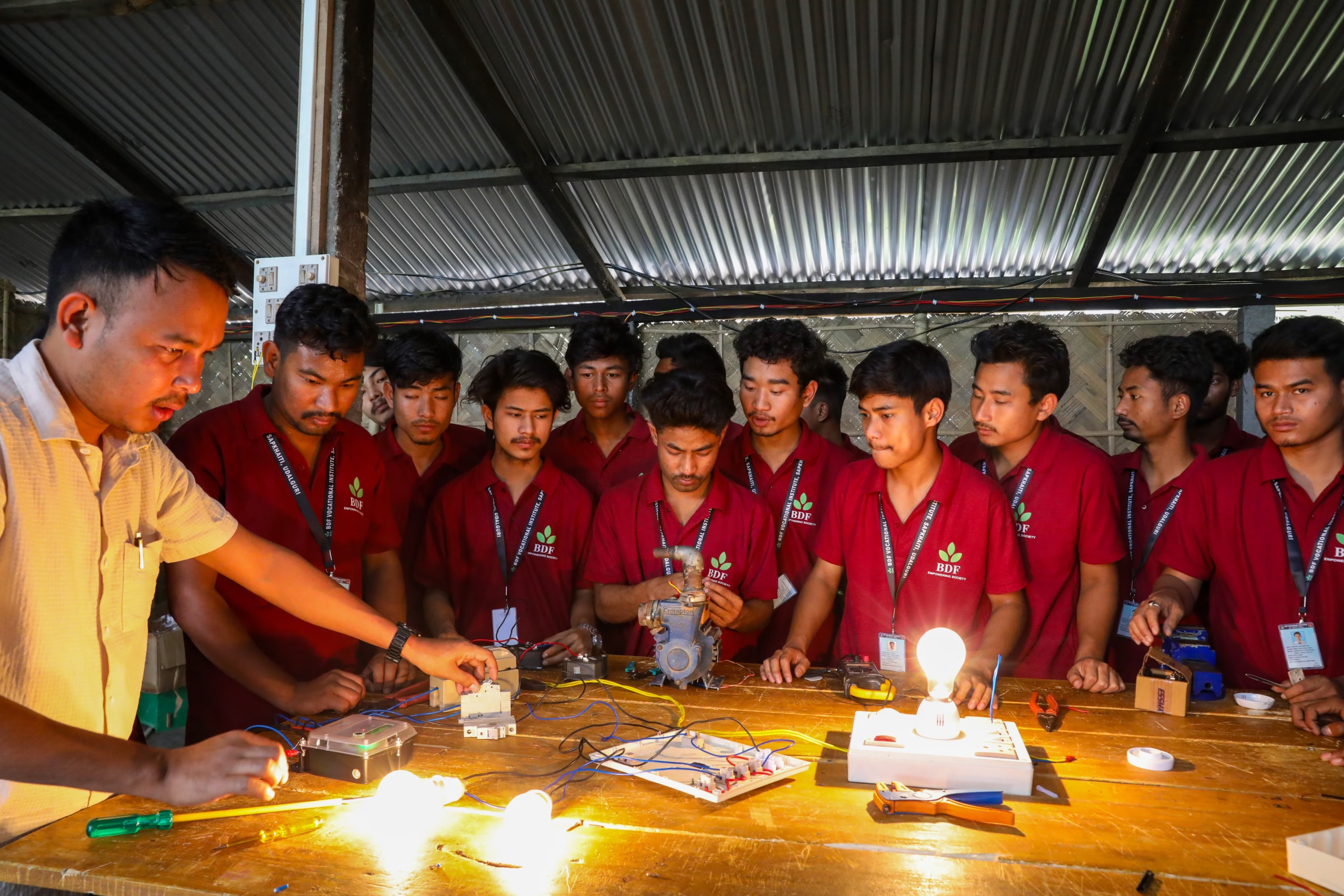
In a remote part of Tilonia, Rajasthan, a woman who cannot read or write is assembling a solar panel. Next week, she will electrify her entire village. No engineers, no degrees, just local knowledge passed from woman to woman.
Barefoot College, founded in 1972 and formalised as a solar training institute in 2004, has trained over 15,000 rural women across India and 96 countries, benefiting nearly 500,000 people through clean energy, education, and water programmes.
Barefoot College has benefitted nearly 500,000 people through clean energy, education, and water programmes.
Their solar programme alone saves 2 million litres of kerosene per year in India. Women, many grandmothers, are trained as solar engineers, health workers, and artisans. The method is radical in its humility: “We believe the solution exists in the village,” says founder Bunker Roy.
The model isn’t about upliftment from above, it’s a rising from within.
5. Dignify Menstruation, Sustainably: Eco Femme (Auroville, Tamil Nadu)
When Eco Femme began in 2009, the goal was simple: make menstruation waste-free, stigma-free, and woman-led. Today, the movement is global.
Eco Femme has distributed over 1.4 million cloth pads, preventing more than 104 million disposables from entering landfills. Their Pad for Pad initiative, donating one pad to an Indian girl for every one sold globally, has reached 80,000+ adolescent girls, while 240,000+ women have benefitted through education and access programs.
Eco Femme has distributed over 1.4 million cloth pads, preventing more than 104 million disposables from entering landfills.
Their model blends commerce, communication, and community training. Sales from the global market fund rural education sessions, delivered by trained women facilitators across 21 Indian states. Their 2022 annual revenue was ₹11.5 crore (~US $1.4 million), showing that sustainable menstruation can be financially viable too.
When local women lead the dialogue, shame is replaced with knowledge, and disposable culture with dignity.
From Rural Roots to Scalable Solutions
From sight-restoring surgeries in Tamil Nadu to biodegradable incense crafted in Kanpur, these five grassroots innovations show that some of India’s most pressing challenges- healthcare, sanitation, waste, livelihoods, and climate- are being addressed not just in labs or incubators, but in workshops, homes, and panchayats.
Each of these stories is a reminder that big change does not always begin with big budgets. Sometimes, it starts with a flower, a cloth pad, a handheld camera, or simply a belief that the answers already exist within our communities.
Want More Stories Like This?
Subscribe to our newsletter for practical communication insights, grassroots case studies, and storytelling strategies that connect mission with measurable change. Whether you’re building a pitch, a partnership, or a movement, this is your creative field kit.