In the middle of a donor briefing, a staff member at a large American nonprofit institution held up a simple but daunting question from the audience: “Where does my dollar actually go?”
The room fell quiet. Everyone knew the journey wasn’t simple. A donation might move through procurement, warehouses, and border crossings before reaching a refugee family. To capture that with cameras would have meant endless travel, blurred logistics, and faces that could never capture the full picture.
So instead, they drew it. In an animated explainer, a single dollar traveled from a donor’s palm to a box of medicine, from a distribution hub to a refugee camp. Each transition was seamless, each scene stripped of noise. The story landed: a straight line between generosity and impact.
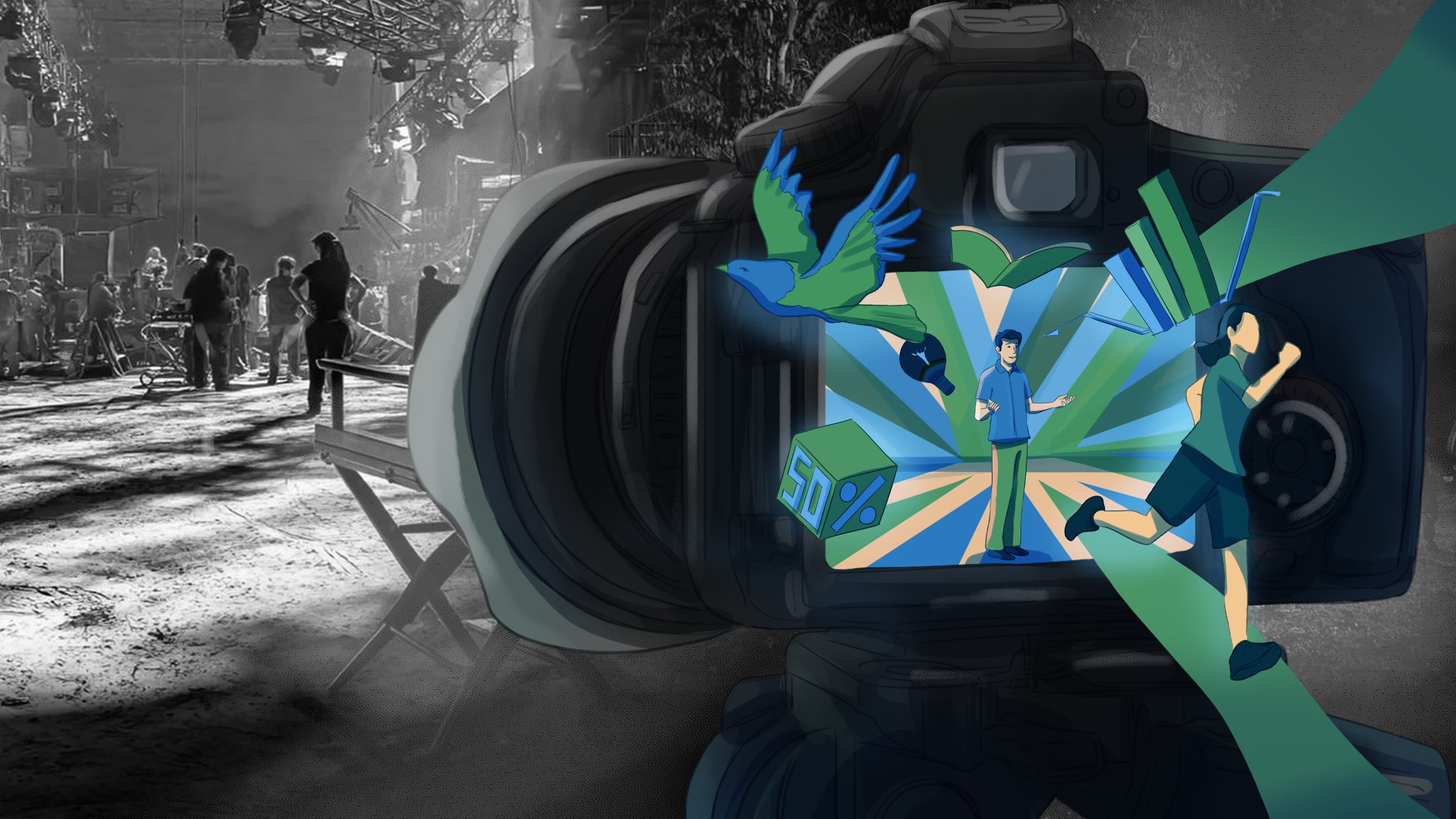
This is the riddle NGOs often face: when do you film what’s real, and when do you let animation carry the story? So, let’s explore this together in this blog.
Why Animation Sticks in the Mind
The answer begins with how people actually learn. Richard Mayer’s Cognitive Theory of Multimedia Learning, later expanded on by Jacob B. Waxman and Sue J. Goldie at Harvard’s Center for Health Decision Science, explains why words and pictures together are more effective than words alone. They call it managing cognitive load:
- Animation reduces extraneous load (unnecessary distractions).
- It helps manage essential load (breaking down complex processes).
- And it fosters generative load (the deeper connections that stick in memory).
Or, as Walt Disney once said:
Animation can explain whatever the mind of man can conceive.
Research has backed this up repeatedly. A 2024 systematic review by Steffen Hansen and colleagues looked at 15 randomised controlled trials across healthcare. In 11 of them, animation significantly improved short-term recall of health information compared with usual care. Whiteboard and shorter animations (1–5 minutes) were the most effective.
Another experimental study, The Effectiveness of Health Animations in Audiences With Different Health Literacy Levels, found that spoken animations were particularly powerful for people with low literacy. In multilingual, mixed-literacy settings, common for NGOs, this can mean the difference between a message being understood or lost.
Clarity in Complexity
Think back to the WHO Monkeypox Explainer, created during the outbreak. The subject was sensitive: public concern was high, but fear could be just as harmful as misinformation. Animation allowed the message to be precise without being alarming. Symptoms, protective measures, and follow-up actions were shown in bold colors, friendly pacing, and clear voiceover.
As animator Jody Clarke, who worked on the piece, put it: Animation can hold an incidental viewer’s attention a lot more than a video counterpart, as the limits with what can be done are literally endless.
Animation can hold an incidental viewer’s attention a lot more than a video counterpart, as the limits with what can be done are literally endless.
This clarity is crucial. When NGOs must show how a virus spreads, how a supply chain functions, or how a system change works, cameras may not capture the unseen. Animation can.
Protecting People, Protecting Stories
Sometimes, though, the issue isn’t complexity but safety.
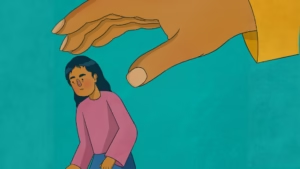
In Mumbai, the nonprofit SNEHA wanted to share the story of a woman, Shabana (name changed), who had survived years of domestic violence. Filming her face would have put her at risk and retraumatised her. Instead, they combined audio testimony with hand-drawn animation. The result carried her voice but safeguarded her identity; a powerful balance of empathy and ethics.
Animations are often the most humane way to represent survivors.
This mirrors a broader finding: animations are often the most humane way to represent survivors. Jody Clarke once reflected on this while producing a charity film on child abuse: “A representation of the subject, rather than the subject itself, can often dissolve a barrier when it comes to engaging with the topic.”
The same applies globally. In a BBC News animation, the refugee journey of Iyad Faroud Al Rousan was rendered in muted tones. Instead of graphic live footage, audiences saw a minimalist portrayal of the boat attack he endured; enough to convey terror and loss, without retraumatising survivors.
Elevating Underrepresented Voices
Animation also allows NGOs to translate research into advocacy. Take the project with the Global Fund for Ending Modern Slavery (GFEMS). Simit Bhagat Studios created an animated film about Ramesh, a construction worker trapped in debt bondage. His story revealed how micro-contractors could prevent exploitation in India’s construction sector. To make it authentic, voiceover came from a regional theatre artist with a Bihari accent. Animation gave realism without exposure, and turned data into dignity.
As we wrote in our blog Animated Stories: A Means to Elevate Underrepresented Voices, animation here was not just a medium; it was a megaphone for workers otherwise unheard.
Other campaigns echo this: EveryAGE Counts in Australia used simple lines to fight ageism. Autism Speaks used animation to convey the sensory overload of a child with autism, making invisible struggles visible. And the Global Health Media Project’s Story of Cholera made germs “seen” for the first time, with over 135 million views across 53 languages.
Animation elevates voices that would otherwise remain unseen or misunderstood.
Each shows how animation elevates voices that would otherwise remain unseen or misunderstood. We’ve explored these cases and the real question “when to use animation” in detail in our blog Why Animation Works for Nonprofits, give it a read to learn more.
Speed, Reach, and Memory
Beyond clarity and protection, animation has practical strengths. The Hansen review highlighted that short animations (1–5 minutes) consistently outperformed longer ones. For NGOs that must explain concepts quickly, in training sessions, on social media, or in donor briefings, this conciseness is invaluable.
Animation is also fast to adapt. When new information emerges, it’s easier to re-record a voiceover and update visuals than to re-shoot live footage. And unlike film, animation doesn’t “age” quickly; styles remain timeless.
Animation is also fast to adapt. When new information emerges, it’s easier to re-record a voiceover and update visuals than to re-shoot live footage.
This agility mattered for UNHCR’s Journey of a Dollar. The explainer didn’t just answer donor questions in one briefing; it became a reusable asset across platforms, showing transparency in 60 seconds.
As Jody Clarke notes: “I think animation is a fabulous multi-layered form of communication… the tone can be set with the style of the visuals, colours, the fluidity (or not) of the animation.” In other words: it sticks, because NGOs can shape it to both message and mood.
When Live Action Still Wins
Of course, not every story needs animation. Live action is irreplaceable when:
- A testimonial requires raw human credibility.
- The environment itself tells the story (a field hospital, a village water point).
- Real-time events unfold and must be documented.
The best NGO campaigns often combine both. A trusted staff member speaking directly to camera, cut with animated visuals that show the supply chain, the virus, or the system. It’s not either/or, but knowing when one carries the weight the other cannot.
Closing the Circle
Back in that UNHCR donor briefing, the animated dollar completed its journey on screen; from palm to refugee camp. What could have been a messy explanation became a story with clarity, empathy, and trust.
Live action will always bring raw truth. But when the challenge is complexity, safety, or speed, animation can bridge the gap between the invisible and the unforgettable.
As we’ve explored in our earlier blogs, the real question is not whether to use animation, but when. And when chosen well, it doesn’t just illustrate the work. It becomes part of it.
Interested in more examples like these, along with suggestions for your nonprofit to develop campaigns that touch hearts, build trust, and improve donor engagement? Sign up for our newsletter. Each issue is full of great ideas for compelling storytelling, ethical communications, and using your mission to create real, measurable change.