Every year on 21 March, World Down Syndrome Day, CoorDown, an Italian non-profit organisation dedicated to promoting the rights, inclusion, and social awareness of people with Down syndrome, releases a campaign that routinely breaks through the noise of the nonprofit communications world. Over 14 years, these campaigns have won multiple Cannes Lions, garnered hundreds of millions of views, and shifted how the wider public thinks about Down syndrome and disability.
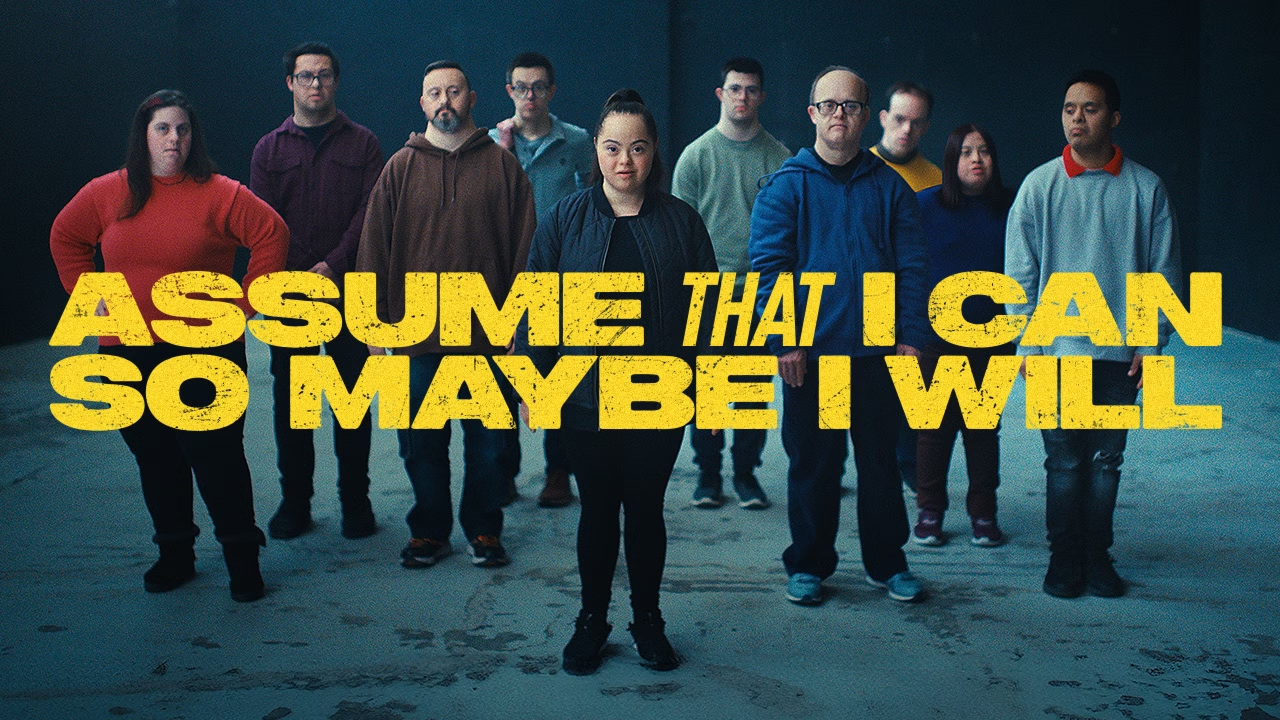
From Integration Days, which embedded individuals with Down syndrome into mainstream brand advertising, to Dear Future Mom, which became one of the most shared video in the world the week it launched, to Assume That I Can, which challenged the assumptions we place on people with disabilities, each campaign has carried a single, sharp message created under the creative direction of Luca Lorenzini and Luca Pannese, and brought to life by a growing global alliance of associations, production companies and professionals.
In this interview, Martina Fuga, President, CoorDown, takes us inside the making of CoorDown’s campaigns, from insight to shoot to global distribution and explains the principles that have kept the work honest, brave, and effective for over a decade.
Transcript of the Interview:
Simit Bhagat: So I’ll start right from the beginning. How did this all start? What was the idea?
Martina Fuga: First of all, I’m a mother of a girl with Down syndrome, so everything started from my direct experience with disability, but CoorDown was involved before me, so it’s not all on me.
Even if I take care of all the campaigns, we are an organisation that promotes the rights of individuals with Down syndrome. At a certain point, we met two local partners. They are the executive creative directors of SMALL, an agency that has collaborated with us for many years. We wanted to do something through communications because we wanted to change the culture. We understood that we can run many programmes and offer services to individuals with Down syndrome, but if we don’t change the mindset and the culture, all our programmes will not find the context to bloom.
So we really needed to find a way to change the culture. I really believe in the power of communication to change the mindset and the way people imagine what Down syndrome is, and to challenge the stereotypes, bias, and assumptions that people have about individuals with Down syndrome and disability. So we met these two guys and asked them to support us, and they had a great idea. We started with an amazing campaign.
I really believe in the power of communication to change the mindset and the way people imagine what Down syndrome is, and to challenge the stereotypes, bias, and assumptions that people have about individuals with Down syndrome and disability.
At that moment, they were working in Milan, and they created an amazing campaign called Integration Days. I don’t know if you had the chance to see it. Integration Days is an amazing campaign. It won maybe seven Gold Lions in Cannes. The insight was that we did not want to ask for inclusion, but to make inclusion visible.
So we included individuals with Down syndrome in the campaigns that the brands they worked with were doing at that moment, in collaboration with the agency. For World Down Syndrome Day, they launched that campaign. So all those brand campaigns were broadcast with protagonists with Down syndrome, and it was amazing.
And it had a huge impact. We started from there. Then, after that, every year for Down Syndrome Day, we did a campaign on this topic. Every year, we tried to change the focus, the tone of voice, and approach the topic from a different point of view. And so we did.
And during the years, we built up a sort of alliance with professionals, companies, and many partners around the world, because we started alone. But during the years, many, many partners joined us, associations and organisations for Down syndrome, but also editors, production companies, and many different kinds of stakeholders. I could say now, though not at the moment, because it was such an informal alliance. But every year, some association got in touch with us and said, “Can I do the campaign with you this year?” And we said, yes, of course, join us. So, year after year, this became a bigger alliance. And that’s the beginning.
Simit Bhagat: There are so many things that I want to unpack here, right from the cast, because for each year, you have an amazing cast. Do the people you cast actually act, or are they just regular people doing their own sort of work? Are these actors that you looked at?
Martina Fuga: Oh, you mean individuals with Down syndrome, or in general?
Simit Bhagat: Yes, individuals with Down syndrome.
Martina Fuga: Oh, we did it. I did actually do the casting of individuals with Down syndrome every year. At the beginning, we involved, for example, in the Dear Future Mom campaign, which had 13 actors. So what we did on that occasion was ask the associations that were partners with us from different countries to submit some potential candidates.
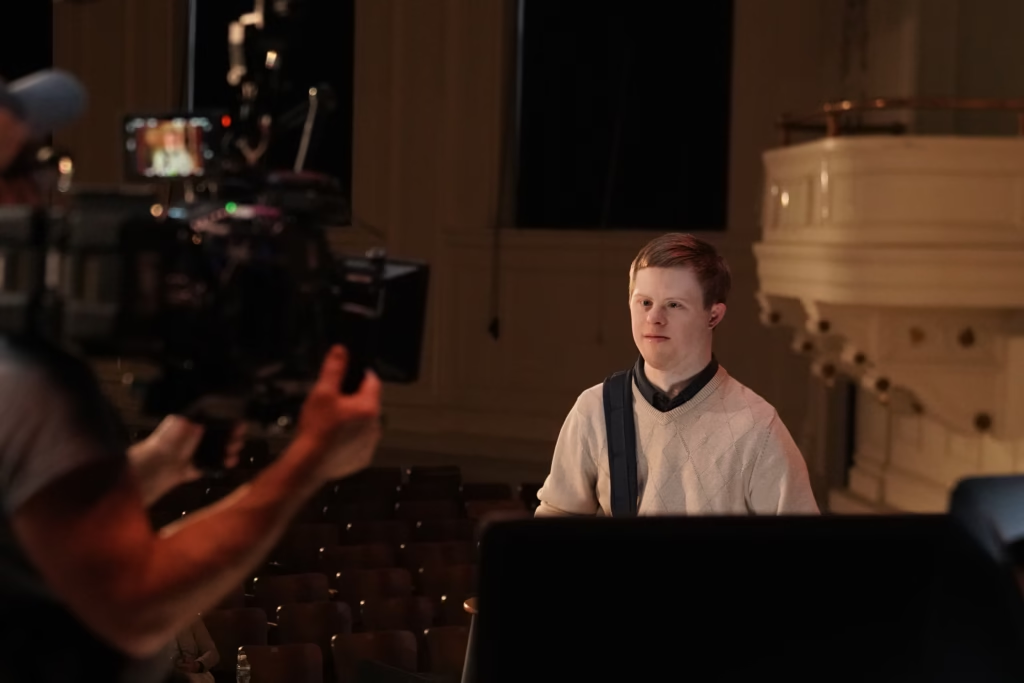
Martina Fuga: But in that case, there wasn’t a scripted role, so we just needed to have diversity. We needed to have different ages. We needed to have different countries. So it depends on the campaign. In some campaigns, we needed very strong acting skills, for example, in Assume That I Can or in Just the Two of Us or Ridiculous Excuses. That was a funny campaign, and we needed humour and sarcastic expression. We involved, we asked different associations, or we launched a casting call on our account, and individuals with Down syndrome submitted their videos and their candidacies.
This year was tough because the casting for the campaign went viral, and there were 600,000 views. So we received a ton of emails. But the amazing thing is that all the emails with the videos were full of comments and stories. Individuals told us about themselves, why they wanted to be part of the CoorDown campaign, and how the CoorDown campaign was meaningful for them.
So it was amazing to receive all this correspondence, even if it was tough to manage. But in the end, we had 30 very good candidates, and it was really tough to decide. But in the end, we decided on the person who fit best with the role and the content. So we decided on Noah, and I think it worked well.
But every time it is a little bit different. It depends on what we are looking for. For example, when we selected Madison Tevlin for Assume That I Can, we were supposed to have a man in, maybe because we talk about drinking, we talk about sex, and we talk about some personal planning, but when we saw her video, we knew that this was it. She was the one we were looking for.
Simit Bhagat: I mean, I wonder, you have such a fantastic cast, and every year it is very, very different. How do you decide? What does the process look like?
Martina Fuga: The process of production or the casting?
Simit Bhagat: The process of production and the team.
Martina Fuga: Okay. So at the beginning, at the very beginning, I worked with Luca and Luca very closely. Now we are close friends. It’s not an agency-client relationship, but I bring them insight.
Usually, I have something that is really meaningful for me and that I really would like to talk about, and I try to explain it to them. Sometimes I also want to fill in a brief. All agencies have a brief to fill in. I don’t want to do it, but in the end, I do.
But we have a lot of discussion, very direct discussion. So I talk about this topic, and they ask me many questions. So we go deeper and deeper. After that, they propose something to me, one or two ideas, and we try to work on it together. Sometimes it is perfect.
So after 14 years, they know the topic better than I do. Usually it’s perfect. It’s just a question of wording. It’s a question of some details, some nuances. Then we start. We have some partners every year, some associations, so I test the content with them.
I forgot to tell you, that’s the insight. I told you that I bring the insight to them, but the insight, for me, sometimes is not just my idea out of the blue. It comes from discussion, brainstorming, and conversation with people with Down syndrome. I have a lot of friends, adults with Down syndrome. We chat with them. I always keep my ears open and collect things that are meaningful to them. So the insight is always from the community we represent.
Martina Fuga: After that, we test the idea, the creative idea, with some associations. Then we start the process of finding a production company. Actually, in the last six years, we did the campaign with the same production company, Indiana Production. I mean, yes, from 2020. So the first thing I do is check with them if they want to do the project. If they say yes, we go ahead. If they say no, I try to find another one.
Three times they found a partner. So, for example, for Ridiculous Excuses, we had two production companies, Indiana Production and Tinygiant, a production company in New York.
And then, after that, the production company takes care of the production. So they involve partners, and I forgot to tell you that most of the work that professionals do in the campaign is pro bono. The agency works pro bono, the directors work pro bono, the editors work pro bono, the music company works pro bono. And that’s the reason why a small association like CoorDown can do this.
The agency works pro bono, the directors work pro bono, the editors work pro bono, the music company works pro bono. And that’s the reason why a small association like CoorDown can do this.
Simit Bhagat: And that was going to be my next question.
Martina Fuga: So the production company involves all the partners. Then we start the casting. I do the casting for individuals with Down syndrome; they do the casting for the other actors and actresses. And then we start to involve all the other parts. It could be the musician, it could be all the others involved. I have a company that takes care of accessibility, and so all the other boxes. Then we shoot. So the day of shooting arrives. The production company has already done a lot of work in pre-production, of course.
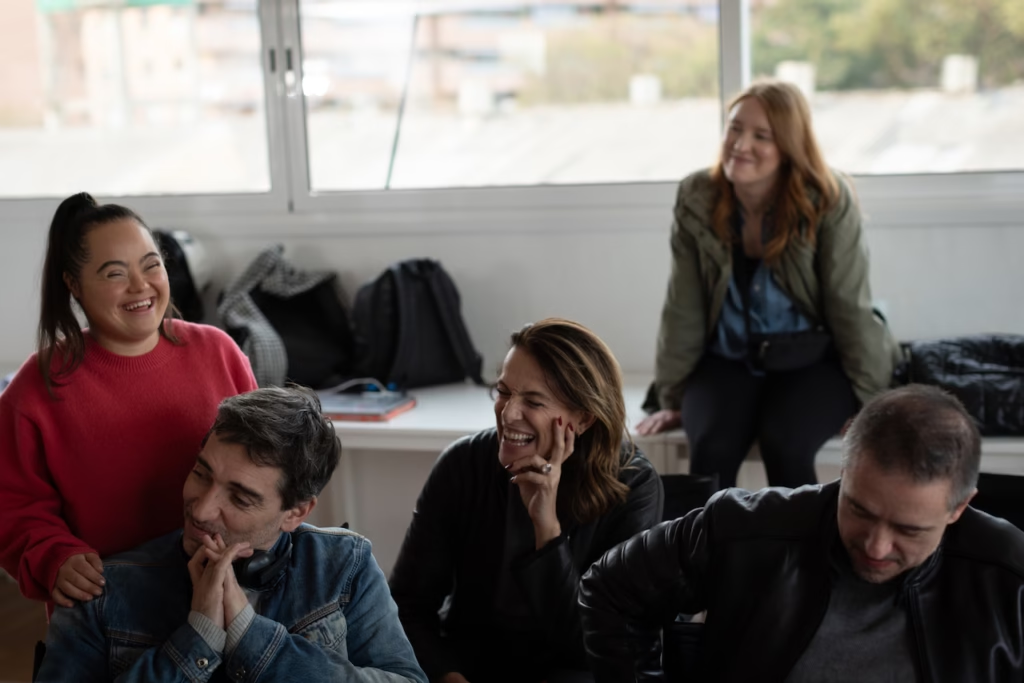
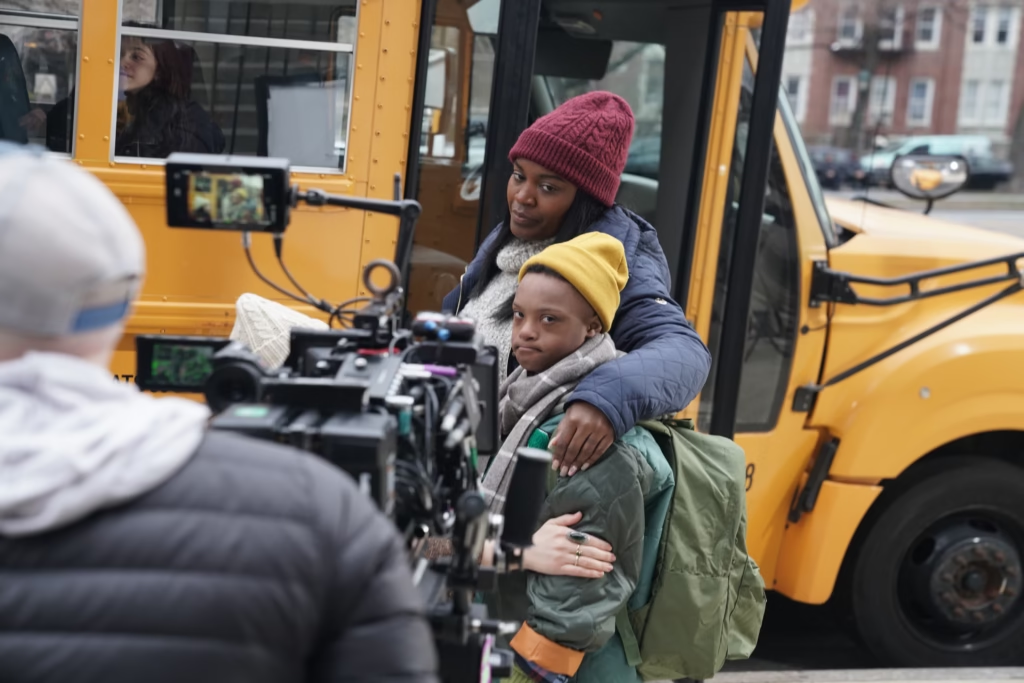
And then we shoot. The shooting days are amazing because having all the people involved on the set is amazing. And also all the crew, every year, have contact with the actors with Down syndrome, and it is always an amazing experience because they do not expect the kind of empathy and the things that they learn in just two days of shooting. And it’s really amazing.
After that, we edit the campaign. And we prepare all the art direction, all the details around it. Sometimes we have an add-on to the campaign. It could be a platform, it could be a toolkit, it could be something else. This year, we had an AI agent to help people who want to test their language or to find out what they can do in order to update their language or spread this awareness around them in their area of influence.
This year, we had an AI agent to help people who want to test their language or to find out what they can do in order to update their language or spread this awareness around them in their area of influence.
Martina Fuga: Then there is another phase of monitoring all the data, the views, preparing the case study, and so on. And then the cycle starts again.
Simit Bhagat: So this is like, how long does it take for one year’s campaign? I mean, you mentioned a couple of days for shooting, but I’m sure there is a lot of work, like pre-production and also post-production.
Martina Fuga: Actually, we started talking about the campaign in September. We start really working on it in January. And the campaign is out in March. But during all the year I work on it. I’m involved in the partnerships, involving stakeholders, keeping them updated, and trying to find new ones. So, it’s a never-ending work, actually. But I could say that from December to March is the period when I do it.
Simit Bhagat: That’s almost four months of it all. Sleepless nights, I suppose.
How do you get Sting to work for you?
Martina Fuga: Oh, Sting. It’s an amazing story. Okay, Simit, we shot the campaign in March 2020. So the day after we finished, I took a plane from Palma de Mallorca, where we shot, and the airport was empty because the COVID pandemic had started.
So, with the team, we decided not to go out with the campaign, not to launch the campaign that year. We had a handshake in the campaign, actually 15 or more, so we said maybe during the pandemic, we cannot have a handshake. So we decided not to do it. And during that month before the shoot, we had already thought about asking Sting to sing the song.
And we tried to approach him. We had a friend who knew him in Tuscany, or said that he knew him, or was supposed to know him. And it didn’t work. I mean, I don’t think he really reached out to him. So we tried to find out another way. We already had the song sung by another singer.
But when we decided to put the campaign on hold, we had one year before the launch. So we said, we can try to find another celebrity to sing this song. And at one point, one day, Luca and Luca told me, we have a friend who knows a friend who knows a friend who knows Sting.
So you have to write a letter to Sting. Okay, I will do it. So I wrote a letter to Sting and explained the project, the idea, and asked him if he wanted to sing the song. And my letter went to the friend, the friend, the friend, and then reached him. And one day, we received an email from him that said, just a little email, “Nice song. I’ll do it.”
Simit Bhagat: Wow.
Martina Fuga: And a couple of days after that, we sent him the tracks to sing the song, and he did it in one night. He has his own recording studio, and he did it. And we received the track, and Luca and Luca invited me to a call, pretending to give me a casual update about something, and they showed me the video campaign with the voice of Sting. Because even if we had received the email, I didn’t believe that he would do it. I wasn’t sure until it was real. So that’s how we got him. So it’s a chain, actually. It’s a chain of friends, a chain of love, a chain of support, and that’s it.
Simit Bhagat: What does it feel like? You’ve been doing this for so many years now, and there are so many organisations, so many partners who have become associated with you on this journey. What does it feel like when you look back?
Martina Fuga: Actually, the most important feeling is gratitude, because I really believe in what we are doing, and we really think that we are changing the way people look at individuals with Down syndrome, people with Down syndrome. And we are changing the lives of people with Down syndrome because, with Hiring Chain, for example, we brought a lot of people to work in open work, not protected work.
The most important feeling is gratitude, because I really believe in what we are doing, and we really think that we are changing the way people look at individuals with Down syndrome, people with Down syndrome.
Martina Fuga: So, Assume That I Can changed the perception. So I really believe that we are doing something great. But we couldn’t do it without all the support, the partnership, and the alliance. And yes, first of all, Luca and Luca, because without them and their great, amazing ideas and skills, we couldn’t do it. But also all the partners we have gathered during the years, and that’s amazing. I feel grateful, first of all. But also, I feel a huge responsibility.
And keep doing it. But in order to keep doing it, we need other kinds of partners, and we need foundations that support us. We need resources and brands. We have never done a campaign with brands, never. So I am sure we were close last year, but we didn’t do it. And I really would like to have a committed brand that wants to do this with us, because I think it’s not just our responsibility. I will finish advocating in this area when brands do campaigns like this, not me, not me as an association. I don’t think it is a nonprofit task or responsibility; all brands should send this kind of message. Or not for individuals with Down syndrome, of course, but for all marginalised categories or groups of individuals.
Simit Bhagat: And do you see that happening anytime soon? Do you see some resistance from them on this?
Martina Fuga: Oh, starting from January 20th of last year, when in the USA there were some anti-diversity and inclusion messages, or backlash around that, it became more difficult. Of course, I am not sure if that is the case here. I mean, if it happened because of this, but I was very close to getting a brand to join us, and they said no, we cannot go on. So, probably that is something that influenced it. But the other option could also be that I am not able to involve brand partners. I am really good at involving partners and stakeholders, but maybe not brands. So probably it is also not my skill.
Simit Bhagat: But maybe because you’ve been doing it for too long now, maybe that’s the next milestone. Maybe that motivates you, that there’s been progress, and you have to do it, you have to figure this out.
Martina Fuga: Yeah, probably. It’s one way to look at it as well.
Simit Bhagat: But I mean, over all these years, I’m sure now it is much easier for you to have partners and foundations and other organisations work with you. But I’m sure that wasn’t the case when you started, when this was completely new and not as established. What do you think worked in your favour? What is it that really gets organisations to come and work with you on this, from where you started to now?
Martina Fuga: I think it is the impact of the campaign, the results, because the campaign really resonates, not just with the Down syndrome community, but more widely. I mean, not just with the Down syndrome community, but with the disability community, and then even more universally. Assume That I Can was a campaign that resonated with all of us. Even if you are not related to disability, as a human being, you have assumptions that create barriers for people you relate with.
So I think that, at the beginning, the first campaign had a huge impact on the advertising community because it won a lot of awards. But the Dear Future Mom campaign was one that had 8 million views on YouTube, and it was the most shared campaign in the world, I mean, not in the nonprofit area, but in general, on YouTube that week. So the success of the campaign gathered attention, of course. And after that, it was meaningful for people.
At the beginning, the ones that contacted us to become partners were organisations for Down syndrome or disability. But after that, it was professionals, directors who wanted to do a CoorDown campaign, or professionals there to offer their support. So to be part of this movement, it’s like a movement, and you love the purpose. You understand that it has an impact, and you want to be part of that team.
Simit Bhagat: And when you look at impact, how do you look at it? What does impact mean to you? I mean, the numbers are one thing, right? But I’m sure this campaign changes the lives of many, many people. How do you see it?
Martina Fuga: Since we hardly measure the impact, we didn’t have the resources to use platforms, software, or whatever supports measuring impact. But, for example, in Hiring Chain, we had a platform that connected associations around the world with companies that wanted to hire an individual with Down syndrome. And through that platform, we received 38,000 contacts in two weeks. And when people reached the platform, we received 1,000 contacts from companies that wanted to hire or asked for information about how to hire an individual with Down syndrome, and that’s an impact because after that, for example, just in Italy, we had at least 70 job placements, and we obtained this result in ten years before the Hiring Chain campaign.
And so, the other way we measure is, of course, views, comments, and engagement. But the way I measure is how many companies contact me after the campaign, how many ask me to be a partner next year. The other thing is, I receive an email every week from someone around the world. It could be a company, it could be a research institute, it could be a university, it could be a museum. They ask me to use one of our videos for their training, for their exhibition, to show at a conference, to use it to spread awareness about this topic. So this is another way to measure. I couldn’t count because I don’t have the time to go back to my mailbox and check it, but I know for sure that every week I answer an email like this. For 14 years.
I receive an email every week from someone around the world. It could be a company, it could be a research institute, it could be a university, it could be a museum. They ask me to use one of our videos for their training, for their exhibition, to show at a conference, to use it to spread awareness about this topic.
Martina Fuga: So that’s an incredible thing, I know. But last year, the V&A, the Victoria and Albert Museum in London, asked for our video Assume That I Can for an exhibition. And this is something that had never happened. It has also happened that a director who is making a film with a protagonist with Down syndrome asked us to help them with casting, to read their script, to check, to consult, just to see if it works, if the narrative works, if the way they represent an individual with Down syndrome is right. So, I call this impact.
But another thing is seeing that, in the past, we were the only organisation that did this kind of campaign. I don’t know, maybe I would be wrong. But, for example, in Italy, every year we win awards on this topic. I mean, last year, a new association with a new agency did very good work and won the awards. And I was happy because I’m not alone anymore. So that means something. And I know that they used our campaign as a reference, and to be a reference for the advertising industry is something I’m proud of.
Because it’s something, even if we never edited a guideline about this, we did it with our work. Maybe in the future I would love to. But I’m sure that many organisations changed their narrative, or adapted it a little, corrected the narrative, and used CoorDown campaigns as a reference. And I don’t want to fail to be humble. But I think it is like this.
Simit Bhagat: It is a big deal, especially because normally, in the not-for-profit space, it’s always the other way around. You look up to an agency’s work, and that is what you use as a reference. But now the tables seem to have turned, and the agency, the creative people, and the creative minds are looking at your work. So I think that’s also another kind of huge impact.
You are based in Italy, but at the same time, all the campaigns have always been global, and they’ve had that global outlook. Has that always been the case, and has that been consciously done, or is it something that happened?
Martina Fuga: It’s consciously done. I mean, the first one was not global, even if it went global anyway. But since Dear Future Mom, when we used different actors from different countries and different languages, it was intentional to go global. And after that, we used English every year as the main language, and we usually think more widely. So not something that resonates only with the Italian community, but something we try to make resonate more broadly.
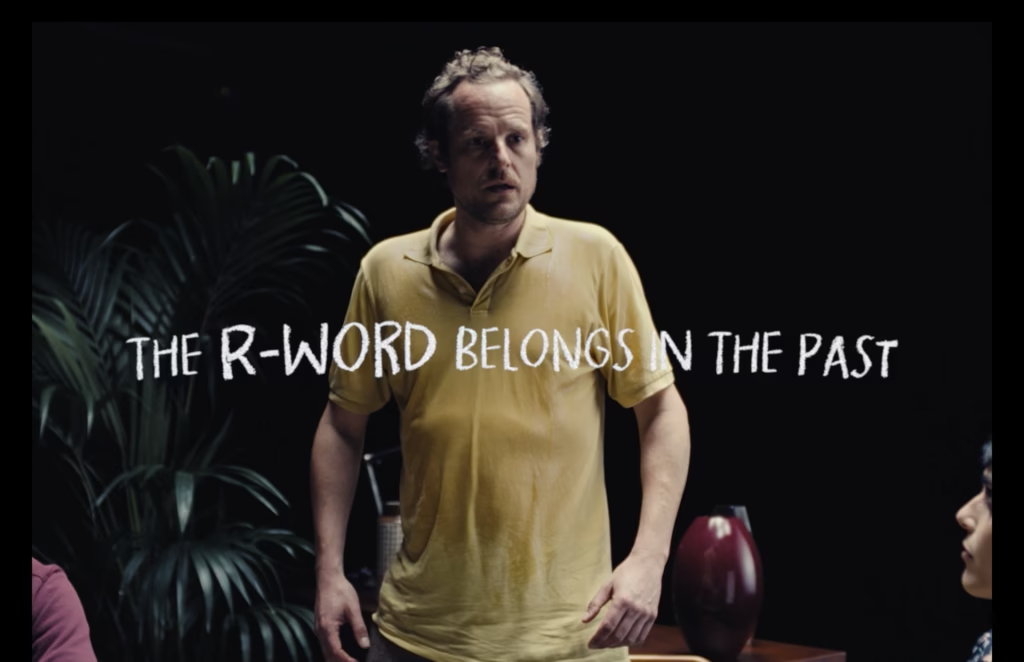
For example, this year we have Just the Two of Us. We talk about the R-word. The R-word is not the main word in Italy, right? We have a different one, more harmful and more used. But we wanted to go wider, to keep the campaign global. And using that word, and not the other word, resonated with more people all around the world, also in different communities. We always think about other communities. Sometimes it is not possible to represent everyone in the casting and use all cultures and practices, but we try to do it.
Simit Bhagat: And I’m sure, over all these years, there must have been a lot of challenges. It sounds great, and the impact is great, but I’m sure it must not have been very easy. So what has that part looked like?
Martina Fuga: The challenge, the huge challenge, is resources. We don’t have funds. And I know that I can’t ask all the individuals and companies involved to work pro bono forever, so every year I really think that it is the last one.
Another challenge is that I don’t have a team in CoorDown. I’m a volunteer, first of all, because I have another job and I have to do my job. I have to be a mother. Not have to be, I want to be a mother. And I am a volunteer here in CoorDown. So finding time for everything is a huge challenge. And another challenge is when you ask someone to work pro bono, not always they work as professionals. They are volunteering. But I’m lucky because all the individuals who work pro bono for us work as if I paid them a lot. So that’s incredible. But I don’t take it for granted, and I’m not sure it will happen again next year.
I’m lucky because all the individuals who work pro bono for us work as if I paid them a lot.
And the other challenge is that I would like to do more. I mean, it’s a big deal this year. There is an urgent need. But if I had funds, human resources, and professionals who could do it, I would like to do more, to have someone who measures and analyses the impact, who does a toolkit to share with the press, and a PR agent who supports me to go to every news outlet and broadcaster. And I don’t have funds for media placement. I don’t use it. All of the traffic is organic, I should say. So there is no advertising because we couldn’t pay for it. So, can you imagine the impact if we could?
Simit Bhagat: There’s no looking back then. Despite these challenges, the kind of impact that you’ve had, the kind of reach that you have had, is absolutely unprecedented. I can only imagine that if you had that, or if you have that going forward. What is it that you are looking at next for you?
Martina Fuga: I don’t know. The first thing is that I would like to consolidate the unformal alliance that I have at the moment. I would like to have the opportunity to measure the impact a little bit, to have some evidence of the impact, because you are talking about that. I have the feeling of it, but I don’t have evidence. And I have to collect it. I’m working on this, this is a spoiler, but I’m working on a survey that I’m going to launch probably tomorrow. So you will receive it. It is about the impact of our work globally and about the potential global alliance, coalition, I don’t know how to call it, to understand if it is meaningful not just for me, but also for others.
So, to stabilise and consolidate this kind of coalition is one step. And the other step is to find a different kind of stakeholder that can support us to grow. To grow and to do this campaign more easily. I mean, if we have a budget, we can plan, so we can work on it. We can have people who work on strategy, on advertising, on the media plan, and everything.
Simit Bhagat: But despite that, you still have a huge distribution network. I mean, the posts kind of go viral, and as soon as you put them out, you have millions of views. How has that happened?
Martina Fuga: Oh, I don’t know. It’s happened every year. Our account has 40,000 followers, so it’s not such a big account. It grows every year, of course, but it’s not huge. I think it works because the campaign works, and it is meaningful for people, and people want to share it. So it happens every year. But I don’t have any other evidence of why it works. I don’t have an answer to that.
I think the topic is meaningful. I think that the secret of Luca and Luca, and what I really learned from them, is that the most important thing is to share one message at a time. So in our job as an NGO, an association that promotes the rights of an underrepresented community, we would like to say a lot of things. We would like to deliver thousands of messages. We need to tell everyone. There are so many things that are meaningful to us. So they told me, “Okay, this is an interesting insight, and we will talk about this next year.” When we try to do too many things, we complicate the message and the message delivery. So this is lesson number one for me.
When we try to do too many things, we complicate the message and the message delivery. The most important thing is to share one message at a time.
Martina Fuga: The other thing is, do not pretend to represent everyone or to know what is meaningful for individuals with Down syndrome. So we speak with them. We discuss with them every day. Luca and Luca know them very well and have had the chance to spend time with them. So we know the community, and we talk with them. We check our words. We never put words in their mouths if they do not think that way. I discussed with Madison Tevlin before the shooting, and I was ready to change every word of the script, but she really wanted to say the words in that way. So that’s another important point.
The other one is staying away from the risks in communicating disability. For me, there are three huge risks. The first one is Pietism. And I think that it is hard to stay away from this risk, but this is an important one.
The other one is inspiration porn. It is everywhere, everywhere. And we never do it, never. I should say that, probably, if we used it sometimes, we could be more successful. But I don’t think it is useful for our community or that it is effective. I think it is damaging. It is hugely damaging for our community. And the third one is the superhero narrative.
I don’t want to make individuals with disabilities into superheroes. Probably other successful campaigns have done it with great results. But then after that, they moved on. For example, I can talk about Channel 4. They are an amazing case of campaign work, wonderful campaigns, amazing campaigns. But they started by talking about superheroes and then moved on. So there is an evolution, a great evolution. They talk about this evolution in their interviews.
So we stay away from these three risks. And what else? I think another thing could be consistency. To be consistent and not disappoint your followers and community. It is something that helps us because many, many people wait for our campaign every year. So to be consistent is something so important.

Simit Bhagat: Everything that you just mentioned, in terms of one message at a time and consistency, these are typically issues that nonprofits face, right? Because they want to communicate everything. But I think one thing about your campaigns is that for each one, it is just one message, and that’s about it. I’m sure that you may want to have ten messages, but then it dilutes the message. And I think that is something a lot of nonprofits can learn from the work that you’ve been doing. Is there anything else that you think the nonprofit world doesn’t do, and something that could be helpful for them?
Martina Fuga: One of the things, for me, is to have clearly in mind who the target is. And I mean, how often do nonprofit organisations talk to themselves? But it is a risk that we often face. Sometimes, some insights I proposed to Luca and Luca were important for our community, but no one outside our community could understand them. But if I want to change the world, I cannot speak only to my community. I have to speak to the world. So if I want to dismantle stereotypes that are rooted in the world, I cannot speak only to my community just to please them.
And I think another thing is to be brave. I mean, Luca and Luca are really brave, and they taught me to be brave. Sometimes I say, no, no, maybe we cannot say that. Maybe we can’t.
For example, last year with Assume That I Can, when we talked about alcohol, sex, and slurs, we said it. But we asked ourselves, are we doing that to provoke, or are we doing it because it is meaningful to the insight? And it was meaningful to the insight because I’m not making a movie. The intention was not to insert sex because sex was important in itself, but because individuals with Down syndrome are always imagined as small kids, infantilised, so they don’t drink, they don’t smoke, they don’t swear. They are nice and good. But they are people, more complex, with many, many differences between one and the other.
Individuals with Down syndrome are always imagined as small kids, infantilised, so they don’t drink, they don’t smoke, they don’t swear.
So on that occasion, I had a lot of questions. I tried to verify whether we needed it or not, and of course, we also had some criticism. But you need to be ready to face criticism too. I never thought about how to get more followers, more prizes, or more views. I do what is really meaningful for us, for the community.
Simit Bhagat: And I think what you said is absolutely true, and it is so important, right? Because normally in communications, especially in nonprofits, you want to stay away from controversy. You want to stay away from things that may feel risky, go the simpler route, the easier route and don’t want to antagonise someone because of the message. But here, it is provocative, and you have consciously chosen to do that. And as you mentioned, it is not just for the sake of doing it. There is a larger message at play.
Martina Fuga: Exactly. Because it is easy to get scared and not want to do it, to just take the easier route.
Simit Bhagat: That’s the easiest thing to do.
And I could keep talking to you for the next hour. But in the interest of time, is there anything that you want to share, something that maybe I haven’t asked?
Martina Fuga: Oh, not at the moment, but I imagine that you will work on it too, so maybe if you prepare something and we share it, if something comes to my mind, I can add something else. And if you need anything, please let me know what you need.
Simit Bhagat: Yes, it was lovely speaking to you.
Martina Fuga: Lovely for me too. Thank you for this.
Liked reading this? Stay tuned for more inspiring stories and insights into storytelling in the nonprofit sector! Subscribe to our newsletter for updates on upcoming posts, articles, and expert tips. By subscribing, you’ll stay connected with valuable resources tailored for the nonprofit community and benefit from the latest trends and strategies to amplify your impact.