Saibai once lived in a world where every day revolved around survival. There was no room to plan ahead, let alone dream beyond the next meal. Life began to shift when she found work with a small business in rural India. She started earning as a distributor of clean energy solutions, carrying biogas units, biodigesters and solar dryers into homes that had never seen such technology before. Her income stabilised the household, and her growing confidence nudged other women around her to think about leadership in a new way.
Stories like Saibai’s remind us why nonprofits matter so much. They step in where systems fall short and create chances that can alter the direction of entire communities. For this work to be understood, supported and recognised, it needs to be told in a way that does justice to its depth. Animation has become one of the most useful tools for that. It is accessible, expressive and often budget-friendly, and it can untangle the most complex programme models into something people can follow. The medium also invites visual ideas that live action alone would struggle to capture.
There is no single correct way to use animation. The style you choose depends on the message, the audience and the feeling you want to leave people with. Below are some widely used animation approaches and how each can help social impact stories travel further and land more clearly.
2D Animation
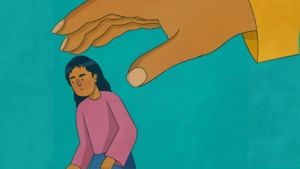
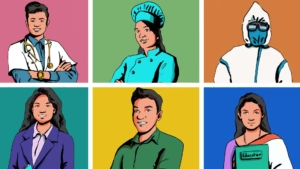
Two-dimensional or 2D animation uses flat drawings, clean outlines and stylised motion to build simple-looking visuals that still carry emotional depth. It often suits explainer videos because it can turn layered concepts into scenes that feel light and easy to absorb rather than heavy or technical. Viewers are guided gently, without too much visual clutter or distraction.
Two-dimensional or 2D animation uses flat drawings, clean outlines and stylised motion to build simple-looking visuals that still carry emotional depth.
A helpful example is UNICEF Europe and Central Asia’s explainer on how war affects a child’s developing brain. The film works with flat colour, reduced shapes and bold, storybook-style backgrounds so that neural pathways feel almost touchable. Glowing threads show connections forming and shifting, and the characters move through soft, illustrated landscapes. With over 2.3 million views, the piece manages to hold a hard subject with clarity and care while still feeling visually warm.
3D Animation
Three-dimensional or 3D animation builds depth, weight and realistic movement, which makes it well-suited to stories that rely on strong facial expressions, body language and immersive worlds. With textured surfaces, considered lighting and camera moves that echo cinema, 3D can sit very close to live action while keeping all the flexibility of animation. Viewers often forget they are looking at a constructed world.
3D animation builds depth, weight and realistic movement, which makes it well-suited to stories that rely on strong facial expressions, body language and immersive worlds.
Ian Foundation’s short film “Ian,” produced by Mundoloco CGI, is a powerful illustration of this. The film follows a young boy with cerebral palsy who longs to join other children at the playground but comes up against bullying and exclusion. Every detail, from the way he moves to how the environment reacts to him, is crafted to pull you into his experience. With 4.4 million views and recognition around the world as of December 2025, it shows how 3D animation can hold difficult emotions in a way that feels human and close.
Motion Graphics or Data-Led Animation
Motion graphics lean on icons, typography, diagrams and charts to walk people through information using clean, data-focused visuals. This style suits organisations that need to explain pathways, results or numbers without losing viewers partway through. When done well, it feels like watching a living infographic that happens to tell a story.
Motion graphics lean on icons, typography, diagrams and charts to walk people through information using clean, data-focused visuals.
At Simit Bhagat Studios, we created an impact-focused motion graphics film for Upaya Social Ventures that explored how dignified jobs change the lives of people living in extreme poverty. The video uses animated maps, moving data points and clear on-screen text to take viewers through Upaya’s theory of change and the wider ripple effects of steady employment. It turned into a go-to resource whenever someone needed a quick and straightforward way to understand Upaya’s otherwise complex work, whether in meetings, at events or in first-time introductions.
Infographic or Kinetic Typography Animation
Infographic or kinetic typography animation relies on quick moving text, icons and bold visual cues to talk about issues through rhythm and layout rather than character driven scenes. It can be especially useful for campaigns that need to show data, urgency or a chain of consequences while keeping the pace lively. People are carried forward by the movement of words and shapes.
Infographic or kinetic typography animation relies on quick moving text, icons and bold visual cues to talk about issues through rhythm and layout rather than character driven scenes.
The Girl Effect’s well-known animation on the pressures faced by adolescent girls across Africa and Asia is a good example. Typography flows rapidly across the screen, supported by a strong mandarin orange and black palette and a steady piano line that builds momentum. Over more than three minutes, the film shows how options close off for girls who face forced labour, trafficking or early marriage. With 2.7 million views as of December 2025, it continues to be a reference point for how infographic-led nonprofit films can stay both energetic and clear.
Stop Motion Animation
Stop motion animation uses physical objects, moved frame by frame, to create movement. Because the materials are real, every frame carries texture, weight and small imperfections that make the story feel handmade and intimate. This quality can be especially powerful when the subject itself is hard to see or describe in everyday life.
Stop motion animation uses physical objects, moved frame by frame, to create movement.
One strong example is The Royal Society’s educational film “What’s the Point of Pain,” produced with BBC Ideas. Clay figures travel through colourful sets and textured models that help unpack chronic and neuropathic pain. Scientific ideas sit alongside lived experiences, so the subject feels grounded rather than purely theoretical. At times, the combination of imagery and sound feels deliberately uncomfortable, mirroring real sensations. With thousands of views on YouTube, it remains a memorable stop-motion explainer that brings a complex topic to life.
Whiteboard Animation
Whiteboard animation works with drawings that appear line by line, as if someone is sketching them in real time. This simple unfolding process guides people through ideas step by step. It often works well for training material, implementation processes or field models, where clarity matters more than visual spectacle.
Whiteboard animation works with drawings that appear line by line, as if someone is sketching them in real time.
Innovation Africa’s explainer on how the organisation brings solar energy and clean water to rural communities shows this in practice. As markers trace out each scene, viewers follow the journey from the original problem to the technology and then to the changes on the ground. Because everything appears in front of you, the logic feels transparent and easy to follow. It becomes much simpler to see how each part of the solution connects to the next.
Hybrid or Mixed Media Animation
Hybrid or mixed media animation blends live action footage with animated overlays so that the final piece feels both real and imaginative. Actual streets, offices or landscapes sit underneath digital layers, icons or data, which helps audiences connect future-facing ideas to places they already recognise. This approach often suits work around innovation or policy.
Hybrid or mixed media animation blends live action footage with animated overlays so that the final piece feels both real and imaginative.
WIPO’s film “What Is the Future of Transportation” offers a clear example. Everyday city streets are overlaid with neon paths, driverless vehicle models and animated patent information, turning a technical conversation into a visual journey that is easier to follow. Real footage keeps the story rooted in the present while the animation hints at what might come next. With over four thousand views as of December 2025, it shows how hybrid films can bring regulatory and innovation themes to life for a wider audience.
Final Thoughts
Across the social sector, animation has grown into a key tool for unpacking dense ideas, showing impact and giving people a direct view into the lives and systems behind programmes. From delicate stop motion pieces to bold kinetic typography and layered mixed media films, each style offers its own way of opening a window into complex work. For nonprofits and social enterprises that operate across multiple locations, partners and themes, this kind of visual storytelling can become the missing link between what they do every day and what supporters actually understand.
If you would like to keep learning about storytelling practices, creative trends and communication strategies shaping the NGO and social impact space, you can subscribe to our newsletter for regular insights, examples and new ideas.