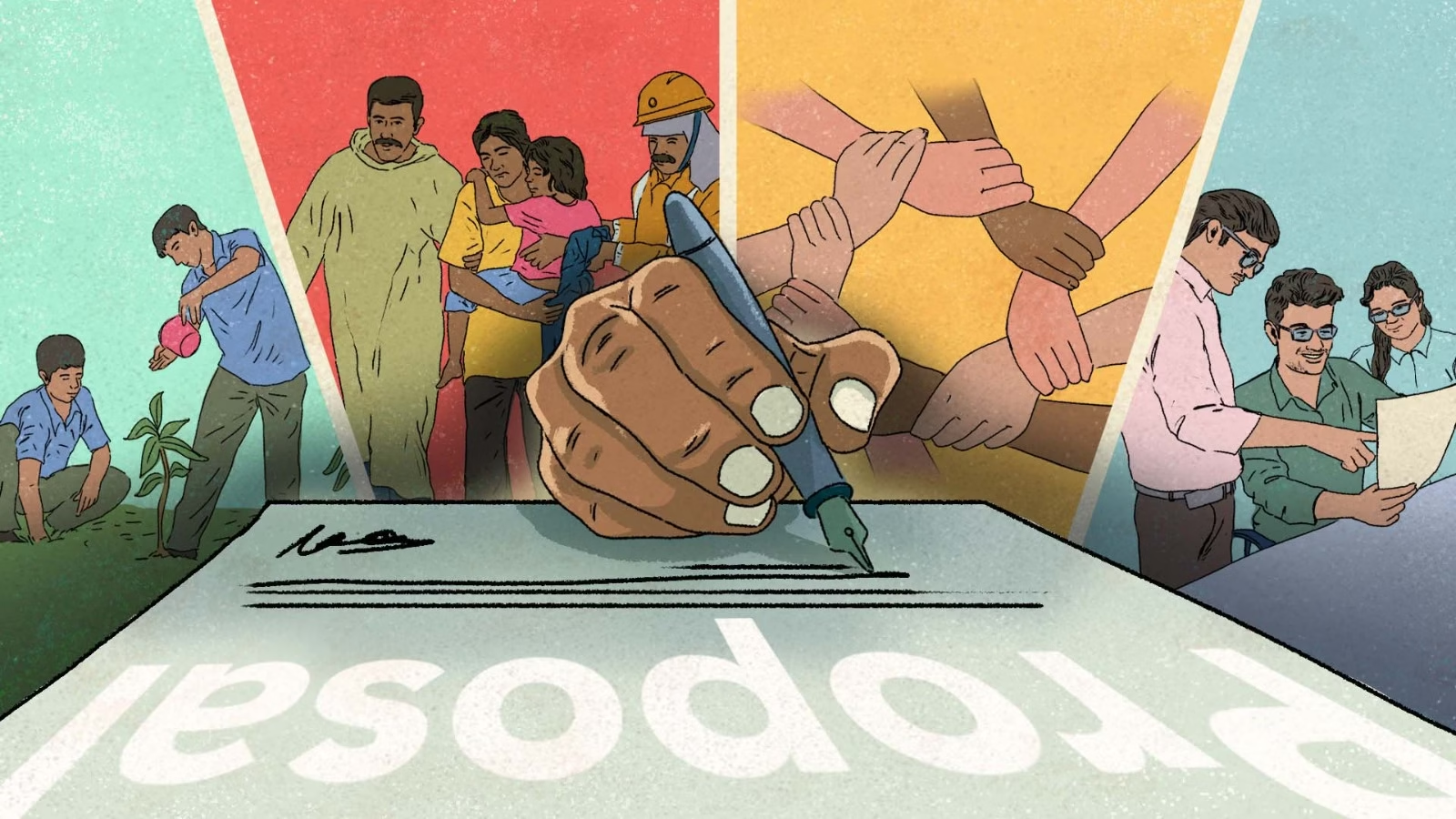
A small rural NGO came to development consultant Vivek Singh’s team for practical guidance. Their fieldwork was solid, with women trained as leaders, farmers organised, and local schools supported. Yet a major CSR donor kept turning them down. The issue was not impact; it was the telling. Their proposal read generic, leaned on emotion, and showed little evidence of capacity or sustainability.
In Stories of Change Ep. 5, Vivek Singh explains why proposal writing is more than an administrative chore. It is a chance for organisations to step back, tally what they have achieved, and set a course for growth.
A strong proposal reaches beyond numbers, showing staffing strength, decision-making structure, and a methodical plan. It is not only about funding. It should map human resources, capital needs, risk assessment, and sustainability in plain sight.
Today, it is crucial for NGOs to know how to write proposals. It helps build trust, unlock partnerships, and scale impact. In this article, we reflect on known best practices and common mistakes to help nonprofit agency teams do their best work writing proposals.
Why Proposals Matter More Than Ever
In today’s funding ecosystem, a strong proposal can decide whether good work grows or fades. It reveals an organisation’s values, structure, and approach before a donor ever visits the field.
Globally, competition for funds has intensified. Research from An Open Data Approach to Transform Grantmaking shows that nearly 70% of U.S. foundations and 41% of the largest ones no longer accept unsolicited proposals. The signal is clear. Funders are overwhelmed, and only the clearest, best-aligned proposals stand out.
Nearly 70% of U.S. foundations and 41% of the largest ones no longer accept unsolicited proposals.
In India, after the 2014 CSR amendment, corporate donors began reviewing proposals with the rigour of business plans. Post COVID, with closer scrutiny on transparency and results, a clear, evidence-based proposal is not just a skill. It is a survival tool.
Lessons from the Field: Five Pillars of an Impactful Proposal
From fifteen years across organisations like Azim Premji Foundation and Tata Trusts, Vivek Singh points to five essentials that help a proposal stand out:
- Tell your story and values. Share the organisation’s journey, its culture, and why the cause matters.
- Show your experience. Describe the projects you have implemented and what they achieved.
- Clarify structure and governance. Funders want to see how you function and who is accountable.
- Explain your approach. Include your theory of change or working method and why your model works.
- Detail your resources. Specify financial, human, and technical capacities.
Anyone reading a proposal should understand what the organisation’s culture is, what it does, and what experience it has.
These fundamentals echo CSRBOX’s NGO Masterclass 7, where experts from Genpact and ThinkCap Advisors stressed that winning proposals are clear, credible, compliant, and impact-driven. Transparency, track record, and measurable outcomes build confidence far more than emotion.
From Story to Structure: Using the Right Framework
The CIVICUS Funding Proposal Toolkit offers a simple and powerful frame, the CROP model, to turn ideas into structured narratives:
| C | Context | Explain why the issue matters and who it affects |
| R | Relevance | Align the proposal with the funder’s priorities |
| O | Objectives | Define clear, measurable goals |
| P | Process | Describe the plan, timeline, and team |
Rather than long introductions, this model helps nonprofits build logical, evidence-based proposals that answer a donor’s core question. Why you, and why now?
Research supports this. In a 2015 meta analysis conducted by Wisdom et al., they concluded that three attributes: clarity, alignment, and feasibility, predicted success. Van den Besselaar’s 2022 study showed that readability influences reviewer scores. Structure is not the same as bureaucracy. It is communication.
The Funder’s Lens: Insights from CSRBOX’s Masterclass
Funders look for proposals that connect vision and accountability. At CSRBOX’s 12th India CSR and ESG Summit, speakers urged teams to begin with a clear problem statement, lay out a solution roadmap, and end with measurable outcomes.
Credibility matters. Third-party validations, transparent governance, and data security help. The masterclass also reminded NGOs to include consent and privacy clauses when collecting beneficiary information. Small details like these signal responsibility.
A winning proposal bridges ideas and funder expectations, combining clarity, accountability, and impact.
In simple terms, funders are not only buying into a project. They are trusting a system.
Learning from the Grassroots: The Sambal Project Example
While global agencies have resources for polished proposals, small organisations often work with limited tools. That is why the Sambal Project by Rise Against Hunger India (RAHI) stands out as a strong grassroots model.
Published on CSRBOX, the proposal offers micro grants of up to ₹5 lakh to support community based organisations in aspirational districts like Odisha, Jharkhand, Bihar, and Madhya Pradesh. Instead of demanding complex documentation, Sambal asks partners to write proposals in simple ways and focus on clarity, not jargon.
Its cluster based approach identifies small, connected geographies for implementation, so local knowledge shapes the design. RAHI positions itself as a capacity enabler. It co develops plans with partners and helps them strengthen proposal skills for the future.
Sambal proves that simplicity and clarity are not limitations. They are strengths.
When Design Tells the Story: The UNICEF Example
At the other end of the spectrum is UNICEF’s Joint Programme on FGM Phase III. It shows how visual design can lift comprehension. The proposal has colourful flowcharts, pie charts, and a Theory of Change diagram that shows how community action can lead to measurable results.
For large programmes across many countries, visuals become tools of trust. They simplify complexity, show transparency, and make monitoring frameworks visible at a glance.
| Traditional Proposal | Visual Proposal |
| Dense paragraphs | Infographics & timelines |
| Hard to navigate | Colour-coded flow |
| Abstract outcomes | Measurable targets displayed |
Design does not replace substance. It helps funders see the story faster.
Smaller NGOs can borrow this by adding one page infographics, simple logic models, or illustrated budgets that make proposals easier to grasp.
Common Pitfalls and How to Avoid Them
Across fieldwork and donor feedback, the same mistakes show up:
| Pitfall | Remedy |
| Emotional writing, weak evidence | Add data and references |
| Generic templates | Tailor to each funder |
| No logical flow | Follow CROP or Log-Frame |
| Ignoring sustainability | Include ‘after-funding’ vision |
| No risk analysis | Add mitigation section |
As per CSRBOX, proposals must include consent and data-protection clauses; small details that demonstrate seriousness and integrity.
Building Capacity: Proposal Writing as Long-Term Investment
Proposal writing is an investment, not a cost. Yet many small organisations treat it as an afterthought once programmes are running. When you view it as capacity building, the results change.
NGOs can start by training internal teams with open resources like the CIVICUS Toolkit or CSRBOX Masterclasses. Keep a simple repository ready. Include impact reports, photos, governance policies, and short videos you can attach to any submission.
Partnerships with experienced consultants or peer networks can lift quality without heavy expense.
The return is not only funding, but it is about stronger storytelling, better systems, and lasting trust.
Like this article? Stay connected with us. Subscribe to our newsletter to learn more about storytelling, communication, and the latest trends that are changing the social impact sector.