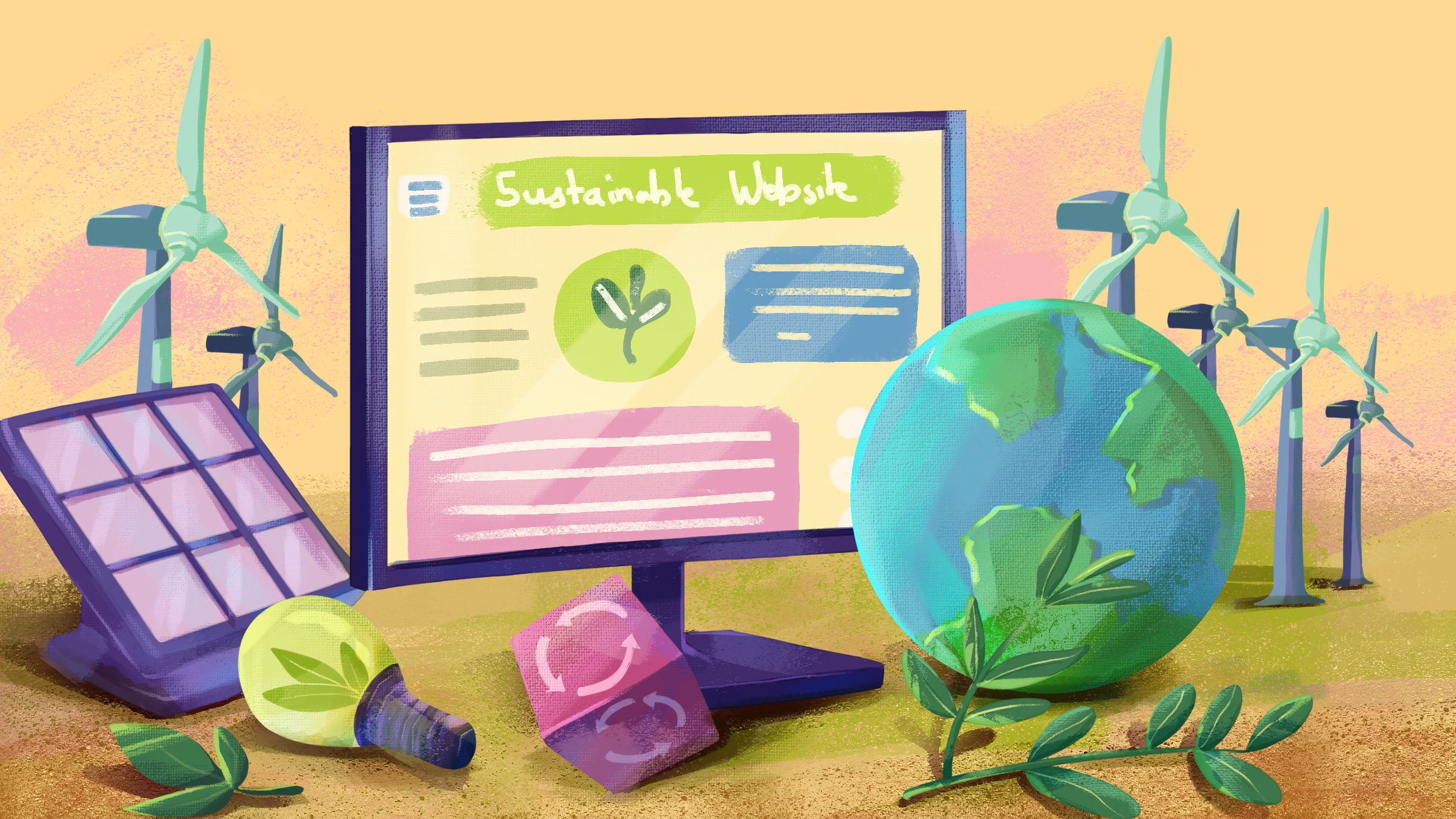
In most conversations about climate change, the web rarely comes up. But every website leaves a mark. When someone loads a page, servers, networks, and devices all use energy. When you add up all the visits, the internet has a big effect on the environment. The Information Communication Technology (ICT) sector already accounts for up to 4% of global carbon emissions; more than the aviation industry, and its share is rising.
This is where sustainable web design comes in. At its simplest, it means building websites that use less energy, produce fewer emissions, and remain accessible and efficient for users. Sustainable websites aren’t just faster and cheaper to run; they also reduce the hidden cost of our digital lives.
Earlier, we shared nonprofit website design examples to inspire organisations to refresh their digital presence. But design is only part of the story; how a site performs environmentally is just as important. That’s where sustainability becomes critical.
Recent studies back this up. The #EcoWeb Report 2025, which analysed 507 climate-sector websites, found that an average homepage emits 1.87 g of CO₂ per visit, but the best-performing sites emit 30 times less. Tools like the Website Carbon Calculator make this impact visible, showing exactly how much carbon a page generates.
An average homepage emits 1.87 g of CO₂ per visit, but the best-performing sites emit 30 times less.
And some organisations are already leading the way. SystemsTree, founded by technologist and writer Siddhesh Wagle, has built a website that produces less than 0.02 g of CO₂ per visit, earning it an A+ sustainability rating. For Wagle, this work is about more than efficiency. It is about values, vision, and responsibility. “Only by knowing where we want to go and where we are, we can take necessary action to reduce this gap,” he writes.
It’s a reminder: sustainable web design is not a niche concern. It is an essential part of climate action. So let’s explore how.
More Than a Lighthouse Score
The #EcoWeb Report 2025 revealed just how uneven the digital landscape is. On average, a homepage has high CO₂ emissions per visit, as discussed earlier in this blog. Furthermore, the best performers managed as little as 0.01 g; the worst hit 21 g, a thirty-fold difference. Page weight was decisive: the lightest 10% averaged 0.76 MB, while the heaviest ran at 21.46 MB. And almost half of that weight, 47%, was images.
Sustainable websites require a shift in mindset: images and scripts aren’t just performance issues; they’re carbon issues.
The lesson is clear. Tools like Google Lighthouse and Ecograder can flag bloated sites, but numbers alone aren’t enough. Sustainable websites require a shift in mindset: images and scripts aren’t just performance issues; they’re carbon issues.
Content as the First Design System
In his blog Othering in Sustainable Tech, Siddhesh Wagle warns against excluding the future from our design choices. “When we consider the future as the ‘other’, we will design tech that will not consider their wellbeing,” he writes.
For websites, this means every line of content, every video, and every design flourish must be weighed against its cost to the future. Accessibility overlaps with sustainability here: cleaner text, compressed visuals, and lighter media loads aren’t just efficient, they are inclusive.
If we treat the future as belonging, not other, our websites can embody care rather than consumption.
Websites like Aline (37.92 KB, 0.014 g CO₂ per visit, A+), Sustainable Creative Charter (132.08 KB, 0.041 g, A+), Branch Magazine (283.65 KB, 0.088 g, A+), and Digital Beacon (82.06 KB, 0.025 g, A+) are considered sustainable because of their low page weights and top A+ ratings. These sites show that design and performance can align with environmental responsibility.
When the Website Lags Behind the Mission
Some organisations have acted on sustainability for decades before their digital identity catches up. SystemsTree itself embodies this. Its site is minimal, clean, and powered by green hosting verified by the Green Web Foundation. The design is simple, but the philosophy is rich, rooted in systems thinking, ethics, empathy, compassion, climate justice, and hope.
As explained in The Importance of Finding One’s True Self to Create Sustainable Tech, sustainability begins inside the technologist. “Finding one’s true self means aligning actions and values with a commitment to environmental and social well-being,” article suggests . In other words: authenticity fuels responsibility. When the self aligns with the mission, websites become carriers of trust, not just information.
Borrowing From the Big Players
Large organisations are beginning to codify digital sustainability. The #EcoWeb Report 2025 showed that 65% of climate-sector websites were already hosted on renewable energy platforms. Some leaders go further, setting weight budgets per page and adopting strict asset policies.
For smaller teams, the lesson isn’t to copy 50-page sustainability manuals. It’s to pick three non-negotiables. For example:
- Always host on a verified green provider.
- Set a maximum page weight (under 1 MB).
- Optimise and compress every image before upload.
As Wagle notes in Current Reality of Tech, ignoring the material costs of digital infrastructure only perpetuates harm. By starting with three basics, even modest websites can resist the myth that sustainability is incompatible with impact.
Operations Are Sustainability Too
In the Lowwwcarbon showcase, the lightest site, One Small Step for Earth, weighs only 6.46 KB, emitting 0.002 g of CO₂ per visit. That means operational habits matter as much as one-time design decisions. Caching, content audits, lightweight CMS choices, and regular testing with the Website Carbon Calculator can keep sites lean. And just as NGOs learned during viral campaigns that operations are branding, digital teams must learn that operations are sustainability. A site neglected after launch will bloat, just as surely as a campaign without logistics will collapse.
A Quick Checklist: Building a Sustainable Website
If you’re starting without a manual, here are three things you can still do today:
- Pick a green host: choose one verified by the Green Web Foundation.
- Set weight limits: budget your homepage under 1 MB, images under 100 KB.
- Measure often: test your site with the Website Carbon Calculator and track progress.
Consistency in these small moves often does more than a glossy sustainability report.
What does sustainability look like beyond the web?
Final Thoughts: Beyond the Playbook
Four voices, four perspectives. The #EcoWeb Report 2025 shows the measurable gap between heavy and light sites. Lowwwcarbon proves that design elegance and efficiency can coexist. SystemsTree demonstrates that a site can be both philosophical and practical, producing under 0.02 g of CO₂ per visit.
The answer is clear: sustainable websites help when you want to scale responsibly. But trust and climate impact begin with how you code, design, and host, every day.
Interested in more examples like these, along with suggestions for your organisation to reduce digital emissions, design lighter platforms, and embed sustainability in your online presence? Sign up for our newsletter. Each issue is full of practical ideas for ethical design, responsible storytelling, and building a web that works for both people and planet.