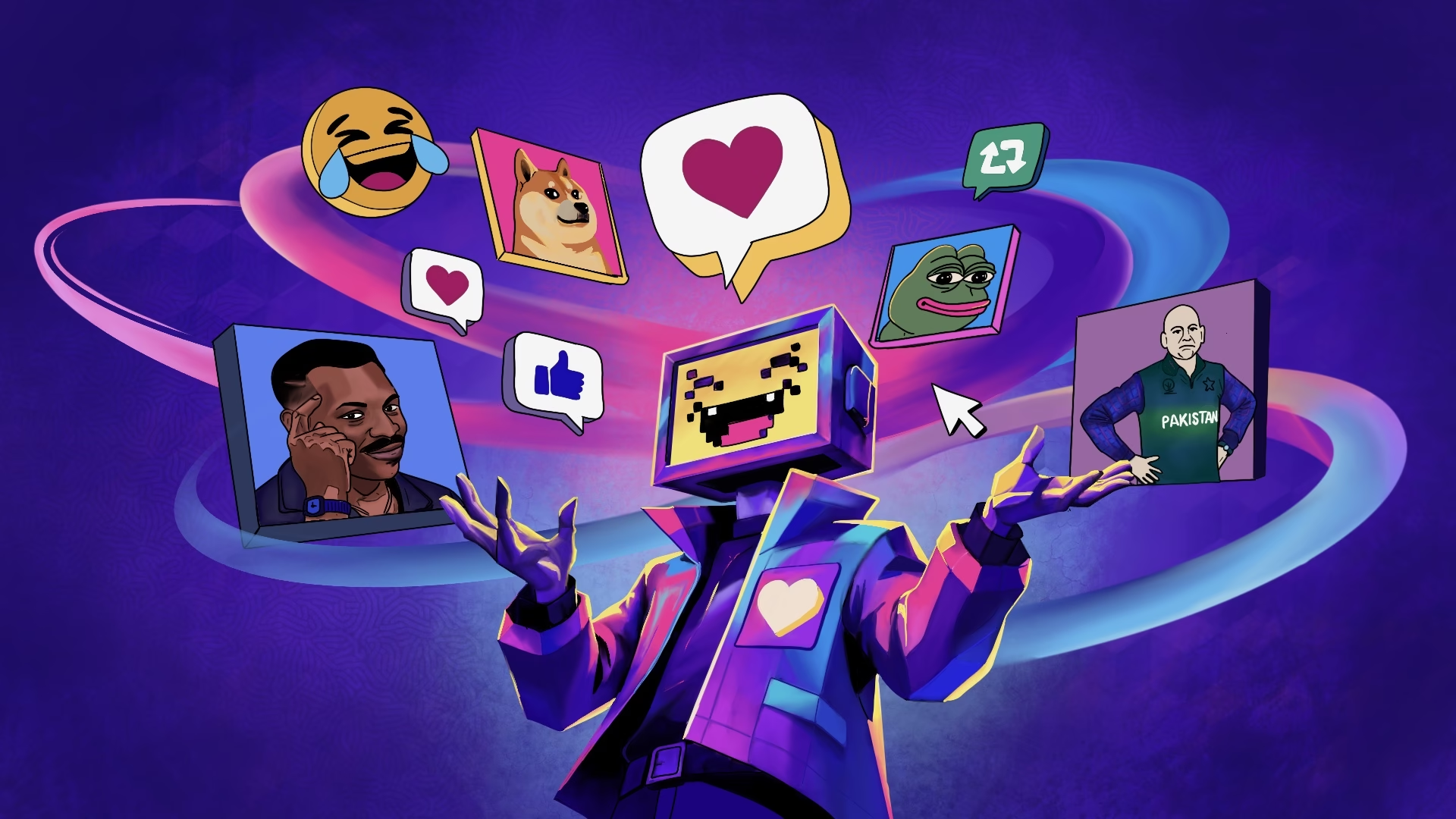
Humour has a way of getting people to open up and engage in a way that serious language can’t. Humour helps people put their guards down and relate to a given situation. Humour can also help people relate to ideas that might otherwise be overwhelming. Humour helps people relate to ideas that might otherwise be overwhelming. Humour can also be used to make ideas feel more familiar and more real.
We touched on this in our earlier blog, Where Memes Meet Meaning, where we looked at how memes can capture the everyday realities of nonprofit work with both wit and truth. But there is a larger shift worth exploring here. Humour has also become an increasingly powerful tool for communication across all industries, not only for entertainment, but also for relatability, memorability, and connection. So, with all of the above said, within this blog, let’s take a deeper look at the rise of meme culture, and the power of humor in your nonprofit’s content mix.
1. Humour Can Open the Door to Difficult Conversations
Some topics are so uncomfortable, stigmatised, or emotionally heavy that people instinctively look away. Humour can soften that first moment of resistance. It does not reduce the seriousness of the issue. It simply makes the subject easier to approach, which is often the first step towards awareness and action.
Humour can become the invitation that helps serious issues finally get heard.
WaterAid’s #GiveAShit campaign showed this clearly. Instead of speaking about sanitation in dry, formal language, it used the familiar poop emoji and a playful tone to draw people into a crisis affecting 2.3 billion people without access to safe, sanitary toilets. The campaign’s strength lay in using humour to make an avoided issue more discussable and more visible in public culture. WaterAid itself described the idea as a way to open up the conversation, and the Shorty Awards summary highlighted the same logic: a culturally familiar joke helped audiences engage with a global sanitation problem. Used thoughtfully, humour can become the invitation that helps serious issues finally get heard.
2. Humour Can Make Organisations Feel More Human and Relatable
One reason nonprofit communication sometimes struggles is not a lack of facts, but a lack of warmth. People are more likely to trust organisations when they sound human rather than overly polished or institutional. Humour can help create that shift. Used well, it makes expertise feel approachable. It also lowers social distance and builds a sense of connection instead of performance.
The real value lies not in being funny for its own sake, but in sounding like someone people can believe.
A useful example comes from a 2025 University of Georgia study, which tested four science-related social media posts using different humour styles. The researchers found that when audiences found the post funny, they were also more likely to see the scientist behind it as trustworthy and credible. The same reporting also noted an important limit: humour that leaned too far into sarcasm or negativity weakened credibility instead of strengthening it. Stanford Graduate School of Business has made a similar point, arguing that humour can help people connect and diffuse tension. The real value lies not in being funny for its own sake, but in sounding like someone people can believe.
Also Read: Where Nonprofit Stories Are Headed Next
3. Humour Helps Messages Stick and Travel Further
One of the biggest challenges in nonprofit communication is that important content can still be easy to forget. Humour changes that. It gives people a reason to pause, remember the message, and pass it on. In crowded social feeds, that matters. A post that is accurate but flat may be scrolled past, while one that makes someone smile has a better chance of staying in their mind.
When content is remembered and resent, it stops being a post and starts becoming part of conversation.
This is exactly why memes work so well. Research has long linked humorous communication with stronger attention and better recall, and more recent studies on humour in social media posts have connected humour styles with measurable engagement such as likes, comments, and shares. One especially useful nuance comes from a study on online recruitment ads: even when humour did not improve attitudes, it still increased people’s intention to share the ad. That distinction is important. Humour may not do every job on its own, but it can extend the life of a message by helping it circulate. When content is remembered and resent, it stops being a post and starts becoming part of conversation.
4. Humour Can Build Community Through Shared Recognition
Humour does more than entertain. It can create a sense of belonging. Memes work especially well because they rely on instant recognition. When an organisation jokes about something its audience genuinely understands, it sends a quiet but powerful message: we know this world too. That kind of cultural fluency can make people feel seen rather than spoken at.
When humour reflects shared experience with care, it stops being just content and starts feeling like community.
A good example of this comes from IDR’s nonprofit humour pieces, which show that the development sector has a real appetite for self-aware humour rooted in everyday experience. Their humour works because it reflects familiar frustrations, contradictions, and unspoken truths that people in the sector immediately recognise. Research strengthens this point further. Studies on memes and belonging suggest that memes can help shape collective identity and community, while humour-style research shows that adaptive, warm humour can increase belonging, whereas aggressive humour can reduce it. That distinction matters. The goal is not mockery. It is recognition. When humour reflects shared experience with care, it stops being just content and starts feeling like community.
5. Humour Works Best When It Is Anchored in Purpose
Humour can be powerful, but only when it is doing real communication work. On its own, a joke may attract attention, but attention is not the same as understanding. The strongest nonprofit humour has a message, is grounded in reality, and knows the reason for its use. It is what helps the humour avoid being arbitrary, careless, or unconnected to the issue at hand.
The most effective humour does not distract from the message. It carries the message in a form people are actually willing to receive.
Research supports that balance. A 2023 study on pro-environmental social media communication found that humour by itself may not produce the desired social response, but humour paired with factual information was more useful. A piece in Stanford Social Innovation Review makes a related argument from another direction, noting that entertaining formats can bring in audiences who might never choose issue-heavy content on their own. At the same time, the caution matters. Other research shows that humour can increase sharing while weakening attitudes in some contexts if it is not handled well. The most effective humour does not distract from the message. It carries the message in a form people are actually willing to receive.
Why Humour Deserves a Serious Place in Nonprofit Communication
Humour is not a distraction from serious work. If used well, it can help start tricky conversations, make organisations feel more human, help messages get further, and create a sense of shared understanding. The goal isn’t to use humor to get attention; the goal is to use language people can understand, remember, and want to engage with. In a crowded digital space, that kind of relatability can be a real strength.
If you enjoyed this blog, subscribe to our newsletter for more reflections on nonprofit communication, storytelling trends, campaign ideas, and thoughtful examples from across the social sector.