A small team sits in a cramped office. Whiteboards are scribbled with urgency. Cold coffee cups gather like casualties. The deadline looms for another campaign, another attempt to shake the world awake. The stakes are enormous. Climate change. Gender violence. Refugee crises. Yet, for all the data, all the heart, the response often falls short.
“We need to go big this time,” someone says.
“But how?”
It’s a question that every NGO faces. In a world overflowing with causes, how do you cut through the noise? How do you get people to care, not just scroll, like, and move on, but actually act?
The answer lies in storytelling. The most resonant campaigns aren’t built solely on logic or facts. They’re built on feeling. They tap into shared human truths. They make people pause. And, in that pause, they plant something powerful.
The most resonant campaigns aren’t built solely on logic or facts.
In this blog, let’s find out how a few standout campaigns moved people and what they show us about nonprofits brand identities.
One Billion Rising: When Dance Became Defiance
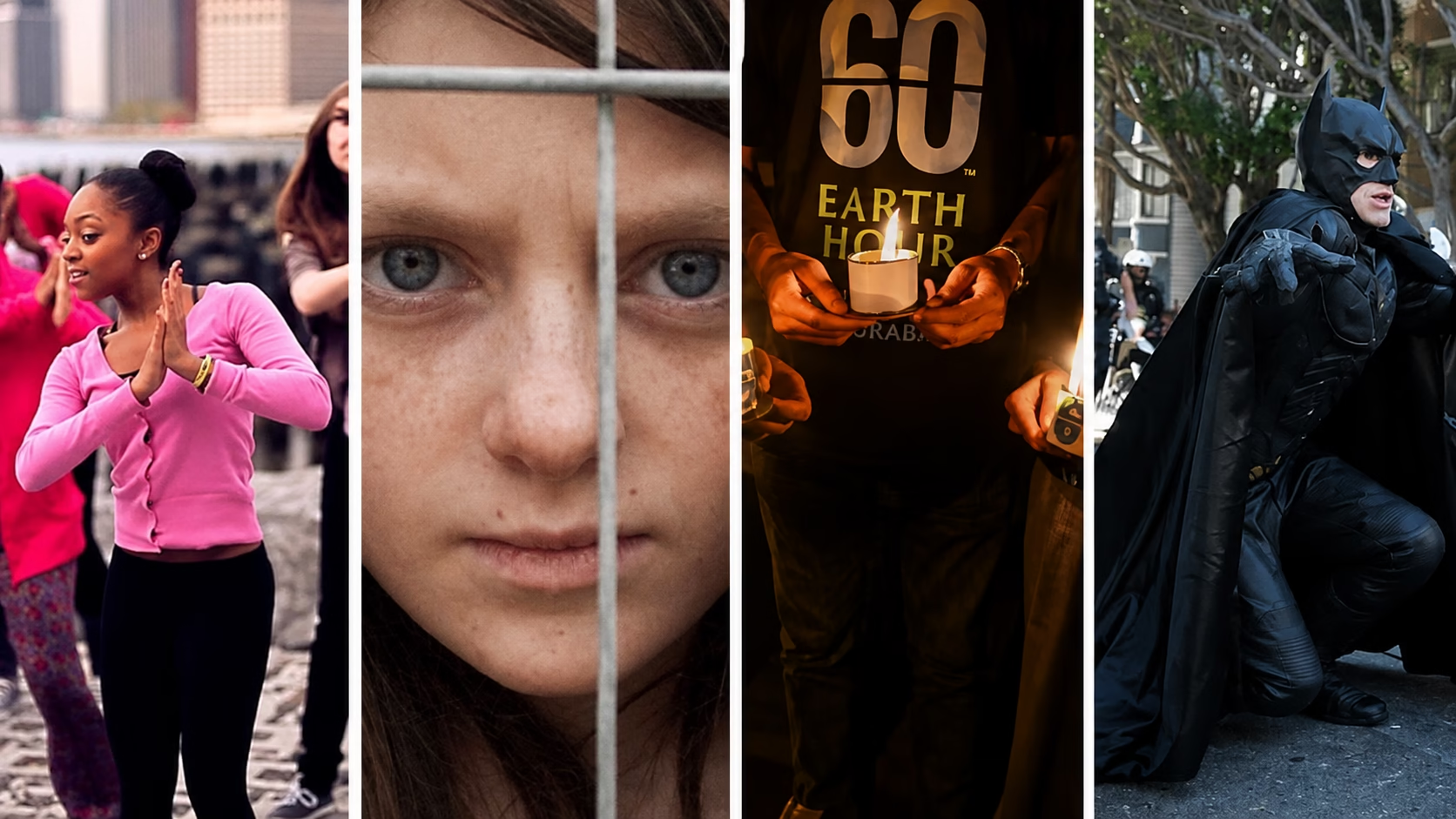
In 2013, a rhythm pulsed through cities and villages across the world. It wasn’t a political chant or a call to arms. It was a dance.
Led by playwright and activist Eve Ensler (now known as V), One Billion Rising emerged from a brutal statistic: 1 in 3 women globally will face physical or sexual violence in her lifetime, more than one billion women and girls. The timing mattered too. The campaign took shape in 2012, not long after Missouri congressman Todd Akin’s widely condemned remarks about “legitimate rape,” a moment that had already put sexual violence back into mainstream public conversation.
Ensler and her team made a deliberate choice not to respond with another petition or panel discussion, but with the body itself. Dance was chosen because it needed no translation, no literacy, no permission from institutions that had failed survivors before. Anyone, anywhere, could rise.
The movement’s anthem, Break the Chain, composed by Tena Clark and choreographed by Debbie Allen, echoed in town squares and schoolyards. It has since drawn over 3.6 million views, becoming a universal symbol of resistance.
On 14 February 2013, the world rose. More than 190 countries participated, and over 5,000 organisations joined hands. In Delhi, protestors invoked the memory of Jyoti Singh. In Washington, D.C., they danced in Farragut Square. By September that year, people from 160 countries had pledged to rise.
Each year, the movement evolved: Rising for Justice in 2014, Rising for Revolution in 2015, spanning more than 200 countries. In Afghanistan, events were held in all 34 provinces, a striking figure given the risks organisers and participants faced simply by gathering publicly. In Italy, more than 100 cities took part.
This campaign shows how shared rituals, dance, song, presence can turn silence into strength, and statistics into collective defiance, even when critics rightly ask what happens after the music stops.
Over time, the movement also widened its lens, adding themes that addressed violence against women of colour, incarcerated women, and, more recently, the intersection of gender justice and the climate crisis.
Not every reaction was celebratory. Some commentators questioned whether a single day of dancing could meaningfully shift entrenched systems of abuse, or whether it risked becoming an emotional release valve rather than a driver of policy change.
One Billion Rising’s own answer to that critique has been repetition and localisation: the campaign never positioned itself as a one-time spectacle, but as an annual ritual that local chapters could adapt to their own laws, languages, and specific forms of violence, from dowry abuse to workplace harassment to trafficking. This campaign shows how shared rituals, dance, song, presence can turn silence into strength, and statistics into collective defiance, even when critics rightly ask what happens after the music stops.
Save the Children: From Viral Grief to Festive Giving
In March 2014, Save the Children released a quiet video with a deafening message.
Most Shocking Second a Day, also released under the title “If London Was Syria,” follows a young British girl, played by actress Lily-Rose Aslandogdu, whose ordinary life collapses into chaos as war closes in. No dialogue, just birthdays, bombings, hospital beds.
The creative decision at the heart of the film was deceptively simple: instead of showing the crisis somewhere distant, the agency relocated it to a recognisably British street, with a British child, a British birthday cake. The campaign’s own tagline made the logic explicit: “Just because it isn’t happening here, doesn’t mean it isn’t happening.” By collapsing the psychological distance between viewer and victim, the film turned a statistic into something that felt like it could happen to any parent watching.
By collapsing the psychological distance between viewer and victim, the film turned a statistic into something that felt like it could happen to any parent watching.
The video hit 23 million views in its first week. As of 2026, it has passed 80 million views, been shared more than 920,000 times, and driven a 1,000% spike in Save the Children’s YouTube following.
But it didn’t end there. The virality made headlines in Time, The Washington Post, and The Independent. Celebrities like Ashton Kutcher amplified its reach, driving 10 million additional views with a single Facebook share. The story didn’t stop with the original film either: a 2016 sequel picked up Lily-Rose’s journey as a refugee crossing the Channel, extending the same character arc into the next chapter of the crisis and proving the format had staying power beyond a single viral moment.
At the other end of the emotional spectrum sits Christmas Jumper Day. Launched in 2012, it takes a lighter approach to raise serious funds: each December, millions don their silliest knitwear and donate £2 to support children in crisis.
To date, the campaign has raised over £30 million. In 2023 alone, it raised £3 million, with 1.5 million children and teachers and 27,000 workplaces taking part. Whether through grief or joy, Save the Children shows how storytelling, when personal and timely, can turn awareness into empathy, and empathy into action.
Earth Hour: When Silence Turned to Speech
It started with one city: Sydney, in 2007. One hour. One gesture: turn off the lights.
But Earth Hour didn’t stay quiet. By 2018, it was observed in more than 180 countries and territories, making it the world’s largest grassroots movement for the environment.
In 2019, the campaign turned to a quieter crisis: biodiversity loss. The new initiative, #Connect2Earth, asked a simple question: what does nature give us? The answer: everything. Air, water, food, shelter.
WWF’s campaign video drove that point home, drawing over 171,000 views, though its deeper goal was conversation, not clicks.
That year, WWF revealed a striking gap: across ten of the world’s most biodiverse nations, only 4% of people understood what biodiversity meant, yet 70% felt personally responsible for protecting nature. Earth Hour set out to close that gap, partnering with the UN Convention on Biological Diversity to align with Aichi Biodiversity Target 1 and raise mass awareness of nature’s value.
Earth Hour has also had to defend itself. Critics have long argued that switching off lights for sixty minutes changes little about global emissions, and that the campaign risks functioning as guilt relief rather than real climate action. In cities where blackouts are already common, the gesture can land as tone-deaf rather than symbolic.
Sid Das, the movement’s executive director, has openly acknowledged the tension, arguing that Earth Hour was never meant to be the solution itself but a low-barrier entry point, “we’re proud that Earth Hour makes people feel good,” he had said, positioning that emotional pull as a deliberate strategy rather than a weakness.
To back that argument with substance, WWF points to policy wins it links back to Earth Hour momentum: marine protection commitments in Russia, forest protection in Uganda, and a plastic bag ban in Ecuador. The campaign has increasingly described itself less as an annual ritual and more as an “open platform” that local groups can use to launch their own initiatives year-round. What Earth Hour shows is that mass participation isn’t just a show of numbers: it’s a show of care, and a campaign willing to answer its critics in public tends to earn more trust than one that simply repeats its own numbers louder.
Make-A-Wish: When a City Became Gotham
In November 2013, five-year-old Miles Scott, battling leukaemia, wished to be Batman. Make-A-Wish said yes.
The scale of what followed wasn’t the original plan. The San Francisco chapter first imagined something modest, a couple of small “missions” around the city with maybe a few hundred onlookers. It was only after a call for volunteers went out on social media that interest snowballed far beyond anyone’s expectations, forcing the team to essentially script and stage a live-action Batman film across an entire city in a matter of weeks.
The costume department at San Francisco Opera altered a Batman suit and built out villain costumes for the day. Composer Hans Zimmer wrote an original score. Apple’s PR team donated a week of support, and city officials, the police department, and local media all folded themselves into the story rather than simply covering it.
What followed was pure magic. San Francisco became Gotham. An estimated 25,000 people lined the streets to cheer as “Batkid” saved the day; police cars, flash mobs, even the city’s mayor played along. The moment was captured in a heartfelt video that drew 1.4 million views from across the globe, and later in the feature documentary Batkid Begins.
Make-A-Wish proves that deeply personal stories, when amplified with care, can unite cities, shape public goodwill, and even support healing.
The campaign generated 6,00,000 tweets, 1.7 billion Twitter impressions, and crashed the Make-A-Wish website at 1,000 hits per second. None of it was possible without hundreds of volunteers and civic institutions choosing to say yes to something with no script and no precedent, which is precisely why it felt real instead of staged.
Behind that one wish lies a much bigger legacy. Since 1980, Make-A-Wish has granted over 615,000 wishes worldwide. In 2023, its Greater Bay Area chapter alone granted 307 wishes, a 12% rise from the year before.
It’s more than just moments, either. According to a 2022 impact study, 95% of wish alumni felt more hopeful, 99% felt more joyful, and 98% of doctors reported improvements in their patients’ well-being. Celebrity involvement helps too: WWE’s John Cena holds the world record, having granted over 650 wishes himself. Make-A-Wish proves that deeply personal stories, when amplified with care, can unite cities, shape public goodwill, and even support healing.
What These Campaigns Teach Us About Change
Each of these campaigns holds a lesson. One Billion Rising showed the power of art: dance as resistance, a song as a rallying cry. Save the Children showed how storytelling, both devastating and delightful, can drive action across digital platforms and festive offices alike. Earth Hour proved that quiet symbols can ignite loud conversations. And Make-A-Wish showed that joy can be a campaign’s greatest asset.
But more than anything, they remind us that change isn’t always loud. It isn’t always fast. It isn’t even always planned.
Change begins when a story feels real: when a child becomes a superhero, a jumper becomes a donation, when the lights go out and awareness flickers on.
Because in the end, people don’t remember campaigns. They remember how a story made them feel, and what it inspired them to do.
If you’re working on a campaign and wondering how to bring your story to life, we’d love to help. At Simit Bhagat Studios, we work with organisations to tell their stories in creative, meaningful ways. Subscribe to our newsletter, we share ideas, inspiration, and insights from across the sector.