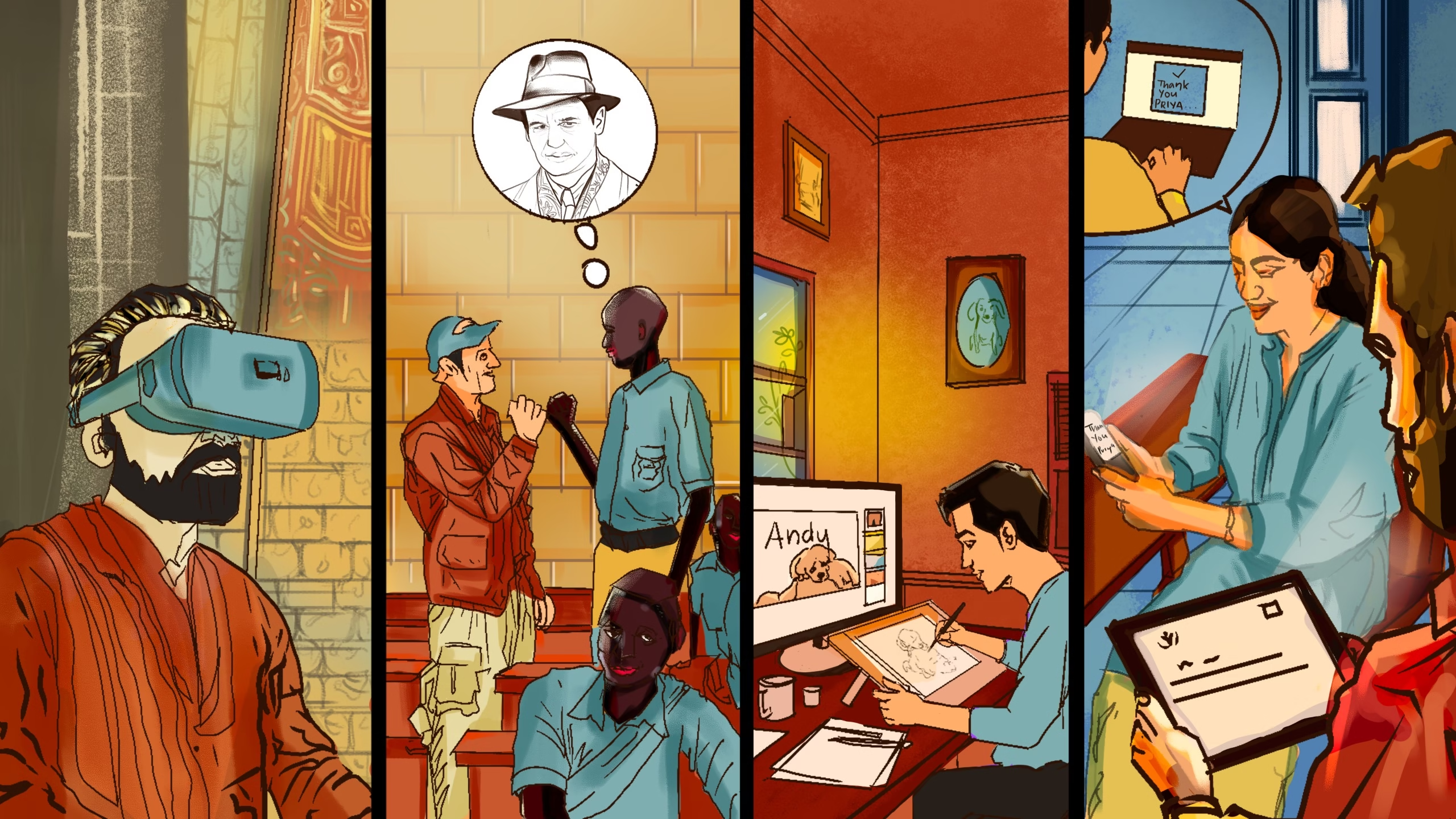
Stories often begin in quiet places. A child stepping into a learning centre for the first time. A mother in a hospital ward is waiting for her baby to breathe easier. An old man slipping on a VR headset and seeing the street he left behind seventy years ago. These are small moments, yet they carry the weight of entire lives.
For nonprofits, this is the heart of the work. The programmes matter, the impact matters, but the stories are what help people feel it. And in a world where attention shifts quickly, understanding how to tell these stories well has become as important as the work itself. Knowing what captures emotion, what builds trust and what keeps communities at the centre can change how far a message travels.
So let us look at a few storytelling trends that are quietly reshaping how nonprofits speak to their audiences today.
Animation and Motion-Led Storytelling
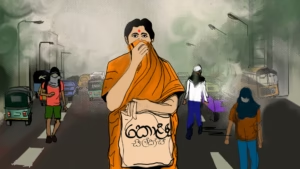
Animated films can turn complex work into something warm, relatable and emotionally rich, inviting viewers into a space where imagination makes difficult realities a little easier to hold. They capture interest for a longer stretch, distilling concepts down to their essence and welcoming individuals of every generation to engage with the core of the narrative.
For example, Canine Companions, a nonprofit in the United States, works with service dogs. Based across seven locations, they released an animated short titled Andy: A Dog’s Tale in 2024. To date, the film has crossed 16 million views and garnered over 57K likes. It follows a tiny puppy learning courage, purpose, and service, and went on to be selected for more than 50 film festivals, winning multiple awards. So, to sum it up, animation can carry a mission farther than facts alone ever could.
Animation can carry a mission farther than facts alone ever could.
Bonus tip: In October 2025, the team also released a children’s book based on the same story. It is a simple reminder that a single piece of content can take many forms. A film can become a book, a reel, a poster or a classroom tool. NGOs do not have to remain in one format when a good story has the strength to move further.
Also read: Why Animation Works for Nonprofits
Personalisation and Donor-Journey Storytelling
More nonprofits are realising that fundraising works best when it feels like a relationship rather than a one-time act. A small, personal message can make donors feel recognised, and that sense of connection often brings them back.
A recent experiment by a digital strategist who donated through multiple Indian NGO campaigns showed how meaningful a personalised touch can be. Organisations that sent a warm thank-you note, a short impact update, or a prompt certificate after a donation ended up feeling more trustworthy. We/Can, for instance, had a simple, mobile-friendly giving process that ended with a kind note from the CEO, while Save The Children India paired a clear thank-you message with a quick tax-exemption certificate, making the whole experience feel smooth and considerate.
Storytelling does not end at the Donate button. It continues in every interaction that honours the donor’s part in the journey.
Herein, we can clearly see that storytelling does not end at the Donate button. It continues in every interaction that honours the donor’s part in the journey.
Real Voices and Community-Generated Stories
There is a quiet strength in letting people tell their own stories, in their own words, without turning their experiences into something distant. When a beneficiary speaks directly, the pauses, pride and resilience come through on their own, creating trust that no scripted narrative can match.
A good example of this is the Voice of Specially Abled People, a US-based nonprofit that works to empower people with disabilities. With a special consultative status at the United Nations, they host a Beneficiary Video Gallery on their site. One clip features Kundan, a visually impaired student in Delhi, explaining how an Orbit Reader transformed his study routine. Another video shows Aasama from Kolhapur. She has a 60% disability and was born without her left arm. She shares how a sewing machine now helps her support her two daughters.
When a beneficiary speaks directly, the pauses, pride and resilience come through on their own, creating trust that no scripted narrative can match.
Their steady storytelling sits alongside their impact. In 2024, VOSAP raised over $1 million to empower specially abled people in India. This shows that real voices can become the strongest storytellers of all.
Also read: How to Make an Organisational Film
Celebrity Collaborations That Amplify Community Stories
Nonprofits increasingly lean on well-known public figures to carry stories that might otherwise stay unseen. A familiar face makes people pause, creating the space for the spotlight to move toward the communities at the heart of the work.
Take, for instance, UNICEF’s recent reel featuring actor Liam Neeson from a children’s hospital in South Sudan. The reel crossed 253K views and garnered more than 20K likes. Standing beside mothers and infants, he spoke about nutrition centres shutting down and babies facing severe malnutrition.
A familiar face makes people pause, creating the space for the spotlight to move toward the communities at the heart of the work.
His presence brought people in, but the heart of the reel belonged to a young mother, Sunday, and her recovering baby, Tito. Thus, when visibility is shared with care, a celebrity can open the door, but the story still belongs to the community.
AR, VR and Immersive Interactive Storytelling
Immersive technology is allowing nonprofits to bring people closer to stories once impossible to witness. When memories are fragile or distances feel insurmountable, VR can create a quiet bridge between past and present, helping viewers feel what words alone cannot hold.
One of the most moving examples is Project Dastaan, a peace-building initiative co-founded by Sparsh Ahuja, Sam Dalrymple and Saadia Gardezi. Through virtual reality, they have helped Partition survivors revisit the childhood homes they left in 1947. More than half of the people they interviewed have been able to see familiar streets, wells, mandirs or mosques through VR reconstructions. Their work has reached classrooms as well, becoming part of the British Key Stage 3 curriculum and receiving support through global grants and fellowships.
VR creates a quiet bridge between past and present, helping viewers feel what words alone cannot hold.
This goes to show how immersive tools can turn history into something you can stand inside, even if only for a moment.
From Trends to Meaning
Storytelling in the nonprofit world keeps evolving, but its purpose stays the same. It helps people feel the work, not just hear about it. Whether through a reel, an animated film, a VR moment, or a simple thank-you note, the intention is to honour communities and build genuine connection.
When nonprofits choose tools that stay true to the heart of their mission, the story travels further and lands deeper. That clarity is what keeps the work alive in people’s minds.
Like this article? Stay connected with us. Subscribe to our newsletter to learn more about storytelling, communication, and the latest trends that are changing the social impact sector.