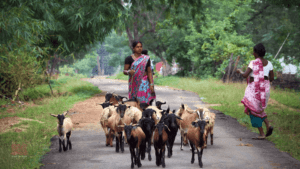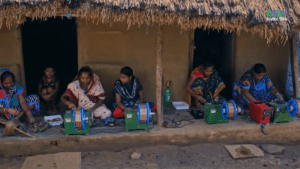
When women from Maa Lakshmi Mahila Samooh began improving the way they raised goats and poultry, the change started with small but important practices. Earlier, animals often fell sick, sheds were not maintained properly and families had limited knowledge about fodder, vaccination and market prices. After training from Heifer International, Passing Gifts, partner NGOs and government departments, they began using cleaner sheds, green fodder, kitchen gardens and collective selling.
Soon, the change showed in everyday life. Goats became healthier, poultry improved, income increased and women began planning together through meetings, records and shared learning.
These stories are at the heart of Passing Gifts’ work, where training, livestock care and women’s leadership come together to support rural livelihoods. And this is why work like this needs to be communicated clearly, and thus, animation gave us a way to explain the process simply, visually and in a format people could easily follow.
Our Design Approach
When Passing Gifts, the Indian subsidiary of Heifer International, came to us to produce an animated film, the goal was clear. The film had to explain improved goat and backyard poultry management in a way that felt practical, local and easy to understand.
The audience was mainly rural communities in Odisha, especially smallholder women farmers and families involved in goat rearing, poultry care and kitchen gardens. At the same time, the film also needed to show programme stakeholders how training, collective action and market linkages were creating change on the ground. Hence, the film couldn’t read as a top-down instructional video for one group and a dry impact report for the other. It had to work as a single, honest story that both could follow.
Also read: Using Animation to Talk About Pregnancy With Care
So, instead of making the film sound like a training manual, we built it around a conversation between women from two panchayats. This made the information feel more natural because one group could ask questions, while the other explained what had changed in their lives.
Choosing 2D Animation for Field-Based Learning
Animation worked well for this project because the film had to show several practices, people and locations without becoming crowded. It had to cover animal sheds, fodder, vaccination, compost, kitchen gardens, group meetings, collection centres and the idea of Passing on the Gift.
The idea of Passing on the Gift is where a family that benefits from training and livestock support passes on the same knowledge, and sometimes offspring animals, to another family in their community, so the impact multiplies within the village rather than stopping at one household.
A live-action film would have required field shoots across different homes, farms and community spaces. It would also have depended on available footage, weather, locations and people being comfortable on camera. Animation provided us with more control over the story and allowed us to communicate real farmer feedback without unnecessarily exposing individual farmers.
Animation provided us with more control over the story and allowed us to communicate real farmer feedback without unnecessarily exposing individual farmers.
We used a 2D digital illustration style with a hand-drawn documentary feel. The simple character animation, soft backgrounds and earthy rural palette made the film approachable. It also helped us to explain the technical practices without making the visuals too corporate or text-heavy. This was an important consideration for an audience where literacy levels and comfort with on-screen text vary, and where the message needed to land through visuals and spoken word rather than captions.
Building a Local Visual World
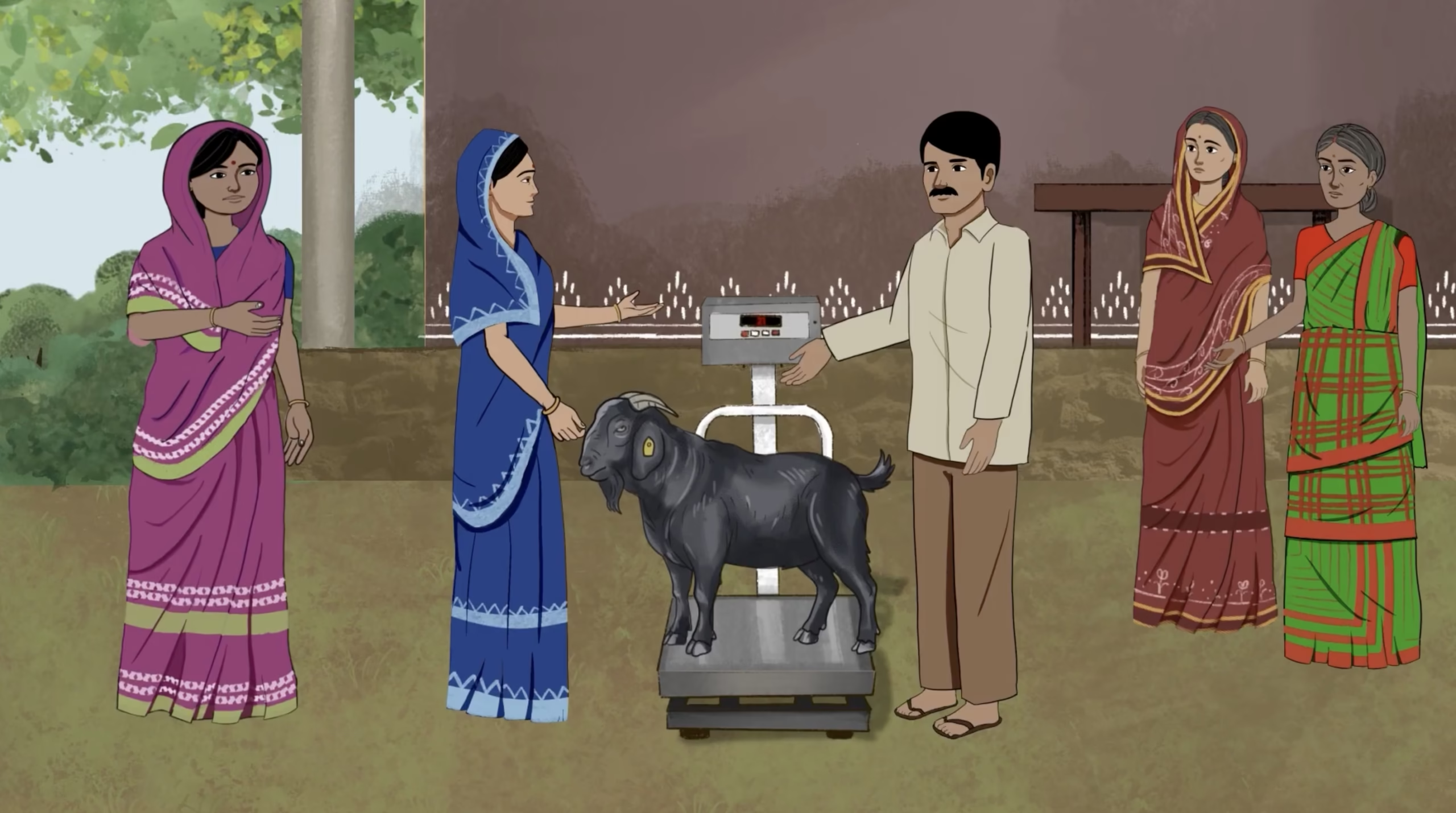
The characters were designed to feel rooted in Odisha’s rural context. In the first character drafts, the women were shown in regular sarees. But we added more visual details that are specific to the region after reviewing.
Also read: How Colour Psychology Influences Engagement in Social Impact Campaigns
We looked at references for saree patterns, drapes and everyday clothing details seen in Odisha. These were added carefully so the characters felt closer to the community, without turning the design into costume or exaggeration. The wall art, village setting, tree, meeting space and animal sheds also helped create a familiar rural environment.
This attention to regional detail wasn’t just an aesthetic choice, it directly affects how well an audience trusts what they’re watching. When a farmer in Odisha sees a shed, a saree drape or a tree that looks like the ones in her own village, the film stops feeling like an outside production and starts feeling like it belongs to her community. That sense of recognition is what makes people lean in and actually absorb the information being shared, rather than tuning out a generic “awareness video.”
When a farmer in Odisha sees a shed, a saree drape or a tree that looks like the ones in her own village, the film stops feeling like an outside production and starts feeling like it belongs to her community.
Additionally, the colour palette stayed muted and earthy, using ochres, greens and terracotta tones drawn from the rural landscape itself, rather than the brighter, saturated colours often used in explainer videos. This made the film feel warm and grounded. While keeping the focus on the women, their animals and the practices being explained.
Using Dialogue and Lip Sync
Since the film was driven by conversation, lip sync became important. The women were not just background figures while a voiceover explained the work. They were speaking, asking questions, responding and sharing what they had learned.
The Odia voiceover, gestures and simple expressions also helped the film feel closer to the audience it was made for.
For this, we used a lip sync plugin and created a set of mouth movements for the speaking characters. These movements were made to be in sync with the dialogues so the characters seemed to be more active and believable. This mattered because the film had many spoken exchanges, and static characters would have made the video feel flat.
Getting this right for a regional-language film brings its own challenges. Odia has different mouth shapes and rhythm than English, so lip sync couldn’t just be templated from standard English visemes, the mouth movement sets had to be built and timed against the actual Odia dialogue track, scene by scene, for the sync to look natural rather than approximate.
The Odia voiceover, gestures and simple expressions also helped the film feel closer to the audience it was made for. Small touches, a nod while listening, a hand gesture while explaining a point, a pause before answering a question, did as much work as the dialogue itself in making the characters feel like real women having a real conversation, not actors reading a script.
The Production Process
The production began with the script and the key messages from the client. We then identified the number of characters, the village setting, the important practices and the scenes needed to explain them.
After that, we moved into storyboarding, rough character design, style references, background design, voiceover, animation, lip sync and final edits. At each stage, the focus remained on accuracy and clarity. The film had to look local, explain the practices correctly and keep the story easy enough for community audiences to follow.
Every visual and narrative choice was tested against one question: would a woman in a village in Odisha recognise this as her own life, or would it feel like it was made for someone else?
A few things ran across every stage of this pipeline rather than sitting in just one step. Client review happened at each major checkpoint, script, storyboard, character design, and final cut, so the technical accuracy of the farming practices could be verified by people close to the programme, not assumed by the animation team. And every visual and narrative choice was tested against one question: would a woman in a village in Odisha recognise this as her own life, or would it feel like it was made for someone else?
The Effect of Thoughtful Animation
The aim was to make improved goat and poultry management easier to understand for rural families, while also showing the larger value of women-led collective action. The final film brought together training, animal care, kitchen gardens, market access and Passing on the Gift in one clear story.
Through this project, we learned that animation can make field-based learning easier to follow, bring dignity to community stories and explain livelihood practices with clarity, precision, and a practical budget. We believe animation is a useful format for making complex stories easier to understand and share.
For organisations working on similar rural livelihood or agricultural extension programmes, a few lessons from this project travel well beyond goats and poultry. A conversational structure works better than a lecture format when the goal is behaviour change, not just awareness. Getting local visual detail right (clothing, setting, dialect) is what earns an audience’s trust. And breaking a “training helped” narrative into specific, visible before-and-after practices is what actually makes a solution replicable for the people watching it.
We turn complex ideas into clear, engaging stories. Ready to explain your programme, process or impact through animation? Let’s talk about how our storytelling approach can help your audience understand and connect with your work.