Lines, Layouts, and Lives: Designing a Study on Youth Mental Health

A behind-the-scenes look at designing a report on student loneliness, stress, and insomnia, using quiet visuals, clear structure, and thoughtful storytelling.

A student lies awake at night and scrolls through notes and notifications, wishing sleep would arrive before sunrise. The next day unfolds in a familiar loop with alarms, deadlines, and fewer real conversations. For many young people, silence and struggle now sit side by side.

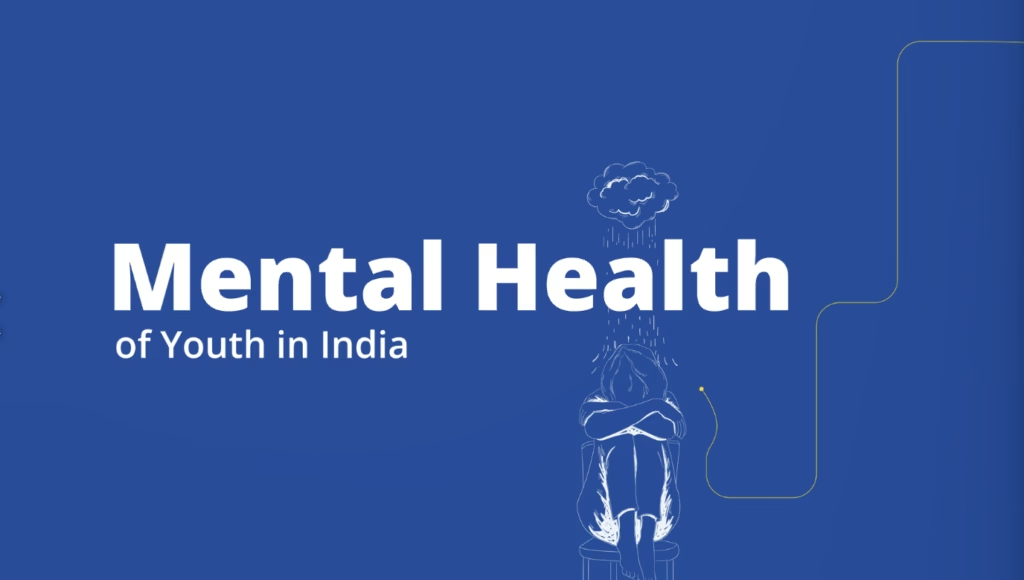
This is the reality that nearly 1,750 college students across India described in a study by the Aditya Birla Education Trust (ABET). Sleeplessness, stress, and loneliness were not rare moments. They were repeated patterns that affected well-being and the classroom experience. 

When ABET reached out to us to design their report, Unveiling the Silent Struggle, we knew it had to do more than present findings. It needed to draw attention to an issue that often stays out of sight. Our job was to make sure the research could be clearly understood and also genuinely felt.

Our Design Approach

We first explored the visual language through a short internal presentation for ABET. We used guiding line elements and a calm palette that reflected the organisation’s identity. When the work moved into a full research report, we kept that base and rethought the rest. 

The task was to turn a heavy manuscript into a reading experience that informed without overwhelming.

The report has considerable academic content, which considers methodology, data interpretation, the purpose of mental health indicators, survey parameters, observations in detail, and more. The task was to turn a heavy manuscript into a reading experience that informed without overwhelming.

Also read: Uncovering the Invisible: Designing a Story-Driven Impact Report on MSMEs and Corruption

Bringing Calm Into the Visual Language

Because the subject is mental health, the design needed to feel steady and professional. We tested ABET’s brand colours of blue and yellow in different combinations. Yellow added energy, but on its own it felt too bright for the tone of the study, and together, the balance did not sit right. 

A blue-led palette worked best. Clean shades of blue and white signalled trust and clarity, while small touches of yellow acted as quiet accents that kept the report connected to ABET’s visual system. We paired this with gentle typography and generous spacing to slow the pace slightly, reduce visual noise, and let the content breathe.

Illustrations that Respect Privacy and Promote Empathy

The study drew on confidential survey responses, so photographs were neither available nor appropriate. We developed a simple illustration system instead. It showed both urban and rural contexts and maintained a balanced mix of male and female students. We avoided stereotypical depictions of distress. 

We developed a simple illustration system which showed both urban and rural contexts and maintained a balanced mix of male and female students.

The scenes remained familiar and grounded in everyday life, such as a late night of study, a moment of sport to ease stress, or a conversation with parents or peers. Where a universal cue helped, we used a low-battery icon near the head to suggest mental fatigue. The illustrations supported the content, protected dignity, and never competed with the research.

Also read: How Organisations Are Using Storytelling to Talk About Women Empowerment

The cover brought the themes together in one place. Small illustrations of student behaviour, stress, communication, and coping formed a connected visual field. It set expectations before a reader turned the first page and suggested a simple truth. 

The experience can feel isolating, yet many students are living through something similar. The same visual language continued inside, so the report told one coherent story from beginning to end.

Designing for Dignity

This project reminded us that design is not only about aesthetics, it is also about care. Mental health studies ask for a communication style that is thoughtful and respectful, acknowledging the vulnerability without spectacle, and presenting the data without losing sight of the people behind the data. ABET now has a report that holds the seriousness of its findings while staying warm, clear, and accessible for stakeholders.

At every stage, our aim stayed the same. Help readers understand and help students feel seen.

At Simit Bhagat Studios, we turn complex research into communication that people can follow and trust. If your organisation is working in education, mental health, or any field where impact should be understood with care, we would be glad to help you shape findings into a story that connects. Contact us today!
Rahul More

Video Editor

Rahul works on video editing and motion graphics across various formats. He previously worked in post-production at Sallys, with experience across commercials, web series, and digital content. He has over three years of experience in video editing and motion graphics. He enjoys reading, playing cricket, fish keeping and making short films. He holds a Bachelor’s degree in Mass Media (Journalism) and a Diploma in Filmmaking from Rachana Sansad Institute, Mumbai.

Abhinav S S

Illustrator

Abhinav works on in-house blog illustrations, storyboarding and various visual projects aligned with the studio’s creative direction. He is currently pursuing a Bachelor’s degree in Fashion Communication from National Institute of Fashion Technology (NIFT) Bhopal. He has played competitive cricket for the state of Kerala and has a strong interest in painting and graffiti.

Subscribe to our newsletter

Sign up for our newsletter and receive exclusive podcasts, blog updates.

Swanand Deo

Web Development Specialist

Swanand Deo is a WordPress and Web Development Specialist working on various digital projects. With over a decade of experience in the design and development space, he has collaborated with over 50 national and international clients. He specialises in User Experience (UX) design, WordPress development, and creating engaging digital experiences. He holds a Bachelor of Fine Arts from the University of Pune.

Aashna Chandra

Graphic Designer

Aashna works on publications, UI/UX and branding projects at SBS. She has previously worked with organisations across the social impact and development space. Her work focuses on layout design, visual identity systems and user interfaces across print and digital formats. She studied at the United Institute of Design, Gandhinagar, specialising in branding, typography, editorial design and packaging.

Vivek Warang

Digital Illustrator

Vivek works on translating ideas into visual narratives. His work ranges from creating storyboards and illustrations to ideation for special visual storytelling projects. He previously worked as an illustrator at OckyPocky. He enjoys telling stories through images and bringing concepts to life through his drawings. He holds a Bachelor’s degree in Applied Arts from D.Y. Patil College, Pune, with a specialisation in Illustration.

Rajshree Goswami

Content Writer

Rajshree began her professional journey in Kolkata and has over four years of experience as a creative writer and proofreader for academic papers. At SBS, she works across all content, including blogs, transcripts, quality checks and writing for annual reports. She is an avid reader and enjoys cinema, fiction and creative writing. She holds a Bachelor’s degree in English Honours from West Bengal State University.

Bhavesh Dhote

Founder’s Office

Bhavesh is part of the Founder’s Office, working across in-house operations, social media strategy, strategic initiatives, market research and film production. He holds a Bachelor’s degree in Electronics and Telecommunications Engineering with a Diploma in AI and Machine Learning from D.J. Sanghvi College of Engineering, Mumbai. He is also a professional badminton player, marathon runner, trekker and plays euphonium and trumpet.

Manish Mandavkar

Motion Editor

Manish Mandavkar has studied animation at Arena Animation in Mumbai. He has previously worked on animated videos and motion graphics for brands, including Unilever and Zee Movies. An avid gamer, he is also passionate about sketching and photography. He holds a degree in Commerce from the University of Mumbai.

Joel Machado

Film Editor

Mumbai-based creative consultant and film editor Joel Machado has worked on documentaries as well as films in the mainstream Bollywood sector. He was also the Chief Assistant Director on the Jackie Shroff short, “The Playboy, Mr. Sawhney.” In addition to earning a B.Com from Mumbai University, he attended the city’s Digital Academy to hone his script writing skills.

Rohit Sreekumar

Founder’s Office

Rohit is responsible for developing strategic alliances and collaborative initiatives in the social sector. He also works on project management and helps internal teams stay on track. He has previously worked at early-stage startups across product and growth roles. In his free time, he enjoys binge-watching series, gaming and reading. He holds a Master’s degree in Computer Applications from Amrita Vishwa Vidyapeetham, Karnataka.

Aliefya Vahanvaty

Sr. Creative Partner

Senior Creative Partner, Aliefya Vahanvaty has worked in a wide range of editorial roles over the course of her career, gaining experience as a correspondent, copy editor, writer, photographer, and assistant editor at publications like the Times of India, Forbes India, Open Magazine, Impact Magazine, and others. In addition to her MA in Sociology from Mumbai University, she also has an MA in Photojournalism from the University of Westminster in the United Kingdom.

Simit Bhagat

Founder

Founder, Simit Bhagat has worked in the fields of filmmaking, project management, and journalism for over 15 years. He has served in a variety of positions for organisations like the Times of India, the Maharashtra Forest Department, the Tata Trusts, and the Thomson Reuters Foundation. From the University of Sussex in the United Kingdom, he earned a Master of Arts in Science, Society, and Development.