A loom under the sun is an ordinary sight in India. What is easy to miss is what sits behind it: long hours, stiff shoulders, tools that have not changed in generations, and work that younger people often walk away from because it simply pays too little for the effort it demands. Reshamsutra’s story begins right there, in that everyday tension between heritage and hardship.
Reshamsutra is a socially driven enterprise based in New Delhi, working to build sustainable livelihoods for marginalised groups by leveraging technology, optimising value chains, and streamlining digital operations. When they approached us at Simit Bhagat Studios, the ask was clear: create a short organisational film that could introduce their purpose and show, in a simple way, what they do, why it matters, and what it has achieved so far.
There was one constraint that shaped everything. We were not shooting new footage, and so, the film had to be built using existing photographs and videos. For a lot of organisations, this is a familiar situation. You have impact, you have material, you have a story. What you do not always have is the budget, time, or on-ground access to film everything again. So the real work becomes this: how do you turn an archive into a clear and compelling narrative without drowning it in jargon or over-designing it?
Here’s how we approached it.
Starting with the message, not the montage
When you are working with existing material, it is tempting to begin by selecting the “best” photos. We did the opposite. We began by locking the message first.
The backbone came from the film’s core points: India’s rural textile sector employs over 8 million people. Yet 90% of rural producers still use primitive tools and techniques. Low income and high drudgery make the work unattractive for the younger generation. That context matters because it explains why Reshamsutra’s intervention is not cosmetic. It is structural.
India’s rural textile sector employs over 8 million people. Yet 90% of rural producers still use primitive tools and techniques.
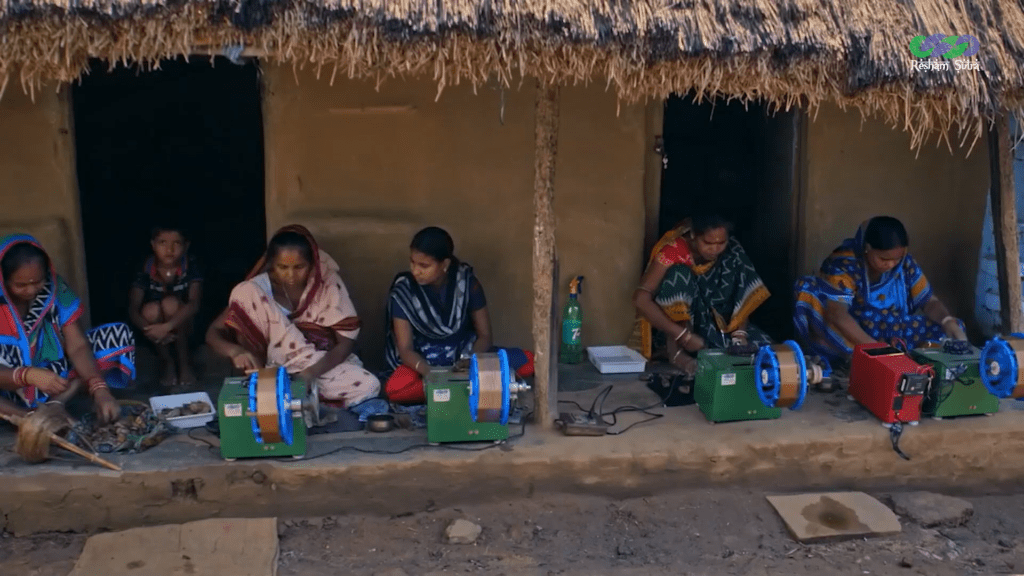
From there, the story could move into what Reshamsutra has built: solar-powered textile machines that increase productivity by up to 400% and are 90% more energy efficient. Then comes the operational model, which is often the hardest thing to communicate clearly. Reshamsutra provides end-to-end business support to rural producers, including capacity building, access to capital, and the formation of producer groups and villages. It is not only a machine story. It is a systems story.

Making existing visuals feel intentional
Once we knew the narrative spine, we began the careful work of selection. Existing footage and photographs can vary widely in style, quality, and context. If you cut them together carelessly, the film starts to feel like a slideshow. So we treated the archive like raw material, not finished content.
Our guiding question stayed simple: what does this frame need to prove? If the line is about the scale of employment, we do not need a dramatic shot. We need a visual that quietly carries the reality of rural textile work. If the line is about drudgery, we need images that show effort without turning labour into spectacle. If the line is about technology, we need clarity. Viewers should be able to understand what is changing and why that change matters.
We also paid attention to rhythm. Some images deserve time on screen because the viewer needs to absorb detail. Others work better as quick cuts because the point is scale or momentum. That pacing is where an organisational film starts to feel like storytelling instead of information delivery.
Keeping the language human
A big part of the brief was avoiding unnecessary jargon. This matters even more for organisations doing complex work, because the impact can get lost in technical vocabulary.
So we kept the film’s voice grounded and direct, while still covering what Reshamsutra actually does: innovating machines, strengthening farm-to-fabric value chains, creating market links for rural producers, and digitising operations. We also included how digital tools support artisans through a digital marketplace and quality certification, helping them access global markets.
This is the balance we aim for in organisational films: clear enough for a first-time viewer, specific enough to feel credible.
Showing scale without overwhelming people
Reshamsutra’s work has real scale: over 16,000 machines deployed across 350 villages. The film needed those numbers, but it also needed breathing space. When viewers are hit with too much data too quickly, they stop feeling the story.
So we designed the flow so that scale comes after context. First, you understand the problem. Then you understand the intervention. Only then do the numbers land with weight.
Ending with credibility and forward motion
The film closes with recognition and direction. Reshamsutra has been awarded the prestigious Ashden Award in the UK and the ASME ISO Award in the USA. This is not a decorative detail. In a short organisational film, awards help viewers who are new to the organisation understand legitimacy quickly.
And then we bring it back to the larger point: Reshamsutra enables rural artisans to become financially independent, while creating a sustainable future for a better tomorrow.
A note for other organisations considering a similar film
If you are sitting on years of photographs, short clips, and scattered documentation, you are not stuck. You are holding raw storytelling material. The shift happens when you stop treating those assets as a gallery and start treating them as evidence. Evidence of a problem, of an approach, of outcomes, and of the values behind the work.
That is exactly what this Reshamsutra film was designed to do.
If you are a nonprofit or social enterprise looking to create a short organisational film using existing material, we would love to help you shape it into a story that feels clear, human, and true to your work.
Client: Reshamsutra
Discipline: Films and Photography
Script: Simit Bhagat
Editor: Rohan Krishnan