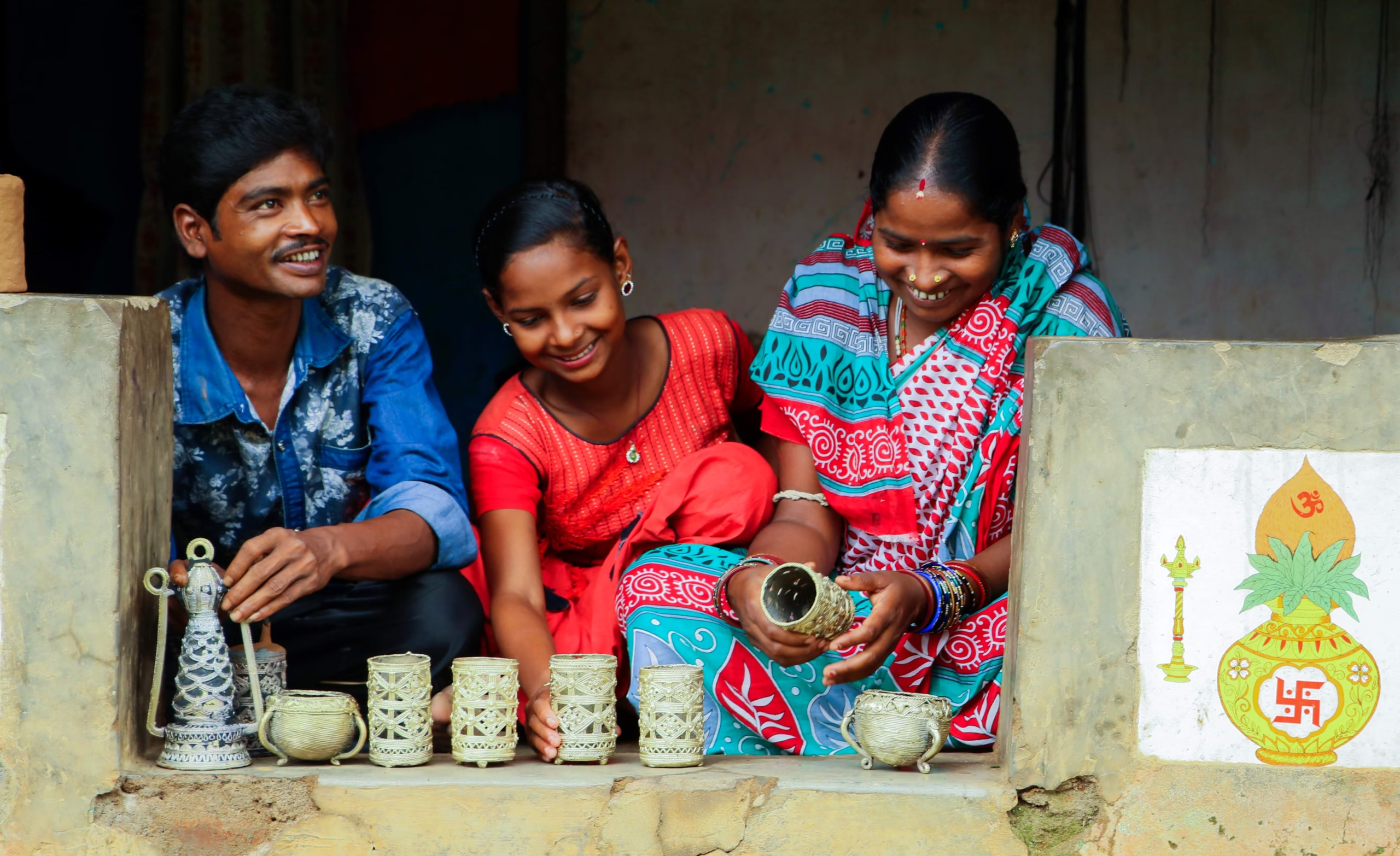
It started on a slow, rainy afternoon, the kind that makes you pause and drift a little. A picture of a man sitting under a tree, with deep lines on his face and kids around him, appeared on an old magazine page. There were no names, no caption, no backstory. Somehow, it did not feel necessary. His eyes seemed full of stories. The way he sat had its own quiet dignity. The photograph held what words could not.
That was the moment the real weight of photography became clear.
In our earlier blog, “A Picture That Spoke,” we wrote about how a single photograph changed the way we perceive storytelling. And in “Why Nonprofits Must Build a Photo Archive,” we explored how real photography can help nonprofits establish their identity, foster trust, and maintain institutional memory. But as visual storytelling becomes central to mission communication, one problem still stands out:
Too many organisations still rely on stock photos.
They’re quick, they’re cheap, and they’re safe. But they’re also distant, hollow, and often damaging to the credibility of the work. Here’s what we’ve learned about why nonprofits need to stop using stock images and what to do instead.
1. Stock Images Erase Trust
In Episode 4 of our podcast, Stories of Change, we sat down with Mumbai-based senior photographer Prashant Nakwe to discuss how nonprofits can utilise photography to effectively communicate their impact. He spoke of the moments he’s witnessed. That includes grassroots efforts in villages, relief work in tribal schools, and community resilience in the face of displacement.
In many NGO photos, something often feels slightly off. People line up in neat rows, smiling as they would at a formal function, but you do not really sense what is happening or why it matters. The gap is not only in the framing but also in the feeling. When an image looks posed or generic, it rarely feels honest, and it slips from memory very quickly.
When a photo comes across as staged or distant, it feels less real and is easily forgotten.
Using visuals captured during real fieldwork can make a significant difference. Authentic visual documentation helps build a genuine connection with audiences. Stock photos, on the other hand, especially those unrelated to actual work, can create distance even before the message is received.
2. Real Photography Builds Memory and Moves People
We remember images long after we forget numbers. Whether it’s Raghu Rai’s haunting photo of the Bhopal gas tragedy or Kevin Carter’s image of a starving child and a vulture, powerful photographs stay. As we explored in the podcast, images tend to leave a deeper impression on both viewers and readers, often conveying emotions that words cannot.
That impact isn’t limited to global headlines. It’s something organisations can and should build intentionally. In our previous blog on archiving, we discussed how a robust photo bank helps nonprofits demonstrate progress, document milestones, and establish their presence. A stock photo can’t do any of that, as it is a generic photo that can’t capture your specific story.
A robust photo bank helps nonprofits demonstrate progress, document milestones, and establish their presence.
Lisa Kristine, a humanitarian photographer who has documented over 150 countries, once said: “A photograph has that ability to transcend language. It speaks on its own accord viscerally with a viewer.” She collaborated with Free the Slaves to document forced labour across the world. Her goal was simple: to help people see what they hadn’t known existed. “If I didn’t know,” she said, “how many others didn’t know?”
Seeing is believing. And real photos show what’s hard to imagine and harder to ignore.
3. Stock Images Don’t Belong in Your Story
Every organisation has a specific purpose. A specific community. A specific promise. Stock images, by nature, are meant for anyone. Which means they connect to no one.
Real images are rooted in reality. In our blog on photo archiving, we discussed how CRY and Save the Children UK utilise compelling, consistent visuals that effectively reflect their missions. These images not only humanise their work but also help people remember what they stand for.
Real images not only humanise an organisation’s work but also help people remember what it stands for.
Fotokonbit, a Haitian nonprofit, takes this idea a step further. Their mission is to help Haitians tell their own stories through photography. Their photos have appeared in major exhibitions and global publications. But they’re not just images. They’re acts of representation. They say, this is us. Not as others see us, but as we see ourselves. A stock photo cannot achieve that because these generic photos can’t witness change.
4. Ethical Photography Requires Context and Consent
Real photography carries responsibility. As war photographer Giles Duley says: “When you photograph somebody who is in pain or discomfort, they trust you to make sure the images will act as their advocate.”
That trust demands care.
During our podcast, Prashant emphasised the need for sensitivity when working with survivors or children. “You cannot show their faces. You must protect their dignity,” he said. He described methods such as silhouettes, backlit profiles, and gestures – small details that keep the subject human, even when anonymity is required.
You cannot show survivors’ faces. You must protect their dignity
Stock images don’t offer this control. They offer no way to verify consent. No guarantee that a child whose image appears in your campaign has any connection to your work or even knows the image is being used. And that matters, because ethics aren’t optional, especially in the development sector.
5. A Good Archive Builds a Strong Brand
Nonprofits don’t just need documentation for impact; they need it for continuity. From donor reports to annual newsletters to social media, a well-organised archive creates a consistent visual identity.
In our previous blog, we talked about how organisations like WWF and UNICEF maintain a cohesive visual language. The success isn’t in having high-quality cameras. It’s in investing time, intention, and care into building their own image bank.
From donor reports to annual newsletters to social media, a well-organised archive creates a consistent visual identity.
Stock images disrupt that by bringing in someone else’s tone, setting, and face into your story.
6. Real Photography Doesn’t Have to Be Expensive
A common concern for many NGOs is their budget. However, there are also solutions. NGOs should aim to train their staff. As field workers already know the ground reality, they just need a few skills to document it better.
Smartphones and natural light can do wonders for photography. What matters more is training people to look differently; to frame the emotion, not just the event. In fact, one should note that documenting the three stages of your intervention, i.e. problem, process, and impact, can be just as important as the intervention itself.
Smartphones and natural light can do wonders for photography.
It’s not about fancy gear; it’s about an honest perception.
Final Thought: You Can’t Tell a True Story With Someone Else’s Picture
A real image isn’t staged. It carries light, dust, movement – everything that makes the moment honest. Moreover, it might be blurred by rain, framed awkwardly, or taken in low light. But if it captures the truth, that imperfection becomes the story.
Stock images aren’t just generic; they’re also devoid of genuine emotion. Those who clicked the stock photos weren’t there when the water pump was installed, when the ration kit was opened, or when the teacher crossed a river to reach a tribal school. You were, and that’s what your audience deserves to see.
Want to explore more about how real storytelling drives impact? Subscribe to our newsletter for honest insights, visual stories, and tools to build ethical communication in the nonprofit sector.